
Plumbing Inspection Checklist for a Flat and Its Building: What to Check and What Good Looks Like
Most plumbing damage starts small and unrecorded: a valve that no longer turns, a damp patch under a basin, a pump that runs longer than it used to. This checklist gives owners, tenants and caretakers one route through every pipe, fitting, tank and pump, with a description of what a healthy item looks like.
Walk the same route every time: main valve, kitchen, each bathroom, veranda and appliances, then back to the start. Compare each item with its 'good' description, mark it OK, Watch or Fix, and date the sheet.
In the flat, look for a stop valve that turns, dry joints and hoses, silent toilets and traps that drain fast and hold water. In the building, look for closed and screened tanks, leak-free pumps protected against running dry, and clean, dry risers and stacks.[9]
This is the checklist, not the repair manual: each section links to the guide for that fault.
Most of this can be done yourself with ordinary tools.
Why a routine round pays: the warning signs it catches
Plumbing rarely fails all at once. Allianz Australia notes that ageing braided hoses usually show rust spots, bulging or frayed strands before they burst.[5] A dated record makes slow changes like these visible.
- Water where it should not be: a damp cabinet floor, a wet ring round a toilet, a dripping overflow, which United Utilities treats as a sign of a faulty cistern.[6]
- Sounds: a toilet that hisses after refilling, pipes that bang, a pump that starts more often than before.
- Smells near floor traps, basins or shafts, often from a trap that has lost its water.
- Slow drains, gurgling, or water rising in a floor trap when upstairs uses a fitting.
- Stains or mould beside bathrooms, the kitchen or a pipe shaft.
- Weaker pressure, air spitting from taps, or rusty water after the supply returns.
How to use this checklist
- Print the checklists, one copy per round, with the date and flat or building number.
- Mark each item OK (matches the 'good' description), Watch (minor, not worsening) or Fix (needs action), with a note or photo.
- Follow the same order every time; the route diagram shows one way round a flat.
- Compare with the last sheet: an item sliding from OK to Watch tells you more than any single reading.
- Pass Fix items on: simple jobs to yourself, concealed work to a plumber, shared items to the caretaker or committee.
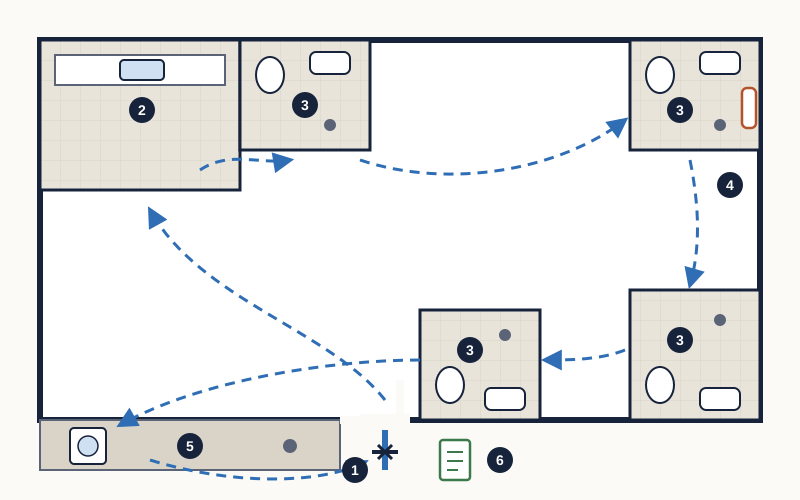
- Main stop valve at the entrance (and meter, if fitted): test the valve and take the first meter reading
- Kitchen sink: tap, valves, hoses and trap
- Each bathroom: toilet, taps, shower, hand spray, basin and floor trap
- Water heater (geyser): check from outside only
- Veranda or utility area: washing machine hoses and floor drain
- Back at the start: second meter reading and the dated record
Tools and kit you need
- The printed checklist, a pen and a phone for dated photos.
- A torch and a small mirror for looking behind toilets and under basins.
- Dry toilet tissue, which darkens at the faintest seep.
- Food colouring for the toilet dye test.
- A flat-head screwdriver for slot-type isolation valves.
- A jug of water for topping up little-used traps.
Step by step: one inspection round of a flat
A RUAP flat has a kitchen, four bathrooms and four verandas, so a round covers at least five wet areas. The same order works in any flat.
- Start at the main stop valve. WaterSafe suggests testing it about every six months by gently turning it off and on; leave a lever valve fully open, and turn a screw-down valve back half a turn so it does not stick.[3]
- If the flat has its own meter, read it, use no water for two hours and read it again; the US Environmental Protection Agency (EPA) treats any change as a sign of a leak.[1]
- In the kitchen, run the tap and check the valves, hoses and trap under the sink with dry tissue.
- In each bathroom, work through the tap, toilet and drainage checklists below.
- Look at the water heater from outside only.
- On the veranda, check the washing machine hoses and the floor drain.
- Back at the start, take the second meter reading and list every Fix item.
Flat checklist: valves and supply pipes
- Main stop valve: reachable, turns by hand, shuts off fully, no drip from the spindle. If it will not move, call a plumber rather than forcing it.[3]
- Angle valves under each basin, sink and toilet: turn freely, no green or white crust.
- Exposed pipes: firmly clipped, dry, no rust trails or crusted joints; EPA notes that water on the outside of a fitting means a surface leak.[1]
- Flexible hoses: no rust spots, bulges, broken strands or tight bends.[5]
- Quiet pipes: no banging when a valve closes. WaterSafe links banging to loose clips, faulty float valves and fast-closing appliance valves.[4]
- Meter test, if metered: no movement after two hours with nothing running.[1]
- Walls along concealed pipe runs: no new stains or soft plaster.
If an item fails, see how to inspect water supply pipes, repair or replace a damaged pipe or, for weak flow, low water pressure.
Flat checklist: taps, showers and toilets
Taps, mixers, showers and hand sprays
- No drip from the spout a minute after closing.
- Handle moves smoothly; no seep round the handle or base.
- Aerator gives an even stream.
- Shower head joint dry; for a dripping head EPA suggests checking the washer or O-ring and taping the thread.[1]
- Hand spray (health faucet) shuts off fully; hose undamaged.
- Shower heads cleaned and disinfected regularly, as the UK Health and Safety Executive (HSE) advises, because showers create fine spray.[2]
Toilets
- Cistern refills, then falls completely silent.
- Dye test: no colour in the pan ten minutes after adding food colouring to the cistern; flush afterwards.[1]
- No dripping overflow or trickle down the pan; push-button cisterns are a frequent culprit.[6]
- Pan firm and dry round its base.
- Button or lever returns by itself; one flush clears the pan.
- Supply connection and its valve dry.
For repairs, see taps, showers and valves, toilet flushing problems and bathroom water leaks.
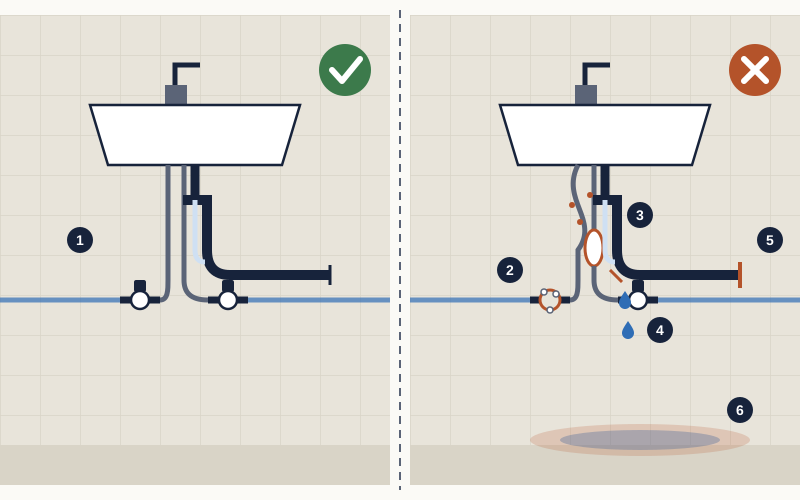
- Good: valves with handles that turn, straight clean hoses, dry trap and joints
- Corroded angle valve with crust: may seize when you need it
- Kinked, bulging hose with rust spots on the braid: replace it
- Drip at the trap joint, seen only while the basin drains
- Gap where the waste pipe enters the wall: water can run behind the tiles
- Puddle or stain on the cabinet floor: the clue that something above is leaking
Flat checklist: traps, floor traps and waste pipes
Every fitting that drains into the building system needs a trap whose water keeps sewer air out. England's drainage guidance, for example, expects a trap at every discharge point, removable or fitted with a cleaning eye.[10]
- Basins, sinks and shower areas empty quickly without gurgling.
- Traps stay dry while draining and can be opened for cleaning.
- Floor traps: grating in place, no hair or soap build-up, water in the trap, no smell.
- Little-used drains topped up with water so the trap cannot dry out.
- No water rising in your floor trap when a neighbour uses a fitting.
- Waste pipe entry into the wall sealed, no staining below.
- Fat goes in the bin, not the kitchen sink.
See how to clear blocked drains and drain odours.
Flat checklist: water heaters, appliances and little-used outlets
- Water heater (geyser): no drips, rust streaks or scorch marks; switch and cable sound. Anything inside the casing is for a technician.
- Hot water is hot but not scalding; keep children away while testing.
- Washing machine hoses firmly connected; United Utilities lists leaks behind appliances among common indoor leaks.[6]
- Every outlet, including a spare bathroom, used at least weekly; HSE warns against letting water stagnate.[2]
- After the flat stands empty, every tap run through before use; HSE lists flushing before a property is let as a control measure.[2]
Routine care, including water heater safety, is in washroom fittings maintenance.
Building checklist: tanks, pumps, risers and stacks
Shared items are usually checked by the caretaker or a committee member. Write down who maintains what: Singapore's housing board, for instance, makes residents responsible for branch sanitary pipes in their flats and the Town Council for the main pipes.[7] Many Dhaka buildings store the WASA supply in an underground reservoir and pump it to a rooftop tank; check whichever parts your building has.
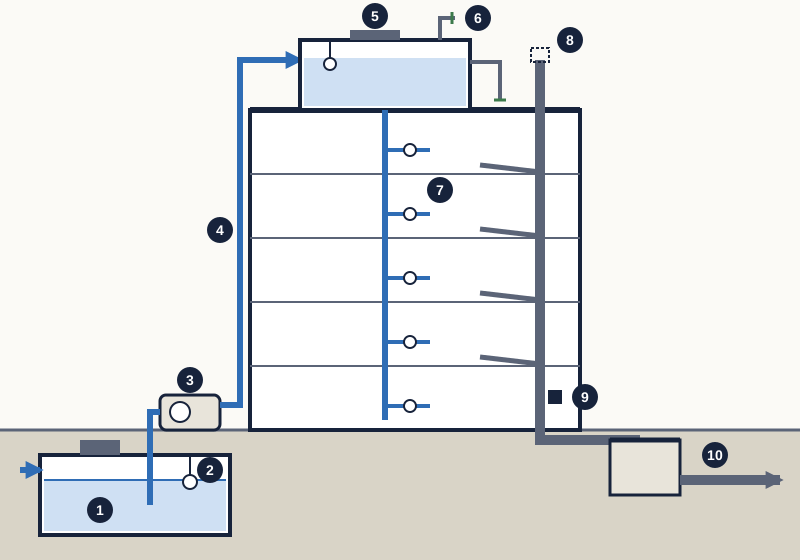
- Underground reservoir filled from the street supply, with its access cover
- Float or level switch that stops the pump when the reservoir runs low
- Pump set
- Rising main to the roof
- Rooftop tank access cover: closed, well fitted and locked
- Vent and overflow pipes with insect screens
- Down-feed riser with a valve for each floor
- Top of the soil and waste stack, open to the air under a cage cover
- Access (rodding) point on the stack
- Inspection chamber and building drain to the sewer
Underground reservoir and rooftop tank
- Covers closed, well fitted and locked; HSE says cold water tanks need a tight-fitting lid.[2]
- Vents and overflows screened against insects; NSW Health advises inspecting such screens at least yearly.[8]
- No cracks, leaks or heavy rust on walls, stand or connections.
- Overflow not running in normal use; if it is, the inlet control is not shutting.
- No drain or sewage line near enough to the reservoir to seep in.
- Last cleaning date recorded. NSW Health suggests checking rainwater tanks for sludge every six to twelve months, a useful reference; ask your cleaning contractor about yours.[8]
Pumps and controls
- Runs smoothly without grinding or heavy vibration, and stops when the roof tank is full.
- No drips from the pump body, shaft seal or joints; floor dry.
- Dry-running protection (float switch, electrode or pressure switch) fitted and working; Grundfos warns that bearings and shaft seals can be damaged if booster pumps run dry.[9]
- Standby pump, if any, used in turn.
- Control panel closed, dry and labelled, no burning smell; only an electrician opens it.
- Faults and the last service date recorded in the log.
Risers, shafts and soil stacks
- Riser valves labelled, reachable and not leaking.
- Pipe shafts dry, with no stains or rust trails.
- Stacks firmly supported and reachable for repair, with no cracks or weeping joints.[10]
- Rodding (access) points capped and not tiled over.[10]
- Vent pipes above the roof open, with their cage cover in place.[10]
- Inspection chambers covered and not overflowing after rain.
- Roof drains clear before the monsoon (see the roof inspection guide).
Rating what you find: OK, Watch or Fix
Use the same ratings for every item, plus 'Fix now' for emergencies. Two questions decide the rating.
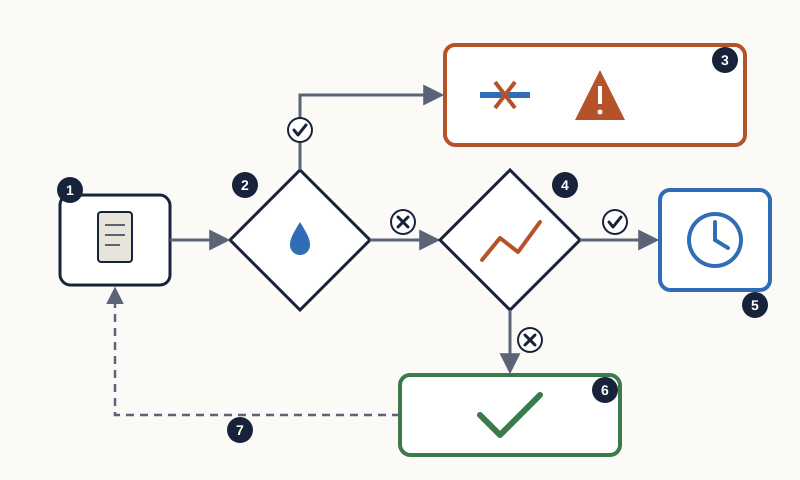
- An item found on the round
- Is water escaping now, near electrics, or reaching another flat?
- Fix now: close the water (and the power if needed) and call for help
- Is it worse than last time, or a repeat fault?
- Fix: book the repair or get quotes soon
- OK or Watch: record it and check again next round
- The record is compared on the next round
| Rating | Meaning | Examples | Action |
|---|---|---|---|
| OK | Matches the 'good' description | Valve turns freely; toilet silent | Record; look again next round |
| Watch | Minor, not worse than last time | Light crust on a valve; old faded stain | Note, photograph and compare next round |
| Fix | Needs action soon | Running toilet; bulging hose; smelly floor trap | Repair or book a plumber; get quotes for bigger jobs |
| Fix now | Water escaping, near electrics, or reaching another flat | Burst hose; ceiling dripping below | Close the water (and power if needed), then call for help |
Keeping records and a maintenance schedule
Keep every dated sheet and photo together so the next person can compare. Only a few items have a published interval, shown below; the owner or committee should set and write down the rest, and many choose a round before and after the monsoon. See planning a preventive maintenance schedule and the monthly building checklist.
| Item | Interval | Source |
|---|---|---|
| Turn the main stop valve off and on | About every six months | WaterSafe[3] |
| Use every tap and shower, including spare rooms | At least weekly | HSE[2] |
| Replace the toilet flapper (flush valve seal) | At least every five years | US EPA[1] |
| Inspect insect screens on tank inlets and overflows | At least once a year | NSW Health, rainwater tanks[8] |
| Check stored-water tanks for sludge | Every six to twelve months | NSW Health, rainwater tanks[8] |
| Everything else | Set by the owner or committee | None |
Common mistakes and troubleshooting
- Ticking boxes from memory instead of looking, wiping and turning.
- Forcing a stiff stop valve; WaterSafe advises calling a plumber instead.[3]
- Mistaking condensation for a leak: sweat forms evenly along cold pipes, while a leak starts at one joint.
- Checking only your flat, when many stains come from shared risers or the flat above.
- Painting over a stain before finding its source (see damp walls and seepage).
- Leaving a spare bathroom unused, so traps dry out and water stagnates.[2]
- Ignoring banging pipes; WaterSafe warns that pressure shocks strain joints and can cause leaks.[4]
When to call a plumber, an electrician or the committee
- Plumber: leaks inside walls or floors, valves that will not turn or shut, toilets still running after a new seal, repeated blockages. After tiling work, use the after-renovation plumbing check.
- Electrician: water near sockets, the water heater or the pump panel, or a burning smell.
- Caretaker or committee: anything in a riser, stack, tank, pump room or chamber, and stains that may come from another flat.
- Tank-cleaning contractor: dirty, smelly or discoloured water. Replacing beats repairing when a part is cracked, badly corroded or keeps failing.
What drives the cost of fixing what you find
We could not find reliable published plumbing prices for Bangladesh, so none are given. Cost depends mainly on:
- The part: a washer or hose costs far less than a valve or a whole fitting.
- Access: concealed pipes mean breaking and replacing tiles.
- Who pays: shared items need committee quotes and approval.
- Specialists: tank, pump and electrical work are separate trades.
- Timing: an early fix usually costs less than a burst.
Compare at least two written quotes; see how to get and compare repair quotes.
Next steps
- Print the checklists in this guide.
- Test your main stop valve today.[3]
- This week, do one full round and mark every item.
- Fix the simple items and book a plumber for the rest.
- Report building items to the caretaker or committee in writing, with photos.
- Put the next round in your calendar.
Common questions
- Our flat has no separate water meter. How can I find hidden leaks?
- Skip the meter test and rely on the rest: listen to each toilet after it refills, do the dye test,[1] wipe joints with dry tissue, and watch ceilings in your flat and the one below. A stain that grows after one bathroom is used points to that room.
- What should a tenant check, and what is the landlord's job?
- A tenant can do the flat round, report leaks promptly, run little-used taps and clean shower heads, as HSE advises tenants to do.[2] Repairs to pipes and fittings are normally the owner's job; agree the split in writing. See the landlord maintenance checklist.
- Why do our pipes bang when a tap is turned off?
- WaterSafe lists faulty float valves, poorly clipped pipes, air at the stop tap, loose stop-tap washers and fast-closing appliance valves.[4] If the noise continues or worsens, call a plumber.
- How often should the building's water tanks be cleaned?
- We could not confirm a single rule for Bangladeshi apartment buildings. NSW Health suggests checking rainwater tanks for sludge every six to twelve months,[8] a reasonable reference. Agree an interval with a cleaning contractor and see the water tank maintenance guide.
Sources
The facts in this guide were checked against these sources.
- Fix a Leak Week — US Environmental Protection Agency (WaterSense) (published Last updated 13 March 2026). accessed 18 October 2026.
- Legionella and landlords' responsibilities — UK Health and Safety Executive (HSE) (published Updated 30 September 2024). accessed 18 October 2026.
- Check your stop tap as clocks fall back — WaterSafe. accessed 18 October 2026.
- I can hear a banging noise coming from my pipework. What could it be? — WaterSafe. accessed 18 October 2026.
- Under the sink: How to prevent flexi-hose bursts — Allianz Australia (published Last updated 14 July 2026). accessed 18 October 2026.
- Find leaks inside your home or business — United Utilities. accessed 18 October 2026.
- Fixing Clogged or Leaking Pipes in HDB Flats — Housing & Development Board (HDB), Singapore. accessed 18 October 2026.
- Managing rainwater tanks for safe drinking water — NSW Health (New South Wales Government) (published Current as at 11 September 2026). accessed 18 October 2026.
- Dry-running protection — Grundfos. accessed 18 October 2026.
- Approved Document H: Drainage and waste disposal (2015 edition) — UK Government (Department for Communities and Local Government) (published 2015 edition). accessed 18 October 2026.
This guide is general information. Have gas, structural and live electrical work done by a qualified, licensed professional. Your building’s rules and committee decisions take precedence over anything written here.
Written from the cited sources by the RUAP.NET editorial team. It has not been reviewed by a licensed engineer, plumber or electrician; for work on gas, structure or live electrics, use a qualified professional.
Spotted a mistake? Tell us — we check it, correct the guide and record the date of the correction. Report an error →