
Flat Roof Inspection Before the Monsoon: A Safe, Step-by-Step Check for Apartment Buildings
When monsoon rain finds a blocked outlet or a cracked roof, the first sign is usually a wet ceiling in a top-floor flat. This guide shows a building committee or caretaker how to check a flat roof safely before June, and which jobs to hand to a professional.
Inspect the roof at least twice a year, and always before the monsoon: clear every rainwater outlet, look for ponding, cracks, blisters and lifted coating, and check the parapets, pipe entries and tank stands.[1][3]
Most roof leaks start at weak points: outlets, the corner between roof and parapet, and pipes passing through the slab.[4] They are cheap to fix in dry weather and expensive once water has reached the flats below.
All roof work is dangerous, even for a few minutes.[5] Keep back from low or unprotected edges, never stand on skylights or tank lids, go indoors at the first thunder, and leave edge, ladder and tank-top work to trained people.
Some steps carry risk — follow the warnings, and call a tradesperson if in doubt.
A shared roof's failures land on a few people: usually the top-floor flats, and sometimes the stairwell. In a 14-storey building such as those in the Rajuk Uttara Apartment Project, that means the 14th floor. Dhaka's monsoon, roughly June to October, brings long spells of heavy rain. A short, organised inspection in April or May catches most problems while there is still time to fix them.
How a flat roof keeps water out
A 'flat' roof is never quite flat. A layer of screed (a sand–cement topping) is usually laid to a gentle slope, called the fall, towards the rainwater outlets. A waterproofing layer, such as a membrane, bitumen felt or liquid coating, covers the roof and turns up the parapet wall as an upstand or skirting. A coping caps the parapet and throws water clear of the wall, and each outlet feeds a downpipe to the ground.
Water gets in where one part fails: a blocked outlet makes water back up until it finds a gap, a crack lets it soak into the slab, and a split skirting lets it run down behind the waterproofing. Asian Paints notes that the meeting point of two surfaces, such as the parapet and the roof, is often weaker than either surface on its own.[3]
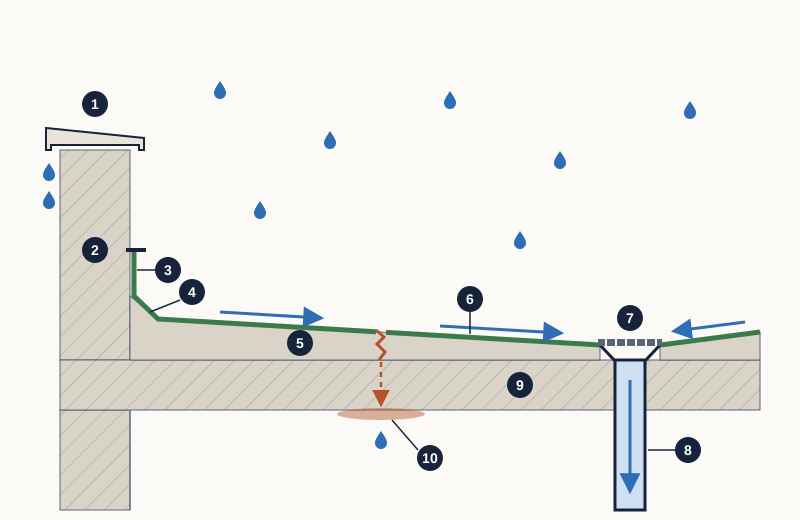
- Coping on top of the parapet, with drips that throw water clear of the wall
- Parapet wall
- Waterproofing upstand or skirting turned up the parapet and fixed at the top
- Angled fillet at the corner between roof and parapet, a common weak point
- Screed laid to falls towards the outlet
- Waterproofing membrane or coating
- Rainwater outlet with its grating
- Downpipe carrying water to the ground
- Concrete roof slab
- Water passing through a crack in the coating and the slab, staining the top-floor ceiling
Warning signs and common causes of roof leaks
Look at both the roof and the rooms under it; a roof inspection should include the inside of the building.[1]
Inside the top-floor flats and stairwell
- Damp patches, brown rings or peeling paint on top-floor ceilings, especially in corners and along outside walls.
- Stains that grow after heavy rain and fade in dry weather, which points to the roof or outside walls rather than plumbing.
- Mould, a musty smell, or plaster that sounds hollow when tapped.[3]
- Water marks round columns or beams at the top of the stairwell, or by the roof door.
Damp can also come from outside walls, windows or a bathroom above, so a stain alone does not prove a roof fault. Our guide to damp walls and seepage explains how to tell the types apart.
On the roof
- Leaves, plastic, silt or bird droppings on outlet gratings, or a missing grating.[1]
- Ponding: water, a dried silt ring or algae where water stands after rain. Standing water finds weak spots and is a sign of poor drainage.[3][4]
- Cracks in the screed, tiles or coating. Asian Paints warns that even small cracks can widen quickly once water gets in.[3]
- Blisters, bubbles, peeling or worn patches in the coating or membrane.[1][3]
- Split skirting where the roof meets the parapet, cracked parapet walls or loose coping; Northern Ireland's Department for Communities links these to water getting in or to wind.[2]
- Gaps round pipes, cable entries, vent pipes and the feet of tank stands.[1][3]
- Punctures or scuffs from foot traffic, dragged equipment or loose debris.[2]
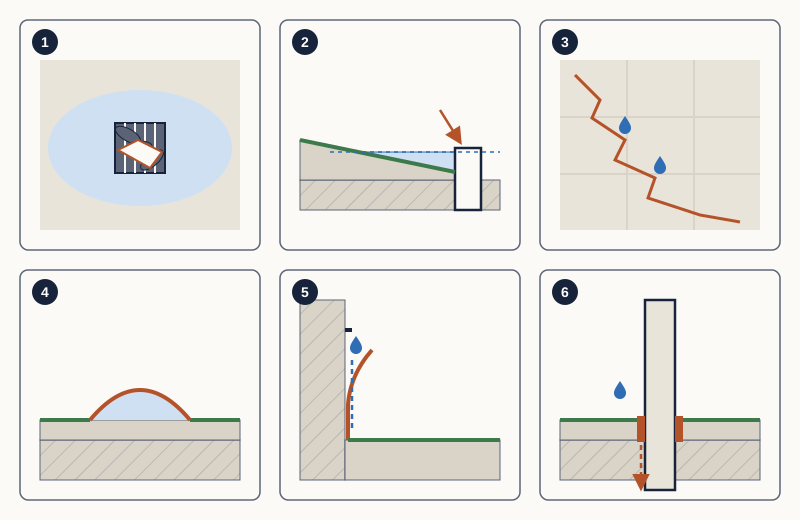
- Outlet grating blocked by leaves and plastic, with water pooled round it
- Outlet set higher than the roof surface, so water ponds in front of it
- Crack in the screed or coating that lets water into the slab
- Blister where moisture or air trapped underneath lifts the membrane
- Skirting peeling away from the parapet, letting water run down behind it
- Failed seal round a pipe through the slab, letting water seep down beside it
Roof safety: read this before you go up
The UK Health and Safety Executive (HSE) says almost one in five deaths in construction work involve roof work, mainly falls from edges and through openings or fragile surfaces.[5] From the roof of a 14-storey building, a fall is not survivable.
Edge work is for professionals. HSE says flat roof edges can be protected with a secure double guardrail and toeboard.[5] Clearing an outlet set into the parapet or repairing coping is a job for a contractor with edge protection, not for a caretaker leaning over the wall.
If a ladder is unavoidable, for example to see the top of a tank, use it only for short, light work. Ireland's Health and Safety Authority advises setting a leaning ladder at about one out for every four up, tying it, letting it extend about 1 m above the landing point, keeping three points of contact and never resting it on a gutter or glass.[6]
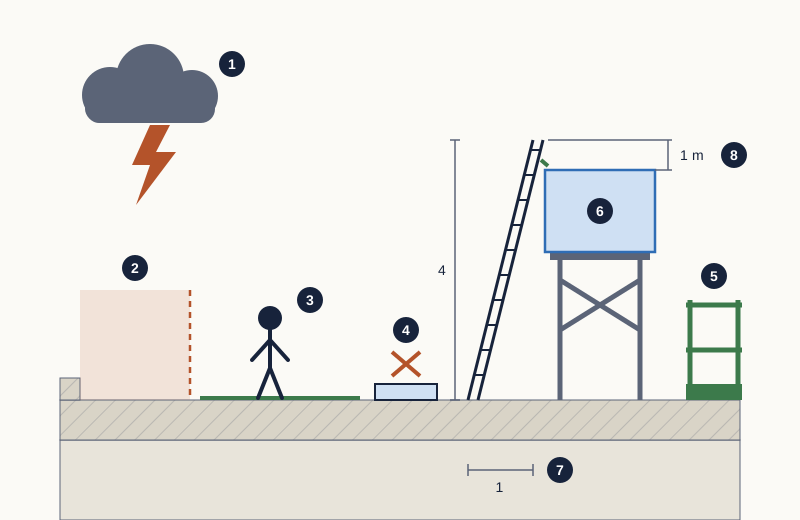
- Thunderstorm: go indoors at the first thunder; nowhere on a roof is safe
- Low, broken or missing parapet: keep well back; edge work needs edge protection
- Inspect from the open roof, away from the edges, with a second person
- Skylight, rooflight or tank lid: treat as fragile and never step or sit on it
- Edge protection for work near an edge: double guardrail and toeboard
- Overhead tank on its stand: do not climb it without a fixed ladder and a helper
- Leaning ladder at about 1 out for every 4 up, on firm, level ground
- Ladder tied at the top and extending about 1 m above where you step off
Tools and equipment you will need
- This guide's checklist, a pen and a phone camera for dated photos.
- Shoes with good grip, gloves, a hat and drinking water; roofs get very hot in April and May.
- A soft broom, sacks for debris and a bucket.
- A plastic scoop or hand trowel for silt; avoid metal shovels and rakes, which IKO says can damage roofing.[1]
- Chalk to circle defects for the contractor, and a torch for looking into outlets.
- A sketch plan of the roof (see the route diagram below). Never use a pressure washer on the roof surface.[1]
Step by step: a pre-monsoon roof inspection
Pick a dry morning in April or May, a few days after rain, work in pairs and follow the same route every time.
- Start indoors: ask the top-floor flats about new stains, check the stairwell, and photograph each stain.[1]
- Check that the roof door, stair and lights work and the route is clear; the roof is not a storage area.[1]
- Walk the safe area first, away from the edges, and mark the outlets, tanks, pipes and the stains below on your sketch.
- Clear each outlet. Lift debris and silt off the grating by hand, bag it, and do not sweep it down the outlet. Check that the grating is present and secure.[1] For a blocked downpipe, see how to identify and clear blocked drains.
- Test the flow. Pour a bucket of water into each outlet. It should drain at once; if it backs up, call a plumber.
- Look for ponding: areas still wet, silted or green while the rest of the roof is dry. Ponding round an outlet set too high needs a contractor.
- Inspect the open surface in strips for cracks, open joints, blisters, peeling coating and punctures. Circle each in chalk and photograph it.[2][3]
- Inspect the parapets from the roof side only, looking for cracks, loose coping, split skirting and gaps in the corner.[2] Never lean over to see the outside face.
- Check the seal round every vent pipe, water pipe, cable entry and tank-stand foot.[1]
- From roof level, check the tank stands for rust and cracked plinths, and look for leaking valves, a dripping overflow and open lids. For cleaning and anything inside the tank, follow how to clean and maintain water storage tanks safely.
- Remove anything that can hold water: buckets, broken pots, tyres and plastic sheets.[7]
- Write up the findings the same day and keep the log with past records.[1]
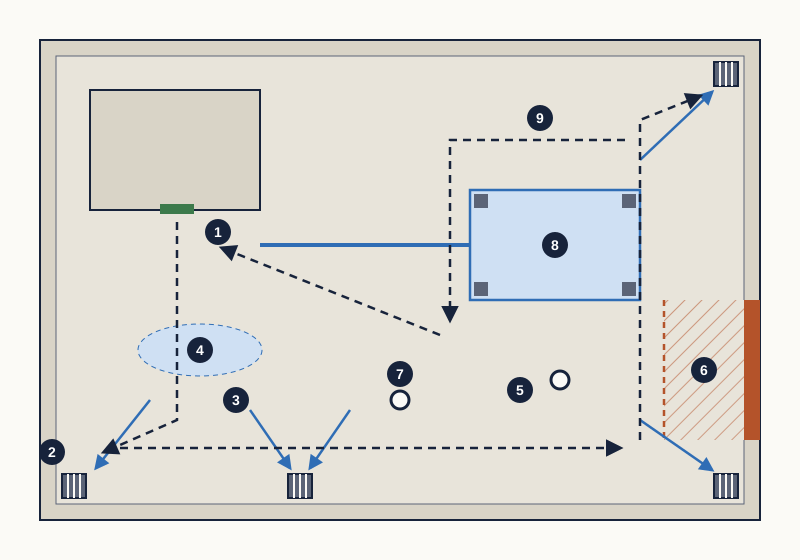
- Roof door: start and finish here; check the door, stair and lights
- Rainwater outlet (one of four): clear the grating and test the flow
- Blue arrows: the falls that carry rain to the outlets
- Ponding patch: mark it and photograph it
- Open roof surface: inspect in strips for cracks, blisters and peeling
- Low or damaged parapet: stay behind the dashed line and note it from a distance
- Vent pipe through the slab (one of two): check the seal round it
- Overhead tank on its stand: check the legs, base, valves and overflow from roof level
- Dashed line with arrows: the inspection route
Standing water and mosquitoes
Ponding is also a health risk, because clear standing water breeds the Aedes mosquito, which spreads dengue. Bangladesh's local government ministry has asked building owners to remove stagnant water from roofs, citing a health directorate warning about monsoon rain.[8] The US Centers for Disease Control and Prevention (CDC) advises emptying or covering anything that holds water once a week.[7]
Prevention and routine maintenance
IKO, a roofing manufacturer, recommends inspection by a competent person at least twice a year, and after unusual weather or new work on the roof.[1] In Bangladesh, do one check before the monsoon and one after it.[3]
- Sweep the roof regularly and lift the debris out rather than washing it into the outlets.[1]
- Keep foot traffic to set paths where possible; drying clothes, gatherings and moving heavy items wear the coating.
- Make anyone who fixes a dish antenna, solar panel, cable or pipe make good the waterproofing, and check their work.[1]
- Allow no drilling or fixing into the roof surface without the committee's agreement.
- Plan to renew sealants round pipes and joints; IKO suggests considering replacement about every five years.[1]
- Keep a roof log of inspection dates, photos, repairs, contractors and warranties.
Fit the roof into the building's wider plan: see the monthly building maintenance checklist and how to plan a preventive maintenance schedule.
Pre-monsoon roof checklist for the committee
- Top-floor flats and stairwell asked about stains; each one photographed and marked on the plan.
- Roof door, stair lights and access clear; roof door lockable.
- Every outlet grating present, secure and clear; silt lifted out.
- Flow test done on each outlet; slow outlets reported to a plumber.
- Ponding areas marked and photographed.
- Cracks, blisters, peeling coating and punctures marked and photographed.
- Parapet cracks, loose coping and split skirting noted from the roof side.
- Seals round pipes, vents, cables and tank-stand feet checked.
- Tank stands, plinths, valves, overflow and lids checked from roof level.
- Containers and rubbish that can hold water removed.
- Contractor repairs listed, quotes requested and a finish date agreed before the rains.
Common mistakes and troubleshooting
- Waiting for the first leak. Asian Paints says most waterproofing systems need at least seven days of curing before they face rain.[4]
- Coating over cracks, dirt or a wet surface instead of repairing and cleaning it first.[4]
- Sealing a hairline crack but ignoring the outlet that makes water pond over it.
- Pushing debris down the outlet, where it blocks the downpipe out of sight.[1]
- Cutting open every blister. IKO advises leaving blisters alone unless they hold water or are damaging the membrane.[1]
- Blaming the roof for every top-floor stain. A stain that appears without rain points to plumbing or a tank overflow; see damp walls and seepage.
- Leaving a loose piece of coping or parapet. At height it is a danger to people below, not just a leak.
Repair, re-waterproof or call a professional?
Most repairs need a waterproofing contractor, a plumber or, for some cracks, a structural engineer. Asian Paints suggests a professional assessment for problems beyond the surface, and full re-waterproofing where damage is widespread or the coating is old.[3]
| Finding | Likely meaning | Caretaker can | Call a professional when |
|---|---|---|---|
| Debris on an outlet grating | Routine build-up | Clear and bag it | Water still backs up afterwards |
| Outlet drains slowly or not at all | Blocked sump or downpipe | Lift silt out of the sump | The blockage is in the downpipe (plumber) |
| Ponding away from outlets | Wrong or settled falls | Sweep it off and mark the area | It ponds after every rain (re-screeding) |
| Hairline cracks in the coating | Ageing coating or surface movement | Mark and photograph | Before the monsoon, for crack repair and re-coating[4] |
| Cracks over about 2 mm, or along beams | Possible movement in the slab | Photograph and measure | Always; Asian Paints advises a structural assessment for cracks over 2 mm[4] |
| Blister in the membrane | Moisture or air trapped underneath[2] | Mark and monitor | It holds water, grows or splits[1] |
| Split skirting or cracked parapet | Movement or water in the wall[2] | Note it from the roof side | Always; the repair needs edge safety |
| Gap round a pipe or tank-stand foot | Failed seal | Photograph it | A contractor should reseal it[1] |
| Widespread crazing or peeling | Coating at the end of its life[2] | Record how far it extends | Plan full re-waterproofing |
Before anyone fills a crack that might be structural, read which wall cracks need a professional inspection. If the roof has an installer's guarantee, check its terms first: IKO, for example, requires repairs to be agreed with it and carried out by the original contractor.[1]
What drives the cost of roof repairs
We could not find reliable published prices for roof waterproofing in Bangladesh, so this guide quotes none. The cost depends mainly on:
- Area: a patch round one outlet costs far less than re-coating the whole roof.
- Preparation: removing loose coating and repairing cracks can take more labour than the new coat.
- System: liquid coatings, bitumen membranes and polyurethane (PU) systems differ in materials, skill and warranty; torch-applied membranes need skilled applicators.[4]
- Screed work: correcting falls to stop ponding means breaking out and relaying screed, a much bigger job than sealing.
- Access and safety: edge protection, scaffolding and moving tanks or equipment all add cost.[1]
- Warranty: ask how long it lasts, what voids it and whether the contractor will return to fix defects.
Get two or three written quotes that name the product, the number of coats, how cracks and outlets will be treated, and the warranty; see getting and comparing repair quotes. The roof is normally common property, and the flat maintenance guide discusses how shared and private costs are usually split.
Next steps
- This week: ask the top-floor flats about stains and book a dry morning for the inspection.
- Before going up: agree who goes, check the weather and reread the safety rules above.
- On the day: follow the route, clear the outlets, photograph defects and remove rubbish that can hold water.
- Within a week: sort the findings into clean-up, minor repairs and contractor jobs, and request quotes.
- By the end of May: finish waterproofing repairs so they have dry days to cure.[4]
- Through the monsoon: clear the outlets and tip out standing water weekly, and inspect again when the rains end.
Common questions
- How often should a flat roof be inspected?
- IKO recommends an inspection by a competent person at least twice a year, plus an extra check after unusual weather or work on the roof.[1] In Bangladesh, do one before the monsoon and one after it.[3]
- Can we just paint a waterproof coating over the whole roof?
- Only after preparation. Asian Paints advises repairing cracks, cleaning the surface and allowing curing time before rain.[4] A coating will not cure ponding caused by wrong falls or a high outlet, and it will not stop water getting in behind a split skirting.
- There is a stain on our top-floor ceiling, but the roof looks fine. What next?
- If the stain grows only after rain, look closely at the outlets, parapet corners and pipe entries above it, and consider a professional inspection.[3] If it appears in dry weather, a plumbing leak or tank overflow is more likely; see damp walls and seepage.
- Is it safe for our caretaker to clean the roof outlets?
- Outlets in the open roof, away from the edge, usually are, in dry weather and with a second person present. Outlets set into a low parapet, or any job that means leaning over the edge, are not. HSE expects edges to be protected, for example with guardrails, when people work near them.[5]
Sources
The facts in this guide were checked against these sources.
- IKO Maintenance of Flat Roofs - Guidance Note (R14-009Y, Maintenance of Flat Roof Waterproofing Systems) — IKO (published June 2025). accessed 18 October 2026.
- Maintenance Checklist: Bituminous Sheet Flat Roofs — Department for Communities (Northern Ireland). accessed 18 October 2026.
- Waterproofing Inspection Checklist: What Homeowners Should Check Every Year — Asian Paints. accessed 18 October 2026.
- Roof Waterproofing Solutions That Survive Indian Monsoons — Asian Paints. accessed 18 October 2026.
- Roof work — Health and Safety Executive (HSE), UK. accessed 18 October 2026.
- Using Ladders Safely - Information Sheet — Health and Safety Authority (Ireland). accessed 18 October 2026.
- Mosquito Control at Home — US Centers for Disease Control and Prevention (CDC) (published 16 April 2024). accessed 18 October 2026.
- Anti-dengue drive: Govt to act against people with still water at home — The Financial Express (Bangladesh) (published 30 April 2020). accessed 18 October 2026.
- Lightning Safety — US National Weather Service (NOAA). accessed 18 October 2026.
This guide is general information. Have gas, structural and live electrical work done by a qualified, licensed professional. Your building’s rules and committee decisions take precedence over anything written here.
Written from the cited sources by the RUAP.NET editorial team. It has not been reviewed by a licensed engineer, plumber or electrician; for work on gas, structure or live electrics, use a qualified professional.
Spotted a mistake? Tell us — we check it, correct the guide and record the date of the correction. Report an error →