
Drain and Sewer Smells in a Flat: How to Find the Source and Stop Them
A rotten-egg or sewage smell from a floor trap, basin or toilet usually means something has broken the barrier between your room and the building's drains. This guide explains how that barrier works, how to trace the smell to its source and which fixes you can safely do yourself.
Most drain smells come from a trap that has lost its water, from slime and hair inside the drain above the trap, or from a leaking seal or joint. Start by pouring water into every floor trap, basin and shower you rarely use: if the smell fades, a dry trap was the cause.[1]
If it keeps coming back, clean the floor trap grating, the basin waste pipe and overflow, check the toilet base, and note when the smell appears. A smell that follows a neighbour's flush, or gurgling drains, points to the building's shared pipes pulling water out of the traps: a job for a plumber and the building committee.[4]
Sewer gas contains hydrogen sulfide, which irritates the eyes and airways and at high levels can dull your sense of smell. If a strong smell comes with headache, dizziness or nausea, leave the room, ventilate and get help.[1][2]
Most of this can be done yourself with ordinary tools.
In an apartment building every bathroom and kitchen drain joins shared vertical pipes, called stacks, that carry waste down to the sewer. The only barrier between those pipes and your room is a few centimetres of water held in a bend in each drain. A smell almost always means that water is missing, dirt inside the drain has started to rot, or gas is escaping through a gap somewhere else.
How a trap keeps sewer smells out
A trap is a U-, P- or bottle-shaped bend under a basin, sink, shower or floor drain; every toilet pan has one built into its base. Water left in the bend after each use forms a plug, the water seal, that stops air from the drains coming back up. England's building regulations guidance, as one example, says every point of discharge should have a trap to keep foul air out of the building, and that traps should keep at least 25 mm of water under working conditions.[3]
Seal depth is measured from the level where water spills out of the trap (the weir) down to the top of the lowest inside surface of the bend (the dip). The same guidance lists 75 mm for washbasins, sinks and washing machines and 50 mm for baths, showers and WC pans, and allows as little as 38 mm for some appliances that discharge to a floor gully.[3] A 2023 review of international drainage standards for the building research network CIB describes typical seals of 50 mm or more, enough to absorb small pressure swings in the pipes.[4] A shallow floor trap simply has less water to lose than a basin trap.
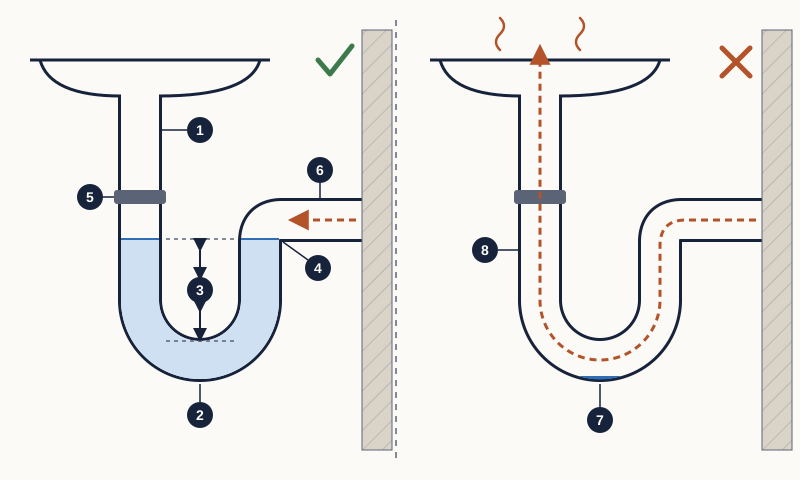
- Tailpiece (waste pipe) from the basin
- Water seal held in the U-bend
- Seal depth: from the spill-over level down to the top of the bend's inside
- Weir, the point where water spills out of the trap
- Removable nut, opened for cleaning
- Outlet to the branch pipe and stack; gas from the pipe is stopped by the water
- Dry trap: the water has fallen below the top of the bend's inside
- Sewer gas passes through the empty trap and up through the basin into the room
Bangladesh's building code (BNBC 2020) also covers plumbing, but we could not consult its plumbing chapter, so no figures from it are quoted here. For a renovation, ask your plumber or engineer to show you the relevant section.
Common causes of drain smells
A trap that has dried out
Water in a trap evaporates slowly. A drain used every day is topped up constantly, but a spare bathroom's shower, a balcony or utility floor trap, or every drain in a flat left empty for a few weeks, for example over the Eid holidays, can lose enough water for gas to pass. Wisconsin's health department advises running water through floor and sink drains regularly for exactly this reason.[1] Floor traps are the usual culprits because their seal is shallow and their grating is open to the room.
A trap emptied by suction or air pressure
Water can also be pulled or pushed out of a trap in seconds. The CIB review describes three ways.[4] In induced siphonage, water rushing down the stack or a shared branch sucks the seal out of a trap nobody is using. In self-siphonage, a fixture's own discharge, typically a full basin emptied at once, fills a narrow pipe and drags the seal after it. In back pressure, air compressed ahead of falling water pushes the seal out, sometimes into the room. The clue is a smell straight after a flush or a washing machine emptying, often with gurgling from a nearby drain.
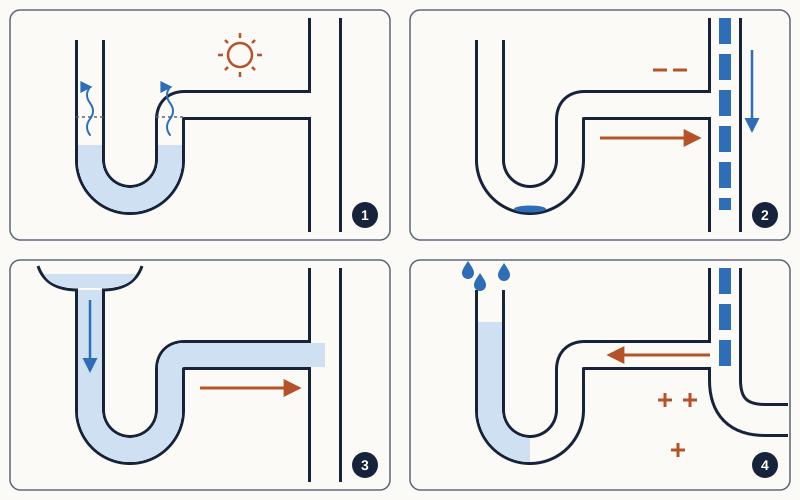
- Evaporation: an unused trap slowly loses its water
- Induced siphonage: water falling down the stack from upper floors sucks the seal out
- Self-siphonage: a fixture's own discharge fills the branch pipe and drags the seal with it
- Back pressure: compressed air at the foot of the stack pushes water out of traps on low floors
Dirt inside the drain: slime, hair, soap and grease
Not every smell comes from the sewer. A layer of slime (biofilm) grows inside basin waste pipes above the trap and in the basin's hidden overflow channel, releasing odour whenever water runs; the building columnist Tim Carter recommends scrubbing both with a long bottle brush.[7] Floor trap gratings catch hair and soap that rot in a warm, wet bathroom. In kitchens, fat poured down the sink cools, sticks to the pipe walls and builds into blockages.[6] If water also drains slowly, read how to identify and clear blocked drains.
Leaking seals, cracked pipes and blocked vents
Gas can also bypass the traps altogether. A loose or failed seal between the toilet pan and the soil pipe lets it out at the base of the pan, and a toilet that rocks when you sit on it is a warning sign.[7] A leaking joint on a stack, or a vent pipe on the roof blocked by leaves or a bird's nest, can let gas into the building or upset the trap seals.[1] A musty rather than sewage smell with no visible source can instead point to hidden mould.[9]
Why tall buildings have extra smell problems
In a high-rise, one stack may carry water from dozens of bathrooms. CIBSE Journal notes that tall buildings see more extreme pressure swings because of their many branch connections, and that high pressure at the foot of a stack can compromise, or even blow out, traps on branches near the base.[5] So the lowest floors of a 14-storey block can have trap problems the upper floors never notice. The stack normally continues through the roof as an open vent, and many tall buildings add a second, dry ventilating stack linked to it at intervals to balance the pressure.[5]
Some flats have an air admittance valve (AAV): a one-way valve on a drain that opens to let air in when the pipe is under suction and closes again afterwards. CIBSE Journal warns that these valves act as closed ends under positive pressure, so they cannot relieve it and may even make it worse.[5] The English guidance adds that AAVs should be accessible, removable, placed in a ventilated space and never used outside.[3] A valve sealed behind tiles cannot be checked or replaced when it fails.
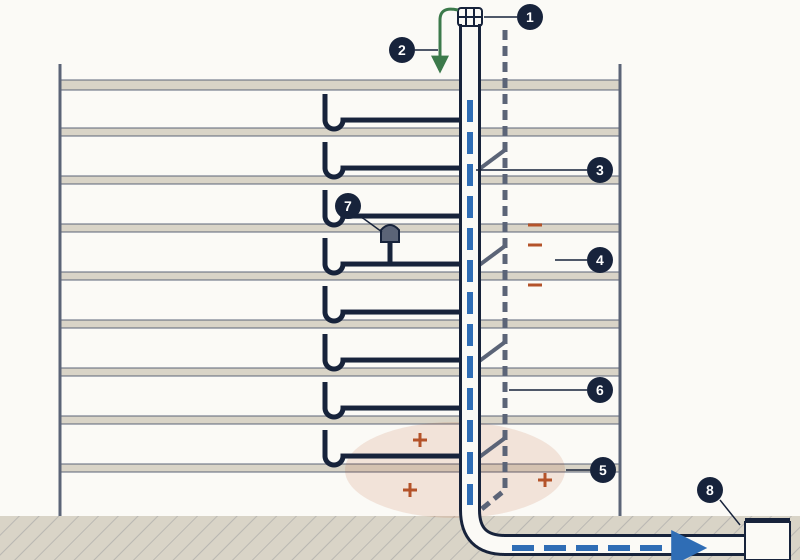
- Open vent outlet with a cage above the roof
- Air drawn into the stack through the vent as water falls
- Water falling down the stack
- Suction zone, where trap seals can be pulled out
- Pressure zone near the foot of the stack, affecting traps on the lowest floors
- Separate ventilating stack linked to the main stack at intervals (in some buildings)
- Air admittance valve on a branch: lets air in under suction but cannot relieve pressure
- Below-ground drain to the manhole and sewer
Reading the signs: when the smell appears and what it suggests
When and where the smell appears is the best clue. Keep notes for a few days before you start taking anything apart.
- Only in a room you rarely use, or after the flat has been empty: a dry trap.[1]
- Straight after someone upstairs or next door flushes, or with gurgling from a floor trap or basin: siphonage or a venting fault in the stack.[4]
- When you run the basin tap: slime in the waste pipe or the overflow channel.[7]
- All the time around the toilet base, perhaps with a damp floor: the pan seal.[7]
- Strongest at the pipe shaft door or on a damp ceiling: a leaking stack joint, which is usually the building's responsibility.
- Worse on the lowest floors when upper floors are busy, such as in the morning rush: back pressure near the foot of the stack.[5]
- Musty and earthy rather than sewage: possibly hidden mould; see how to prevent mould in bathrooms.
Tools and materials you will need
- A jug or bucket of water and a bright torch.
- Rubber gloves and an old toothbrush or small stiff brush for gratings.
- A long, narrow bottle brush for basin waste pipes and overflows.[7]
- A little cooking oil for traps that will stand unused for a long time.[8]
- A bucket and cloth to catch water if you open a basin trap.
Step by step: tracking down a drain smell
Work from the quick checks to the slow ones. Stop at any step that clears the smell, then watch whether it returns over the next week.
- Open a window and switch on the exhaust fan. If the smell is strong or anyone feels unwell, leave first (see the safety box above).
- Sniff close to each drain in turn: floor traps, basins, sinks, shower, toilet, washing machine outlet and balcony drain. Note the strongest.
- Pour about a litre of water into every drain, especially those you rarely use. If the smell is gone within an hour or so, a dry trap was the cause.[7]
- Lift the floor trap grating, clean off hair and slime, and check with a torch that water now stands in the trap below.
- Run the basin tap. If the smell rises as the water runs, clean the waste pipe and overflow as described below.[7]
- Rock the toilet gently by hand. If it moves, or the floor round the base is damp, the seal is suspect: stop and call a plumber.[7] Our guide to bathroom water leaks covers damp floors in more detail.
- Ask a neighbour above to flush while you watch and listen at your floor trap and basin. If the water level drops or the drain gurgles, the trap is being siphoned; write it down.[4]
- Check the pipe shaft door and nearby ceilings for damp, stains or a stronger smell. Do not open sealed shafts or break boxing yourself.
- If the smell remains, give your notes to the building committee or a plumber. Where a water test has failed, a plumber may use a smoke test to find leaks, though the English guidance does not recommend it for uPVC pipes.[3]
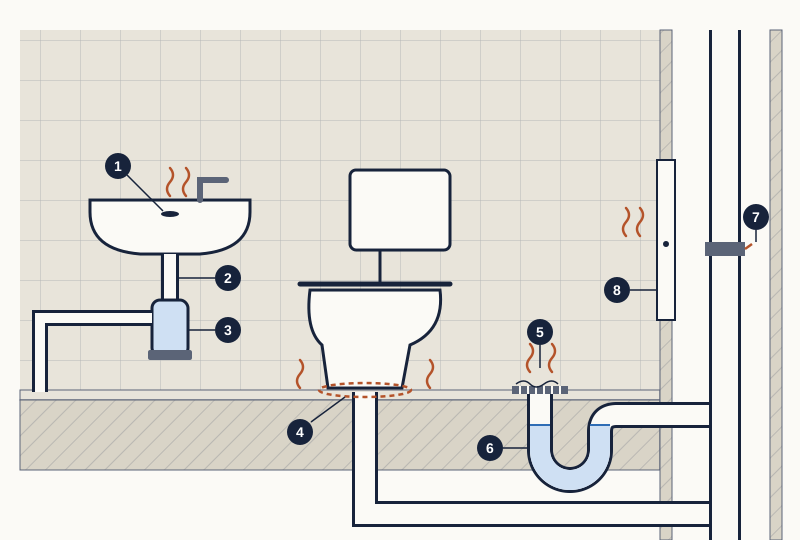
- Basin overflow slot, where slime collects inside
- Waste pipe (tailpiece) above the trap, where biofilm builds up
- Basin bottle trap with a removable base for cleaning
- Seal between the toilet pan and the soil pipe
- Floor trap grating clogged with hair and soap
- Floor trap water seal, which dries out when unused
- Leaking stack joint inside the pipe shaft
- Shaft access door: a smell strongest here points to the shaft
Fixes you can do yourself
Refill and protect traps you rarely use
Pour water into rarely used drains at least once a week. Where a drain will stand unused for longer, refill the trap and then add a little cooking oil; Family Handyman suggests about a teaspoon for each inch (25 mm) of pipe diameter. The oil floats on the water and slows evaporation.[8] Before going away for a few weeks, refill every trap, and run every tap and shower again as soon as you return.
Clean the floor trap, basin waste and overflow
- Wear gloves. Lift out the floor trap grating and any removable inner cup, and scrub off hair and slime.
- Flush the trap with a bucket of water and refit every part the right way up. In floor traps where a removable cup forms the seal, leaving it out means there is no seal at all.
- For the basin, remove the pop-up plug and work a long bottle brush up and down the waste pipe while the tap runs.[7]
- Clean the overflow by pushing a narrow brush or pouring cleaning solution through the overflow slot several times; Carter uses oxygen bleach dissolved in hot water.[7]
- If the basin has a bottle trap with a screw-off base, put a bucket underneath, unscrew it, rinse out the sludge and check the rubber washer; replace a washer that is flat or cracked before refitting.[7]
Keep fat and food out of the kitchen sink
Texas's environmental regulator, TCEQ, advises pouring cooled cooking oil into a sealed container for the bin, wiping greasy pans with paper towels before washing, and fitting a strainer over the sink drain. It also warns that rinsing greasy dishes with hot water only carries the grease further down the pipe, where it cools and clogs.[6] Less grease in the pipe means less to rot and smell.
Prevention: a routine that keeps drains fresh
- Weekly: pour water into every floor trap, shower and basin you rarely use.
- Weekly: clear hair from shower and floor trap gratings.
- Monthly: brush out basin waste pipes and overflows.[7]
- Every day in the kitchen: wipe pans before washing and keep a strainer in the sink.[6]
- Before travelling: refill every trap and add a little oil to those that will stand longest.[8]
- Every few months: rock each toilet gently and look at the floor round its base.
- For the building committee: have roof vent outlets checked for leaves, nests and damage as part of the monthly building maintenance checklist.[1]
Common mistakes and troubleshooting
- Covering a smelly floor trap with tape, a mat or a heavy object. It hides the smell for a while but lets water pool on the floor and does not restore the seal.
- Pouring strong chemicals into a drain that is merely dry. Water is the fix.[1]
- Mixing bleach with other cleaning products.[9]
- Refitting a basin trap without its washer, or cross-threading the nut, so that it leaks and smells.
- Capping or blocking a roof vent. It needs a cage or perforated cover that keeps out debris without restricting air, and the English guidance puts vent outlets at least 900 mm above any opening within 3 m.[3]
- Assuming the fault is inside your flat. A smell that follows other people's flushing is usually a stack problem to raise with the committee.
Troubleshooting tip: if a smell returns within a day or two of refilling a trap, the water is probably being siphoned out, or the trap is cracked or leaking. If it takes a week or more to return, ordinary evaporation is the more likely cause.
When to call a plumber or the building committee
The table shows which smells most people can deal with and which need someone else.
| What you notice | Likely cause | DIY? | Who to call |
|---|---|---|---|
| Smell from a rarely used drain that clears after pouring water | Dry trap[1] | Yes | No one, if it stays away |
| Smell when the basin tap runs | Slime in the waste pipe or overflow[7] | Yes | Plumber, if cleaning does not help |
| Smell at the toilet base; pan rocks or floor is damp | Failed pan seal[7] | No | Plumber |
| Smell or gurgling after a neighbour flushes | Siphonage or a venting fault in the stack[4] | No | Building committee and plumber |
| Traps on the lowest floors bubble or empty at busy times | Back pressure near the foot of the stack[5] | No | Building committee and plumber |
| Strong smell at the shaft door or a damp ceiling | Leaking stack joint or cracked pipe | No | Building committee |
| Smell with slow draining or water backing up | Blockage | Partly | See the blocked drains guide; plumber if the stack is blocked |
Stacks, roof vents and shared drains are usually the building's responsibility; your own traps, toilet seal and fittings are usually yours. If the smell started after a renovation, a trap may be missing, too shallow or badly connected: see how to inspect plumbing after a flat renovation.
What drives the cost of fixing a smell
We could not find reliable published prices for drain repairs in Bangladesh, so this guide gives no figures. The cost depends mainly on:
- Whether anything needs replacing at all: refilling and cleaning cost almost nothing.
- The part: a basin trap washer or a new bottle trap costs far less than replacing a floor trap set into the floor.
- Access: a toilet seal means lifting and refitting the pan; a floor trap or stack joint can mean breaking tiles or opening a shaft.
- Diagnosis: a smoke test or camera survey adds to the bill but can prevent guesswork repairs.
- Who pays: work on stacks and vents is normally shared through the building's service charge.
Ask for a written quote that names the fault, the parts and any guarantee, and compare at least two. See how to get and compare repair quotes.
Next steps
- Today: ventilate, and leave the room if the smell is strong or anyone feels unwell.
- Pour water into every drain and see whether the smell fades.
- Clean the floor trap gratings, basin waste pipe and overflow.
- For a week, note when and where the smell appears.
- Call a plumber for a rocking toilet, a smell at the pan base or a trap that keeps emptying.
- Report smells linked to other flats, the pipe shaft or the lowest floors to the building committee, with your notes.
Common questions
- Why does the bathroom smell of sewage when we come back from holiday?
- The water in the traps evaporated while the flat stood empty, so air from the drains could get through. Run every tap and shower and pour water into each floor trap. Before the next trip, refill the traps and float a little cooking oil on top to slow evaporation.[8]
- Why does my floor trap smell after the flat upstairs flushes?
- Water rushing down the shared stack can suck the seal out of traps on other floors, which is called induced siphonage.[4] Refilling helps only until the next flush. The fault is in the building's pipework or venting, so record when it happens and report it to the committee.
- Can I seal the floor trap permanently?
- Not if the floor needs it to drain shower water or spills: blocking it leaves the water with nowhere to go. If a floor drain really is never used, ask a plumber about a proper solution rather than taping it over, and keep its trap topped up in the meantime.[1]
- Will bleach or drain cleaner get rid of the smell?
- Only if the smell comes from slime, and a brush usually does that job better.[7] Chemicals cannot refill a trap or fix a broken seal, and bleach must never be mixed with cleaners containing ammonia.[9]
- Who is responsible for a smell coming from the pipe shaft?
- Stacks and vents in shared shafts are usually the building's responsibility, so report the smell to the committee or caretaker with dated notes. If a shared stack is also draining slowly, our guide to blocked drains explains what the building should do.
Sources
The facts in this guide were checked against these sources.
- Air: Sewer Gas — Wisconsin Department of Health Services (published Last revised 18 April 2023). accessed 18 October 2026.
- Hydrogen Sulfide | ToxFAQs — Agency for Toxic Substances and Disease Registry (ATSDR), US CDC (published Page last reviewed 28 October 2024). accessed 18 October 2026.
- Approved Document H: Drainage and waste disposal (2015 edition) — UK Government (Building Regulations 2010, England) (published 2015 edition, in effect from 1 October 2015). accessed 18 October 2026.
- An international review of design requirements for the single stack drainage configuration — CIB W062 Symposium 2023, Leuven (J. S. Lansing, PAE), hosted by IRB/ICONDA (published 2023). accessed 18 October 2026.
- Module 150: Ensuring effective foul water drainage in high-rise buildings — CIBSE Journal (published July 2019). accessed 18 October 2026.
- Reducing Fats, Oils, and Grease in Your Home or Apartment — Texas Commission on Environmental Quality (TCEQ) (published Last modified 17 April 2026). accessed 18 October 2026.
- Sewer Odors in Bathroom — Ask the Builder (Tim Carter). accessed 18 October 2026.
- Why You Should Be Using Oil in Your Floor Drains — Family Handyman (published Updated 24 June 2024). accessed 18 October 2026.
- A Brief Guide to Mold, Moisture and Your Home — US Environmental Protection Agency (published Last updated 18 February 2026). accessed 18 October 2026.
This guide is general information. Have gas, structural and live electrical work done by a qualified, licensed professional. Your building’s rules and committee decisions take precedence over anything written here.
Written from the cited sources by the RUAP.NET editorial team. It has not been reviewed by a licensed engineer, plumber or electrician; for work on gas, structure or live electrics, use a qualified professional.
Spotted a mistake? Tell us — we check it, correct the guide and record the date of the correction. Report an error →