
Planning a Preventive Maintenance Schedule for an Apartment Building: Register, Frequencies, Budget and Records
Most apartment buildings are maintained by reaction: the pump fails, the lift stops, the roof leaks in July, and the committee scrambles. This guide shows how to turn that into a written plan that names every asset, says when it is checked and by whom, how it is paid for and where the record is kept.
A preventive maintenance schedule is a list of a building's equipment and fabric, each with tasks at set intervals, a named owner and a record. US government guidance cites studies estimating that time-based preventive maintenance saves around 12–18% compared with fixing things only when they break.[1]
Build it in five steps: make an asset register; take intervals from the manufacturer's instructions, contracts and the law; rank items by how much their failure matters; budget for routine costs and a long-term reserve; and log every job so the plan can be reviewed each year.
Specialist items such as lifts, generators, electrical rooms and fire equipment need qualified contractors. The committee's job is to plan, check and keep the records, not to do that work itself.
Most of this can be done yourself with ordinary tools.
This guide is about planning, not about the tasks themselves. For the jobs a caretaker should do every month, see the monthly building maintenance checklist. Here we cover how a committee decides what goes on the list, how often, who does it, how it is paid for and where it is recorded. The examples assume a tall residential building with shared pumps, tanks, lifts and a generator, such as the 84-flat, 14-storey blocks in RUAP, but the method works for a building of any size.
Why plan: the cost of running a building on breakdowns
Maintenance professionals usually describe three approaches.[1] Reactive maintenance means running equipment until it fails, then repairing it. Preventive maintenance means doing tasks by the calendar or by running hours whatever the equipment's condition, such as changing oil or cleaning filters. Predictive (condition-based) maintenance means measuring condition, such as vibration or temperature, and acting when the readings start to drift.
Reactive maintenance looks cheap because nothing is spent until something breaks. Guidance written for the US Department of Energy by the Pacific Northwest National Laboratory (PNNL) sets out the hidden costs: failures tend to happen at awkward hours, overtime and urgent call-outs cost more, one failed part can damage another, and equipment run to failure wears out sooner.[1] The same guidance notes that preventive maintenance has its own drawbacks: it takes labour and can include work that was not needed, so a good plan mixes the approaches rather than putting everything on a timetable.[1]
Failures also follow a pattern over an item's life. New equipment fails more often while installation faults show up, then settles into a long period of low, steady failure, then fails more often as it wears out; good maintenance can stretch that middle period.[1]
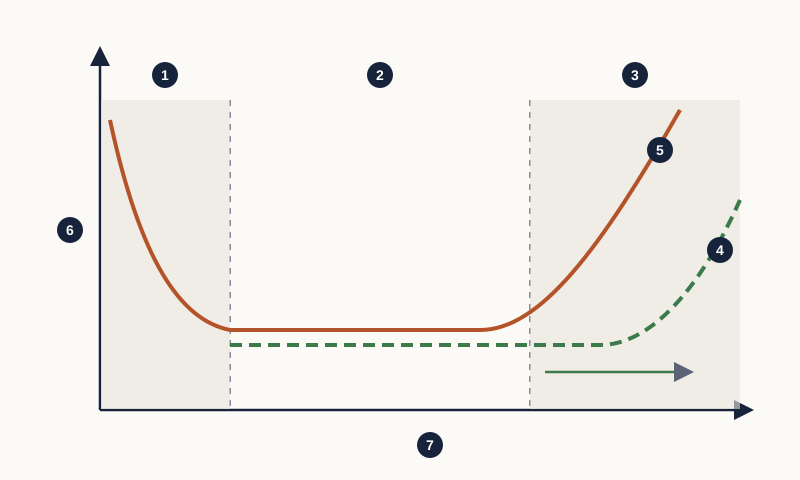
- Early period: installation and design faults show up
- Useful life: low, steady failure rate
- Wear-out: the failure rate climbs quickly
- With good maintenance: wear-out starts later, so the item lasts longer
- Run to failure: wear-out arrives sooner
- Failure rate
- Time
Signs your building needs a written plan
- The same fault keeps returning: the pump trips, the same light fittings fail, the roof leaks at the same spot every monsoon.
- Nobody can say when the generator, pumps or lifts were last serviced, or the information lives only on one person's phone.
- Large repairs arrive as surprises and are paid for by an emergency collection from owners.
- Rising breakdowns, unresolved resident complaints and safety concerns are among the signs PNNL lists that a maintenance budget is too low.[2]
- Warranties lapse because the servicing the manufacturer required was not done, or was done but not recorded.[4]
What you need before you start
Planning needs more paper than tools. Gather what already exists before anyone walks the building. Consumer Affairs Victoria in Australia, describing what an owners corporation needs to prepare a maintenance plan, lists building plans, equipment details, the age and condition of the building, earlier reports and the maintenance history.[11]
- One named coordinator on the committee, plus the caretaker or building manager who sees the plant every day.
- Where they exist: drawings, handover documents, equipment manuals, warranty cards and the nameplate details of pumps, lifts, generator and transformers.
- Current service contracts, recent invoices and any inspection reports.
- A phone camera, a torch and a notebook or tablet for the walk-round; nobody needs to open panels or climb on equipment.
- One place to keep the register and the log: a shared spreadsheet, or a building-management system such as RUAP's ERP console.
Step 1: build an asset register
In maintenance, an asset is any item of plant or equipment you look after.[2] For a building, add the fabric too: the roof, external walls, drains and common areas. The register is simply a table with one row per asset. Victoria's guidance asks, for each major item in a maintenance plan, its present condition, when it will need repair or replacement, the estimated cost and its expected life afterwards;[11] those columns are a good place to start.
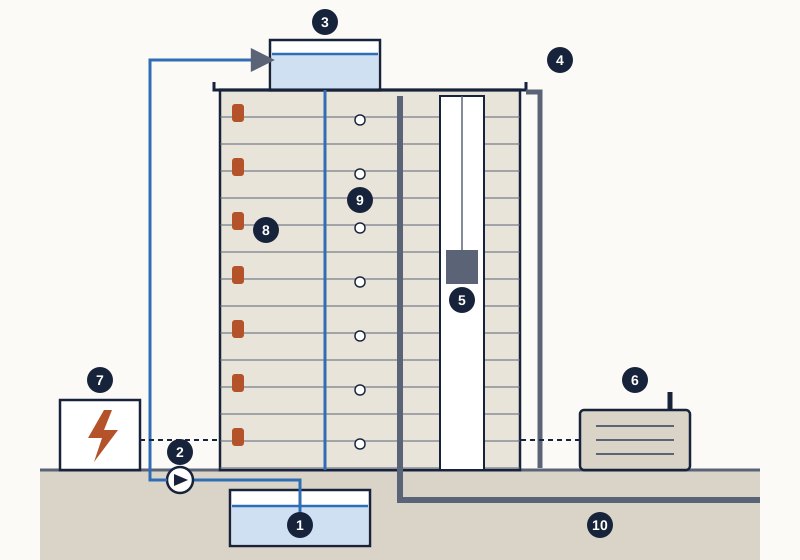
- Underground reservoir
- Water pump
- Roof tank
- Roof surface, outlets and downpipe
- Lift and lift shaft
- Generator
- Electrical room or substation
- Fire equipment on each floor
- Common lighting in stairs and corridors
- Drainage stack and building drain
- Walk the building from the bottom up with the caretaker: reservoir and pump room, electrical room, generator, ground floor, each typical floor, stairs, lift lobbies and machine room, roof and tanks.
- Give each asset a short code and a location, for example a pump number and the room it is in, and photograph its nameplate.
- Record make, model, capacity, year installed (or 'unknown') and who installed or services it.
- Note its present condition in plain words (good, fair, poor, not working) and anything visibly wrong.
- Attach the manual, warranty and contract to the row, or note where the paper copy is kept.
- Mark which assets are safety-critical: lifts, fire equipment, electrical supply, generator, water storage and the roof edge.
| Column | What to record | Why it matters |
|---|---|---|
| Asset and code | Name, number, location | Everyone refers to the same pump or panel |
| Details | Make, model, capacity, year installed | Needed for spare parts, manuals and replacement quotes |
| Condition | Good, fair, poor or not working, with the date seen[11] | Shows what is getting worse year by year |
| Tasks and frequency | What is done, how often, by whom | Turns the register into a schedule |
| Contract and warranty | Contractor, expiry dates, warranty conditions[4] | Avoids gaps in cover and lapsed warranties |
| Expected life and cost | Remaining life and a replacement estimate from a quote[11] | Feeds the long-term reserve fund |
Step 2: set the maintenance schedule, from weekly to once a decade
Do not invent intervals. Take them, in this order, from: the law and any official inspection requirements; the manufacturer's instructions, which the UK Health and Safety Executive (HSE) tells duty-holders to use as the guide for planned maintenance;[7] warranty and service-contract terms; and then the building's own history of failures.
Rules differ by country, and this guide does not set out Bangladeshi requirements for lifts, fire equipment or generators; ask the lift contractor, a fire safety consultant and the relevant authority what applies to your building. Examples from elsewhere show how specific such rules can be. In Great Britain, lifting equipment that carries people must have a thorough examination at least every six months, or to a scheme drawn up by a competent person.[6] In England, high-rise residential buildings need at least monthly checks on firefighting lifts and key fire equipment, and blocks over 11 metres need quarterly checks of communal fire doors and annual checks of flat entrance doors.[8]
Group the tasks into frequency bands so the caretaker and committee can see the year at a glance. PNNL's example checklist for a standby diesel generator, for instance, spreads its tasks across weekly, monthly, six-monthly and annual columns, while stressing that the manufacturer's recommendations come first.[5]
| Band | Typical kind of task | Usually done by |
|---|---|---|
| Daily or weekly | Look, listen and note: pumps running normally, tank levels, lights, leaks, generator panel alarms | Caretaker |
| Monthly | The routine walk-round in the monthly checklist, plus any legal or contract checks set monthly | Caretaker and contractors; committee reviews |
| Quarterly or six-monthly | Contract service visits, and independent examinations where rules require them[6] | Licensed or qualified contractors |
| Annual | Seasonal work such as the pre-monsoon roof inspection and tank cleaning, contract renewals, schedule review | Committee with contractors |
| Long cycle (5–10+ years) | Repainting, re-waterproofing, pump or lift modernisation, major electrical upgrades | Committee, from the reserve fund |
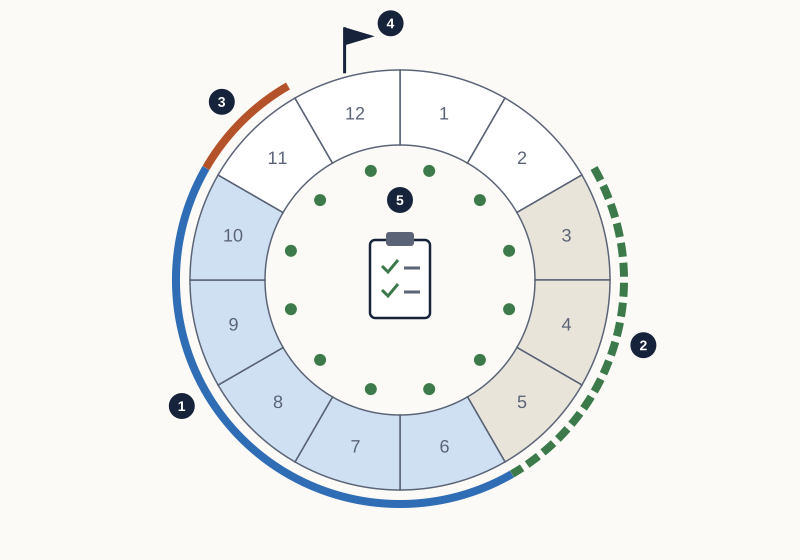
- Monsoon, roughly June to October
- Pre-monsoon work: roof, drains and external sealing
- Post-monsoon review of damp and leaks
- Annual schedule review and budget (shown in December; pick a fixed month)
- Routine monthly tasks, from the monthly checklist
In Dhaka the calendar has one fixed point: the monsoon, roughly June to October. Work that keeps water out, such as clearing roof outlets and drains and renewing external sealing, belongs in the dry months before it, and a damp and leak review belongs straight after it.
Rank by consequence and likelihood
Not everything deserves the same attention. PNNL suggests ranking each item by how critical it is and how likely it is to fail, using failure records where they exist and staff experience where they do not.[3] Items whose failure could hurt someone, or leave the building without water, power or a lift, go to the top. Cheap items whose failure harms nobody, such as a single corridor bulb, can simply be replaced when they fail.[3]
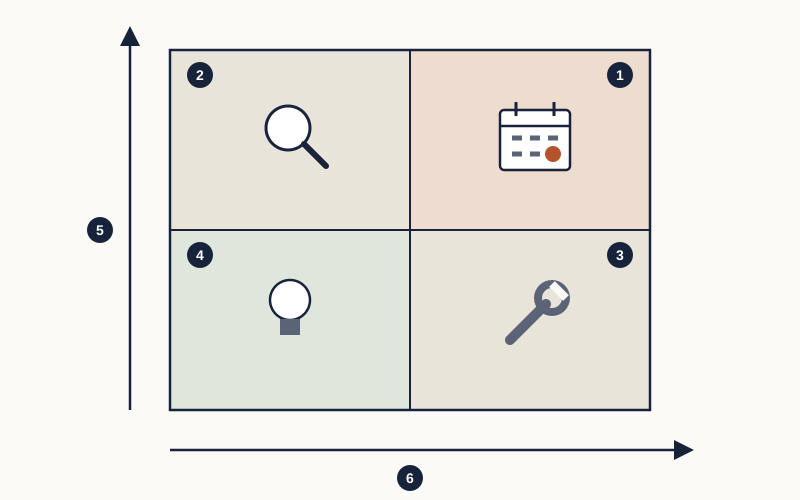
- High consequence, likely: top of the schedule, preventive and condition checks, spares on hand
- High consequence, unlikely: regular inspections and tests as rules and manufacturers require
- Low consequence, likely: simple routine tasks or keep spares
- Low consequence, unlikely, cheap: replace when it fails
- Consequence of failure: safety, residents affected, cost
- Likelihood of failure: age and past history in the records
Step 3: decide who does what: staff, contractors and AMCs
Split every task three ways: what the caretaker can observe and record, what a contractor does under an annual maintenance contract (AMC), and what needs a one-off specialist. HSE's guidance is that maintenance should be done only by people competent for the work, and in most cases with the power isolated first.[7] PNNL likewise says generator maintenance should be carried out by qualified personnel.[5]
For lifts, keep two roles apart. The firm that services a lift is not the right one to give it an independent safety examination: HSE says the examiner should be independent of whoever routinely maintains the equipment, and must give a written report that lists defects.[6]
A good AMC is specific. PNNL notes that most maintenance contracts rest on three elements: a clear scope, objectives and the owner's priorities.[4] Before signing, make sure the contract states:
- Exactly which assets are covered, using the codes in your register, and which are excluded.
- What each visit includes, how often visits happen, and what report the contractor leaves behind.
- Response times for breakdowns, and whether parts and call-outs are included or charged extra.
- Who keeps the warranty valid, since manufacturers may require servicing by an authorised agent.[4]
- That the contractor updates your equipment list when anything is replaced, so the register stays accurate.[4]
Get and compare written quotes the same way you would for a repair; see how to get and compare repair quotes. For electrical work, see when to call a qualified electrician.
Step 4: budget for routine costs and a reserve fund
A schedule without money behind it will not happen. Strata law in New South Wales, Australia, separates two pots, a useful model even where it is not required: an everyday fund for routine costs such as cleaning, utilities and maintenance, and a capital works fund for large, predictable items such as repainting and replacing common property, guided by a 10-year plan that must be reviewed at least every five years.[10] Victoria's rules likewise tie a maintenance fund to a 10-year plan of major capital items.[11]
As a starting benchmark, a US National Research Council figure quoted by PNNL puts suitable annual maintenance and repair spending at 2 to 4 percent of the current replacement value of the buildings concerned.[2] It was written for public-sector building stock and is a rough guide only; your own register and quotes are a better basis.
What drives the cost
- The number and age of assets: older pumps, lifts and generators need more parts and more visits.
- How much is covered by AMCs, and what each contract includes or excludes.
- Access: work at height, scaffolding for external walls, or breaking tiles to reach concealed pipes.
- Timing: emergency call-outs out of hours usually cost more than planned visits.[1]
- Deferral: work that is put off tends to grow into larger replacement work later.
No prices are given here because we found no reliable, dated figures for Bangladesh. Put real quotes into the register, and add the reserve-fund contribution to the service charge so the money builds up year by year instead of arriving as a special collection.
Step 5: keep records that outlive the committee
Records turn a schedule into evidence. PNNL advises logging generator maintenance both to confirm it was done and to give a basis for spotting trends,[5] and HSE expects any maintenance log kept for machinery to be up to date.[7] For each job, record the date, asset code, what was done, who did it, parts used, cost and any defect left open, and attach the contractor's report and photos.
Software helps once the register runs past a few dozen rows. A computerised maintenance management system (CMMS) typically tracks work orders, schedules recurring tasks and analyses history to show failure rates and costs.[2] Repeated work orders on one pump or one stretch of roof are the signal that it needs repair or replacement rather than another service.[4] RUAP's building-management console can hold the register, schedule and complaints in one place, and our guide to running a building with software explains which jobs are worth moving online first.
Share results with residents. England's rules for high-rise residential buildings require monthly fire-equipment check results to be recorded where residents can see them, such as on a notice board.[9] Even where that is not required, it builds trust and makes the service charge easier to collect. For handing records from one committee to the next, see running a building committee.
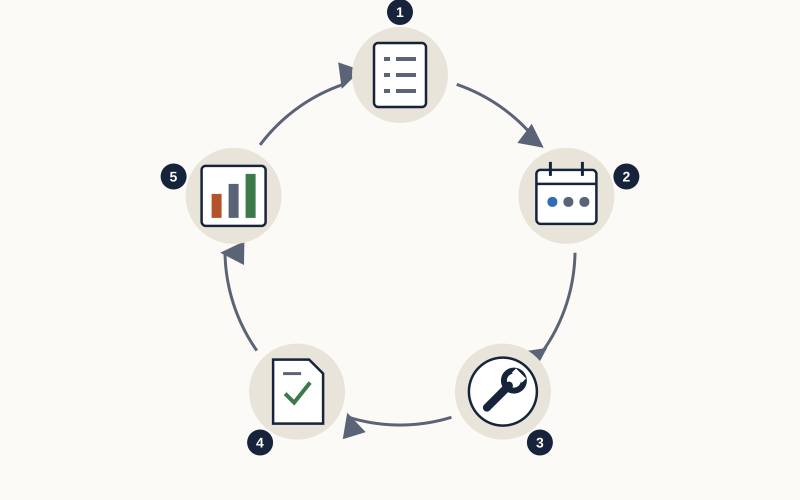
- Asset register
- Schedule with intervals and owners
- Work done by staff or contractors
- Record and report for every job
- Annual review: failures, costs and funds
Step 6: review and adjust the schedule each year
Once a year, before the budget is set, compare the plan with what actually happened. PNNL suggests first estimating how much of the work was reactive and how much was planned,[1] then setting short-term (one-year) and long-term (five- to ten-year) goals.[3]
- Which assets broke down most, and should their tasks be done more often or the item be replaced?
- Which tasks found nothing for years and could be done less often?
- Are contracts, warranties and statutory examinations all current?
- Has the condition column changed, and does the reserve fund still match the 10-year plan?
- Have new assets been added and retired ones removed?[3]
Common mistakes to avoid
- Copying a generic schedule without checking the manufacturers' manuals and your own contracts.
- Scheduling everything: unneeded tasks waste labour and can even damage components.[1]
- Signing an AMC without a list of covered assets or a duty to leave a report after each visit.
- Letting the lift maintainer be the only one who judges whether the lift is safe.[6]
- Keeping records in one person's notebook or phone, so they leave when that person does.
- Budgeting only for this year and leaving roof, lift or pump replacement to a sudden special levy.
- Treating the plan as finished; it needs reviewing every year.
When to call a professional or engineer
Bring in a qualified professional whenever the committee cannot judge condition safely or confidently:
- A condition survey of the structure, roof and external walls before drawing up the 10-year plan, or after an earthquake; see wall cracks for the signs that need an engineer.
- Any work on lifts, the generator, the substation or distribution boards, and fire detection or firefighting systems.
- Repeated failures that suggest a design or installation problem rather than ordinary wear.[4]
- A defect found at an inspection that makes equipment unsafe; under HSE rules, lifting equipment with such a defect must not be used until it is fixed.[6]
- Name a coordinator and agree who approves spending.
- Collect drawings, manuals, warranties, contracts and past reports.
- Walk the building and complete the asset register with codes, details and condition.
- Mark safety-critical assets and rank the rest by consequence and likelihood.[3]
- Give every task a frequency, an owner and a source (law, manufacturer, contract or history).
- Review or tender AMCs with a clear scope and a reporting duty.[4]
- Set the annual budget and a reserve contribution tied to a 10-year plan.[10]
- Choose one place for the register and log, and share results with residents.
- Put the annual review date in the calendar.
Next steps
- This month: appoint a coordinator and gather every document you can find.
- Within two months: finish the walk-round and the first version of the asset register.
- Then: draft the frequency table and adopt the monthly checklist for the caretaker.
- Before the dry season ends: book the pre-monsoon roof and drain work.
- At the next annual general meeting (AGM): present the plan, the budget and the proposed reserve contribution for approval.
Common questions
- What is the difference between a preventive maintenance schedule and a monthly checklist?
- The schedule is the whole plan: every asset, every task at every interval from weekly to once a decade, who does it and how it is funded. The monthly checklist is one slice of it, the caretaker's routine walk-round. See the monthly building maintenance checklist.
- How often should a lift be serviced?
- Follow the lift manufacturer's instructions, your maintenance contract and the rules that apply where you are. As one example, Great Britain requires lifts that carry people to have a thorough examination at least every six months by an independent competent person, separate from routine servicing.[6] Ask your lift contractor to confirm in writing what applies in Bangladesh.
- How much should we put into a reserve fund?
- Work it out from your register: list the major items, their remaining life and a replacement quote, then spread each cost over the years left until replacement. New South Wales[10] and Victoria[11] both base this on a 10-year plan of major works.
- Can the caretaker do the maintenance?
- The caretaker can observe, clean, record and report, and switch off at the breaker in an emergency. The maintenance itself should be done by people competent for that specific equipment.[7]
Sources
The facts in this guide were checked against these sources.
- O&M Best Practice Issue Discussion: Maintenance Approaches — Pacific Northwest National Laboratory (PNNL), for the US Department of Energy Federal Energy Management Program (published July 2021). accessed 18 October 2026.
- Comprehensive O&M Program — Pacific Northwest National Laboratory (PNNL) (published May 2022). accessed 18 October 2026.
- Prioritizing O&M Actions — Pacific Northwest National Laboratory (PNNL) (published December 2020). accessed 18 October 2026.
- O&M Contract Challenges and Improvements — Pacific Northwest National Laboratory (PNNL). accessed 18 October 2026.
- Best Practices for Standby Generator Operations and Maintenance — Pacific Northwest National Laboratory (PNNL) (published July 2021). accessed 18 October 2026.
- Thorough examinations and inspections of lifting equipment — Health and Safety Executive (HSE), UK. accessed 18 October 2026.
- Maintenance of work equipment — Health and Safety Executive (HSE), UK. accessed 18 October 2026.
- Fire Safety (England) Regulations 2022 — GOV.UK (Home Office) (published 2022-05-18 (updated 2023-07-24)). accessed 18 October 2026.
- Fact sheet: Lifts and essential fire-fighting equipment (regulation 7) — GOV.UK (Home Office) (published 2023-07-24 (updated)). accessed 18 October 2026.
- Your strata levies, finances and insurance — NSW Government, Australia (published Last updated 22 June 2026). accessed 18 October 2026.
- Owners corporation maintenance plan — Consumer Affairs Victoria, Australia (published Last updated 13 May 2026). accessed 18 October 2026.
This guide is general information. Have gas, structural and live electrical work done by a qualified, licensed professional. Your building’s rules and committee decisions take precedence over anything written here.
Written from the cited sources by the RUAP.NET editorial team. It has not been reviewed by a licensed engineer, plumber or electrician; for work on gas, structure or live electrics, use a qualified professional.
Spotted a mistake? Tell us — we check it, correct the guide and record the date of the correction. Report an error →
Related guides
Guides: Running the committee · Guides: Digital management