
Damp Walls and Seepage: Find the Cause Before You Treat It
A damp patch, bubbling paint or white powder on a wall can come from rain, humid air, a hidden pipe or, on the ground floor, the soil. This guide shows how to tell which one you have and how to stop it.
Damp has four common causes: rain getting in through the outside wall, windows or roof (penetrating damp); moist indoor air turning to water on cold surfaces (condensation); a leaking pipe; and, only at ground level, moisture rising from the ground.[1] Each needs a different fix, so diagnose first.
The clues are where and when: a patch by an outside wall or window that grows after rain suggests seepage; mould in cold corners suggests condensation; a patch that stays wet in dry weather suggests a pipe.[5]
Paint cannot stop water: fix the source, let the wall dry, repair the plaster, then repaint.[5] Outside walls and roofs are work for the building committee and trained workers, not for a resident leaning out of a window.
Most of this can be done yourself with ordinary tools.
In Dhaka, damp walls usually appear in the monsoon (roughly June to October), when heavy rain and high humidity arrive together. Repainting rarely lasts: the wall is wet because water is reaching it, and until that water stops, no finish will hold.
The four kinds of damp and why the difference matters
UK government health guidance groups household damp into condensation, penetrating damp (water coming in from outside), rising damp (from the ground) and traumatic damp, meaning water from leaking pipes, overflows or flooding.[1] The same peeling paint can come from any of them, and the right fix for one can be useless for another.
Penetrating damp: rain getting in
Wind-driven rain gets in through cracks in the outer plaster, gaps round window frames and defects at the roof and parapet. Asian Paints also lists terrace leaks and ageing waterproofing among the usual causes of seepage.[5] Scottish Government guidance adds blocked or broken gutters and downpipes, and notes that this kind of damp may follow no consistent pattern.[2] Water can travel inside the wall, so the stain is not always opposite the point of entry.[5]
Condensation: moisture from the air
Warm, humid air leaves water on any colder surface, just as a cold bottle sweats on a hot day.[4] Cooking, showering and drying clothes indoors add moisture, and UK guidance calls condensation the most common form of damp.[1] It gathers on cold spots: corners behind wardrobes and beds, uninsulated air-conditioning ducts and cold-water pipes.[4] It usually shows as small black mould spots rather than one wet patch.
Plumbing leaks: water from inside the wall
A concealed pipe, a shower mixer or a bathroom with failed waterproofing can keep the next wall wet for weeks with no visible drip.[5] The US Environmental Protection Agency (EPA) notes that hidden mould often grows inside walls around pipe chases.[4] Our guide to bathroom water leaks shows how to trace such a leak.
Rising damp: ground floor only
Rising damp is ground moisture drawn up into walls. Scottish Government guidance says it is unlikely to rise above about 1.2 m and affects only ground-floor walls and floors; damp higher up has another cause.[2] In a 14-storey block, a damp wall on the fifth floor is never rising damp.
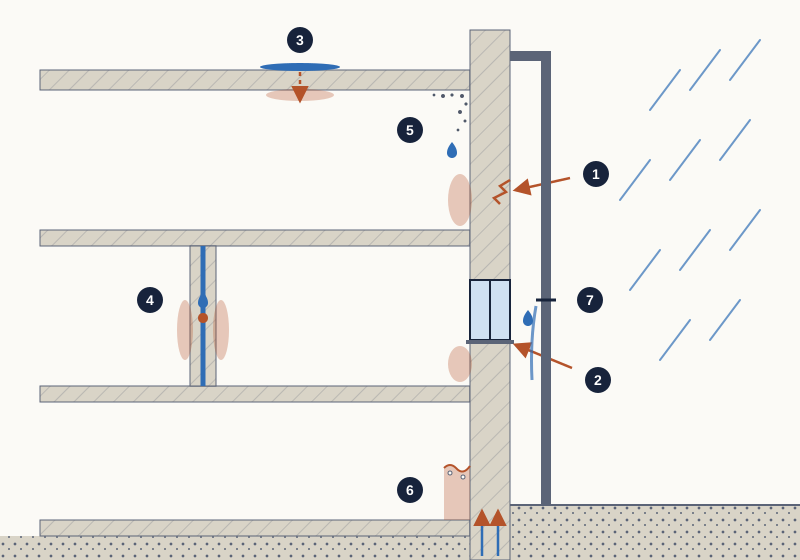
- Rain driven through a crack in the outer plaster, leaving a patch on the inside face
- Gap at the joint between the window frame and the wall, with a stain below the window inside
- Water ponding on the roof soaks through the slab and stains the top-floor ceiling
- Leak from a pipe hidden in an internal wall, wetting both faces of the wall
- Condensation and mould spots in the cold corner where the outside wall meets the ceiling
- Ground moisture rising into the ground-floor wall (rising damp), with a tide mark and salts near the floor
- Leaking joint in a rainwater downpipe, which keeps the outside wall wet
Signs and symptoms: what the stain tells you
Note each sign you see, with the date and the weather:
- Yellow, brown or irregular patches, which may grow after rain.[5]
- Paint that bubbles, blisters, peels or flakes, and plaster that turns soft or powdery.[5]
- White, powdery or crystal deposits (efflorescence): salts carried out of the masonry by water and left behind as it dries.[5]
- Black or grey mould spots, often in corners, on window reveals and behind furniture.
- A musty smell. Mould can grow hidden behind surfaces, so a smell with nothing visible may still mean a problem.[1]
- Water droplets on glass, walls or pipes, a sign of high indoor humidity.[3]
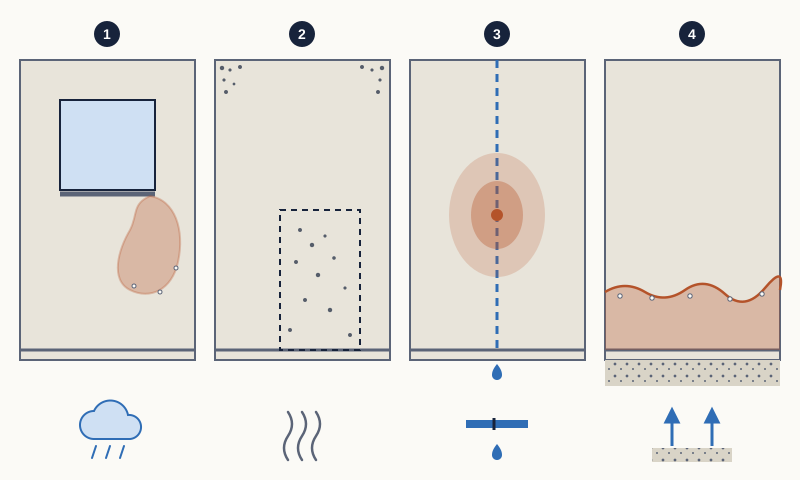
- Rain seepage: a patch spreading down from a window corner, with salts at its edge; grows after rain
- Condensation: mould spots scattered in the upper corners and behind a wardrobe (dashed outline)
- Plumbing leak: a round patch centred on one point of a pipe inside the wall (dashed line), growing even in dry weather
- Rising damp: a wavy tide mark with salts at the base of a ground-floor wall only
| Type | Where it shows | When it is worse | Typical look |
|---|---|---|---|
| Penetrating (rain) damp | Outside walls, round windows, top-floor ceilings, below verandas | During and after heavy rain; fades in dry spells | Distinct wet patch, tide lines, salts; spreads from one area[2] |
| Condensation | Cold corners, behind furniture, beside windows, bathrooms and kitchens | Humid days, closed-up rooms, after cooking or showers | Mould spots, droplets, no single source[4] |
| Plumbing leak | Along a pipe route, next to or below a bathroom or kitchen | All year, even in dry weather; sometimes after a fitting is used | Patch that keeps growing from one point; may drip below[5] |
| Rising damp | The lowest metre or so of ground-floor walls only | Fairly constant through the year | Horizontal tide mark, salts, crumbling plaster near the floor[2] |
Tools and materials you will need
Diagnosing damp needs observation more than equipment. A basic kit:
- A phone camera, a pencil to mark and date the edge of each patch, and a notebook for rain and changes.
- A torch for looking along walls, under window sills and inside wardrobes.
- An inexpensive digital hygrometer (humidity gauge); EPA says indoor relative humidity should stay below 60%, ideally 30–50%.[3]
- For mould: gloves, a mask, a mould cleaning product and cloths.[1]
- Later: crack filler, primer and paint, chosen once the cause is fixed.[6]
A handheld moisture meter can help, but treat its numbers with care: in masonry most meters give relative readings, and salts in the wall can push readings up even where it is fairly dry.[8] Use one to compare spots over time, not to justify an expensive treatment.
Step by step: work out which damp you have
Allow two to four weeks, ideally including some rain:
- Make it safe: if the damp is near a socket, switch or light, switch that circuit off at the breaker and do not touch it.
- Photograph each patch and mark its edge in pencil with the date, so you can see whether it grows.[1]
- Note where it is: outside wall, window, under the roof or a veranda, beside a bathroom or kitchen, low on a ground-floor wall, or a cold corner.
- Check the timing. A patch that appears or grows within a day or two of heavy rain points to rain getting in; one that stays wet through a dry week points to a pipe.[5]
- Look outside from a safe place (window, veranda or ground) for cracks in the outer plaster, gaps round window frames and blocked rainwater pipes. Do not lean out or climb.
- Measure room humidity morning and evening for a few days. Readings often above 60%, with droplets on glass and mould in corners, point to condensation.[3]
- Rule out plumbing: does the patch grow after a nearby bathroom is used? Do a meter check with every tap off, as in how to inspect water supply pipes.
- On the top floor or below a terrace, ask the building committee to check the roof; see how to inspect a flat roof before the monsoon.

- Start: switch off any wet electrics at the breaker, photograph the patch and mark its edge with the date
- Does the patch appear or grow within a day or two of heavy rain, and fade in dry weather?
- Probably rain seepage: ask the building committee to check the outside wall, window joints and roof
- Does it stay wet in dry weather, or sit along a pipe route or beside a bathroom or kitchen?
- Probably a plumbing leak: do a meter check and call a plumber
- Is there mould in cold corners or behind furniture, with humidity often above 60%?
- Probably condensation: improve ventilation, reduce humidity and move furniture off the wall
- Is it on the ground floor and low on the wall?
- Possibly rising damp: get an independent survey before paying for any treatment
- Cause unclear or more than one cause: get a professional diagnosis
Treatment for each cause
Rain seepage through walls and windows
Stop the water at the outside face. Cracks in the external plaster are filled, and walls exposed to driving rain may then need a protective or waterproof exterior coating.[5] Asian Paints describes elastomeric (flexible) coatings that bridge hairline cracks, and stresses the joints round window frames and the base of parapets.[6] Berger likewise advises sealing gaps round windows and keeping rainwater pipes clear.[7] Outside walls are usually shared property, so the building committee normally arranges this work. For window seals see doors, windows and their fittings; judge any crack wider than a hairline first with our wall cracks guide.
Condensation
- Run the bathroom and kitchen exhaust fans during and after showers and cooking, and keep the door shut so moist air does not spread.[1]
- Leave a gap between furniture and outside walls so air can move behind it.[1]
- Dry clothes outdoors or on the veranda where you can.[1]
- Use the air conditioner or a dehumidifier to bring humidity down when needed, and keep AC drip pans and drain lines clear.[3]
- Clean small areas of mould and dry them before redecorating; see how to prevent mould in bathrooms.[3]
Plumbing leaks
No coating can cure a leaking pipe; the pipe has to be repaired or replaced.[5] EPA advises drying wet materials within 24–48 hours to prevent mould; a soaked wall rarely dries that fast, so keep air moving and wait before repairing plaster and paint.[3] If a neighbour's bathroom is the source, agree a plan in writing; our flat maintenance guide covers who is responsible for what.
Rising damp on ground-floor walls
First rule out rain splash, blocked drains, leaking pipes and condensation, which are more common. Typical causes are a missing or damaged damp-proof course (a water-resistant layer near the base of the wall) or soil and paving built up against the wall.[2] Injected damp-proof courses and similar treatments are specialist work; get an independent diagnosis before paying.
Why painting over damp fails
Fresh paint can hide a stain for a few weeks, but it cannot stop water entering the wall, so it soon bubbles or peels again.[5] Water moving through plaster also carries salts that crystallise under the paint and push it off.[6] EPA warns against painting over mould without cleaning and drying it first.[3] A dense waterproof coat on the inside face can even trap moisture; EPA notes that a vapour barrier in the wrong place can stop damp materials drying.[4]
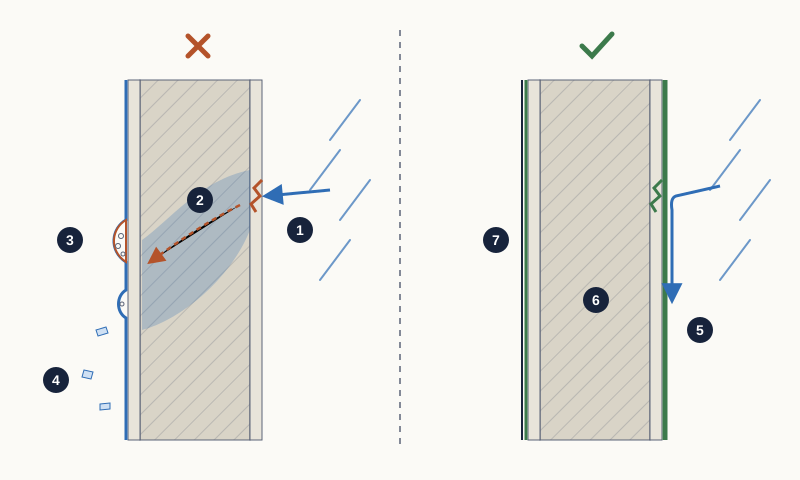
- Rain entering through a crack in the outer plaster
- Water and dissolved salts moving through the wall towards the inside face
- New paint blistering as water and salts collect behind it
- Flakes of paint falling away, so the wall needs repainting again
- Crack filled and a protective outside coating applied, so rain runs off the face
- The wall has dried out, with no water moving through it
- Primer and paint on a dry surface, which stay intact
The order that lasts:
- Find and fix the source: the crack, window joint, roof defect, pipe or ventilation problem.[5]
- Let the wall dry out. After a long soaking this can take weeks; fans and open windows help on inside walls.[6]
- Brush off loose salts and flaking paint, and clean off any mould.
- Repair cracks and damaged plaster, and let the filler cure fully.[6]
- Apply a suitable primer, then the finish coat; see repainting walls and ceilings.[7]
- Check again after the next heavy rain; UK guidance suggests re-inspecting at least six weeks after remedial work.[1]
Prevention: a routine before and after the monsoon
Asian Paints recommends inspecting waterproofed areas before and after the monsoon, fixing small cracks and plumbing faults early and keeping terrace drains clear.[5] Berger suggests crack repairs and exterior repainting before the rains.[7] A simple routine:
- Before the monsoon: report cracks in the outside plaster, gaps round window frames and blocked rainwater pipes to the building committee.
- Before the monsoon: clear the drainage holes in sliding-window tracks so water does not overflow indoors.
- Every month: check the humidity in bedrooms and aim to keep it below 60%.[3]
- Every month: look behind wardrobes and beds that stand against outside walls for mould spots.
- After heavy storms: check rooms on outside walls, the walls beside windows and top-floor ceilings for new patches.
- After the monsoon: photograph old stains again and plan repairs for the dry season, when walls can dry out.
Liquid waterproofing membranes need roughly one to two weeks of dry weather to cure, so plan roof and outside-wall work for the dry months.[6] Committees can add these items to a monthly building maintenance checklist.
Common mistakes and troubleshooting
- Repainting, or applying a 'damp-proof' paint inside, before the source is found. The stain returns and the evidence is gone.[5]
- Treating every damp patch as rising damp. Above the ground floor, it cannot be.[2]
- Trusting one moisture-meter reading; salts and metal fixings can raise readings on their own.[8]
- Shutting rooms tight against the humidity, then drying clothes indoors.
- Filling a crack that keeps reopening. Filling it without knowing why it formed may only be a temporary fix.[5]
- If damp returns after a repair, note when: after rain (the outside fix failed), in dry weather (a pipe) or in humid, closed-up weather (condensation).
When to call a professional
Asian Paints advises an expert assessment when seepage keeps coming back, appears in several places or has no clear source.[5] Get help when:
- The patch grows in dry weather, or water drips: call a plumber.
- Water is near wiring or the distribution board: switch off and call an electrician.
- The damp comes with a crack that is widening, diagonal or at a beam or column: see which wall cracks need a professional inspection.
- The source is the roof, a parapet or the outside wall: the committee needs a waterproofing contractor with safe access.
- Mould covers more than about 10 square feet (about 1 m²): EPA points to professional guidance for larger areas.[3]
- A ground-floor flat is offered an injected damp-proof course: first get an independent diagnosis using more than one measuring method.[8]
What drives the cost of damp repairs
We could not find reliable published prices for damp repairs in Bangladesh, so this guide gives none. The cost depends mainly on:
- The cause: clearing a rainwater pipe or resealing a window joint costs far less than renewing waterproofing on a facade or terrace.
- Access: outside-wall work above the ground floor needs scaffolding, a cradle or rope access, which can cost more than the repair.
- Concealed pipes: reaching a leak inside a wall means breaking and replacing plaster or tiles.
- Damage: plaster that has gone soft must be cut out and replaced before painting.
- Products and warranty: ask which product, how many coats and what warranty.
Ask for written quotes that name the cause, method, materials and warranty, and compare at least two; see how to get and compare repair quotes.
Next steps
- Today: make any wet electrics safe at the breaker, photograph the patch and mark its edge with the date.
- This week: record the humidity, the weather and the use of nearby bathrooms.
- Fix what you can inside the flat: ventilation, furniture placement, a leaking fitting.
- Report outside-wall, window-surround and roof problems to the building committee in writing, with photos.
- Repaint only after the source is fixed and the wall is dry, and check again after the next heavy rain.
Common questions
- Will waterproof or anti-damp paint on the inside wall fix seepage?
- Not on its own. Paint cannot stop water that is still entering the wall, so it will bubble or peel again.[5] An inside coating can help only once the outside defect or pipe is fixed and the wall has dried; the real fix is at the source.
- My flat is on the ninth floor. Can I have rising damp?
- No. Rising damp comes from the ground and affects only ground-floor walls and floors; damp higher up has another cause.[2] Look for rain seepage, a pipe leak or condensation instead.
- What is the white powder on my wall?
- Usually efflorescence: salts carried out of brick, plaster or cement by water and left on the surface as it dries.[5] It means water is moving through the wall, so brush it off dry and find the source before repainting.
- Is mould from damp walls dangerous?
- It can be. UK health guidance says damp and mould mainly affect the airways and lungs and can trigger or worsen asthma, and that children, older people and people with lung conditions or weak immune systems are most at risk.[1] Clean small areas promptly and fix the cause.
Sources
The facts in this guide were checked against these sources.
- Understanding and addressing the health risks of damp and mould in the home — Office for Health Improvement and Disparities and UK Health Security Agency (GOV.UK) (published Last updated 1 April 2026). accessed 18 October 2026.
- Repairing Standard: statutory guidance for private landlords — Annex B: To ensure the house is wind and water tight and in all other respects reasonably fit for human habitation — Scottish Government (published 31 January 2024). accessed 18 October 2026.
- A Brief Guide to Mold, Moisture and Your Home — US Environmental Protection Agency (published Last updated 18 February 2026). accessed 18 October 2026.
- Mold Course Chapter 2: Why and Where Mold Grows — US Environmental Protection Agency (published Last updated 1 December 2025). accessed 18 October 2026.
- Seepage Meaning Explained: Causes, Signs, Effects and How to Stop Wall Seepage — Asian Paints. accessed 18 October 2026.
- Why Waterproofing is the First Step Before Wall Painting — Asian Paints. accessed 18 October 2026.
- How To Prevent Wall Seepage During The Monsoon — Berger Paints India (published September 2023). accessed 18 October 2026.
- Measuring moisture in masonry — The Building Conservation Directory 2024 (Cathedral Communications) (published 2024). accessed 18 October 2026.
This guide is general information. Have gas, structural and live electrical work done by a qualified, licensed professional. Your building’s rules and committee decisions take precedence over anything written here.
Written from the cited sources by the RUAP.NET editorial team. It has not been reviewed by a licensed engineer, plumber or electrician; for work on gas, structure or live electrics, use a qualified professional.
Spotted a mistake? Tell us — we check it, correct the guide and record the date of the correction. Report an error →