
Blocked Drains in Flats: How to Find the Blockage and Clear It Safely
A sink that empties slowly, a flooded shower floor or water rising out of a floor trap when someone upstairs flushes all mean a drain is blocked. This guide shows how to find the blockage, clear what you safely can, and spot when the building's shared pipes are at fault.
Most blockages in a flat sit close to the fitting: grease and food in the kitchen sink trap, hair and soap in a basin or floor trap, or wipes in a toilet. Start with the simplest physical method: clean the strainer or grating, then plunge, then open and clean the trap.[1][9]
If only one fitting is slow, the blockage is almost always in that fitting or its branch pipe. If several fittings back up together, or dirty water appears in a lower flat, the shared vertical pipe (the stack) may be blocked; stop using water and tell the caretaker or committee.[3]
Treat chemical drain cleaners as a last resort: they can burn skin and eyes, damage plastic pipe joints and react dangerously when mixed.[8] Call a plumber when plunging and cleaning the trap fail, when a toilet stays blocked, or when sewage is involved.
Most of this can be done yourself with ordinary tools.
How drainage works in a flat and in a tall building
Every sink, basin, shower floor and toilet has a trap: a bend or chamber that holds a little water to keep sewer air out of the room. A short branch pipe runs from the trap, under the floor or inside a wall, to a vertical stack that collects waste water from every floor. A vent pipe continues the stack up through the roof to let air in, and at ground level the stacks join a building drain with inspection chambers (manholes) that leads to the public sewer or a septic tank.
Singapore's Housing & Development Board (HDB) puts the usual split plainly: residents maintain the sanitary branch pipes in their flat, and the Town Council maintains the main sanitary pipes.[3] Check your own building's rules, but the logic usually holds: what serves only your flat is yours, and the shared stack and building drain belong to everyone.
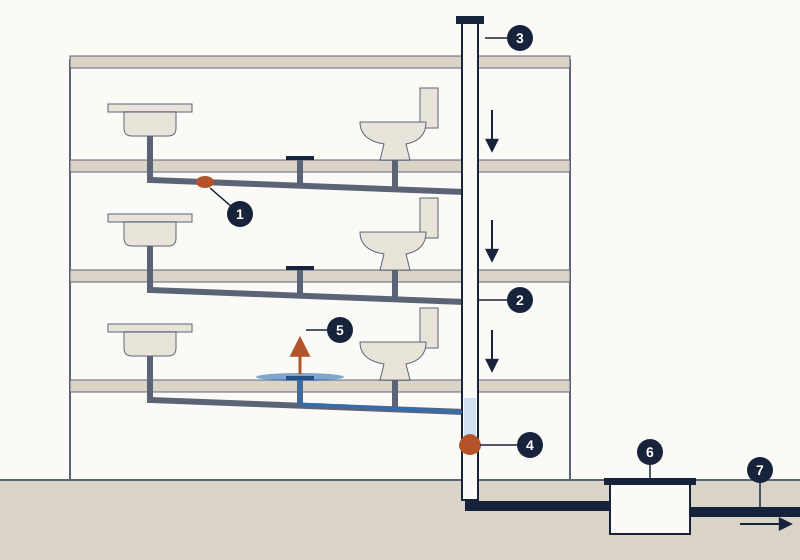
- Branch pipe from one flat's fittings to the stack: a blockage here affects only that flat
- Vertical stack shared by every flat on that line
- Vent pipe open above the roof, letting air in so that water flows freely
- Blockage near the base of the stack
- Waste water from the floors above backs up and comes out of the lowest floor trap first
- Inspection chamber (manhole) at ground level, where plumbers rod the drain
- Building drain to the public sewer or septic tank
This gives the most useful rule for diagnosis: a blockage in a branch affects only that branch's fittings, while one low in a stack affects everyone above it, and the overflow appears at the lowest open fitting above the blockage, often a floor trap in a ground- or first-floor flat.
Warning signs and common causes
Drains rarely block overnight. Watch for these early signs:
- Water draining more slowly than usual from a sink, basin or shower floor.
- A glugging or gurgling sound as water goes down, a sign that air is struggling to get through the pipe.[1]
- An unpleasant smell from a plughole or floor trap; if smell is the main problem, see how to find and fix drain odours.
- Water rising in the floor trap or shower area when a nearby basin, washing machine or toilet is used.
- The toilet bowl filling higher than normal after a flush and emptying slowly.
- Dirty water appearing in a floor trap or around a toilet when nobody in your flat is using water, which points to a shared pipe.
Kitchen sinks: grease and food
Fats, oils and grease (often shortened to FOG) from cooking are liquid when hot but harden as they cool inside the pipe, building up until it blocks. Northumbrian Water, a UK water company, warns that boiling water poured after them does not help: the fat simply sets further down the pipe, where it can affect neighbours too.[5] Which?, the UK consumer organisation, adds that coffee grounds clump into hard blockages.[1]
Basins, showers and floor traps: hair and soap
Long hair is a common cause of blocked bathroom drains, according to the bathroom manufacturer Geberit, and soap and dirt residue add to it.[4] HDB says solid matter and grease are what choke floor traps, and advises keeping the grating in place to keep hair and other solids out.[2] Where the whole bathroom floor drains to one trap, as in many Bangladeshi flats, bucket water, mop water and sand all reach it; Hong Kong's Building Rehab Platform names rubbish and sand at bends and traps as a cause of blocked building drains.[10]
Toilets: anything other than toilet paper
Wet wipes, sanitary pads, nappies, cotton buds and kitchen roll do not break down like toilet paper. Which? passes on the advice of Severn Trent, a UK water company, to flush only pee, poo and toilet paper and put everything else in the bin.[1] A weak or incomplete flush can look like a blockage; if the bowl empties normally but refills slowly or leaves waste behind, read toilet flushing problems instead.
One fitting or the whole stack? Find where the blockage is
Before you pick up a tool, spend two minutes working out where the blockage probably is. The answer decides whether this is your job, a plumber's or the building committee's.
| What you see | Likely location | Who should act |
|---|---|---|
| One sink or basin drains slowly; everything else is normal | Strainer, trap or the first metre of the branch pipe | You; a plumber if it persists |
| Shower area floods; basin and toilet are fine | Floor trap grating, hair catcher or trap body[2] | You |
| Toilet bowl rises after a flush; other fittings are normal | Toilet outlet or the pipe just beyond it | You (plunger), then a plumber |
| Floor trap bubbles or rises when the toilet or basin is used | Shared branch pipe under the bathroom floor | Plumber |
| Several fittings in different rooms are slow at once | Your flat's branch near the stack, or the stack itself | Plumber; tell the caretaker |
| Dirty water comes up in your floor trap when you are not using water | Stack blocked below your floor; waste from upstairs is backing up | Caretaker or committee, urgently |
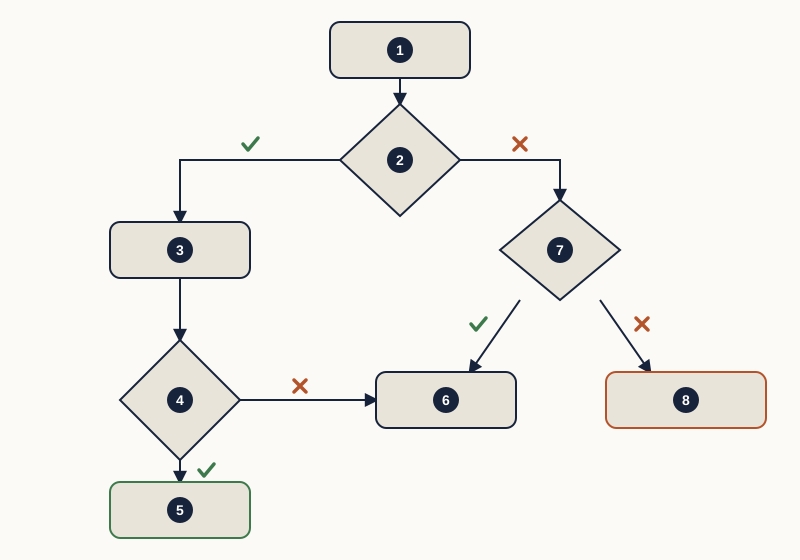
- Water drains slowly or backs up
- Is only one fitting affected?
- Clear it yourself: strainer or grating, plunger, trap, then a hand auger
- Does it now drain normally?
- Solved: fit strainers and follow the prevention routine
- Call a plumber
- Is the problem only in your flat, and in no other flat?
- The stack or building drain may be blocked: stop using water and tell the caretaker and committee
Tools and materials
A small kit kept in one bag handles most blockages in a flat:
- Rubber gloves (not cotton, which soaks up chemicals[8]), safety glasses and old towels.
- Two plungers: a cup plunger for sinks, basins and floor traps, and a flanged (bell-shaped) toilet plunger, kept separate for hygiene.[1]
- A bucket and an old toothbrush or bottle brush for cleaning traps.
- An adjustable spanner, used gently, for stiff trap nuts.
- Long tweezers or a plastic hair-removal strip for floor traps and shower drains.[4]
- A hand drain auger (snake) for sinks and floor traps, and a separate toilet auger for the WC.[6]
Step by step: clearing a blocked fitting
Work from the gentlest method to the strongest, and test with a little water after each step. If water starts coming up somewhere else, stop.
Kitchen sink or wash basin
- Stop running water into it. If the sink is full, bail the water into a bucket.[1]
- Lift out the plug strainer and remove any food or hair you can reach.
- If the basin has an overflow hole, press a damp cloth over it so the plunger's pressure goes down the drain instead of out of the hole.
- Leave enough water in the bowl to cover the plunger cup, press the cup over the plughole to make a seal and plunge firmly several times.[1]
- If the water still will not go down, put a bucket under the trap, unscrew the trap's nuts by hand or gently with a spanner, empty it and scrub out the grease and debris.[1]
- Refit the trap firmly, without forcing plastic threads, then run water and check the joints for drips.[1]
- If the trap was clean, the blockage is further along the branch: feed a hand auger into the pipe, turning it as you go, then withdraw it slowly. If that fails, call a plumber.[9]
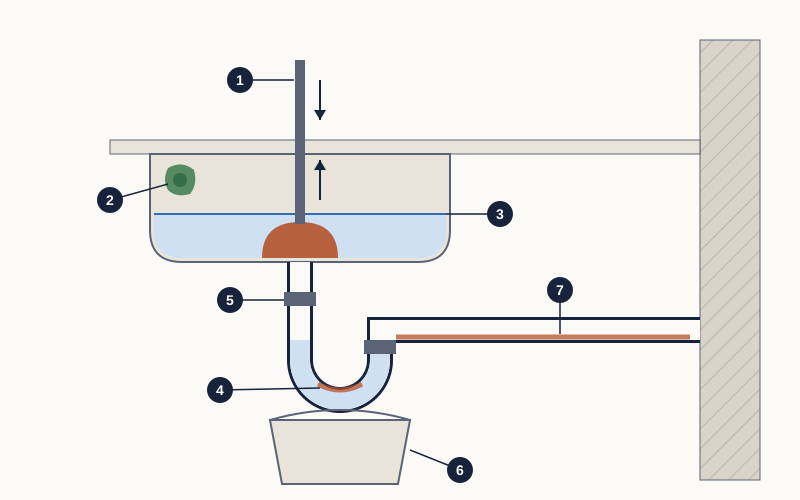
- Cup plunger, pressed down and pulled up firmly
- Overflow hole, sealed with a damp cloth
- Enough water to cover the plunger cup
- The trap's water seal, where grease and debris collect
- Slip nuts: undo by hand or gently with a spanner to remove the trap
- Bucket placed under the trap before it is opened
- Grease lining the waste pipe to the wall, where a hand auger may be needed
Bathroom floor trap or shower drain
- Lift off the grating and any hair catcher or basket under it, and clean them over a bin, not back into the drain.
- Pull hair and sludge out of the trap with gloved fingers or long tweezers; Geberit recommends tweezers so you do not damage the trap or pipe.[4]
- Pour in about half a litre of hot tap water, not boiling. If it does not drain, plunge it, leaving a little water to make a seal.[1]
- If it is still slow, the sediment may be below the trap's water seal. A hand auger can reach it; for serious chokes HDB advises engaging a licensed plumber.[2]
- Refit the grating and hair catcher, and keep the grating closed from now on.[2]
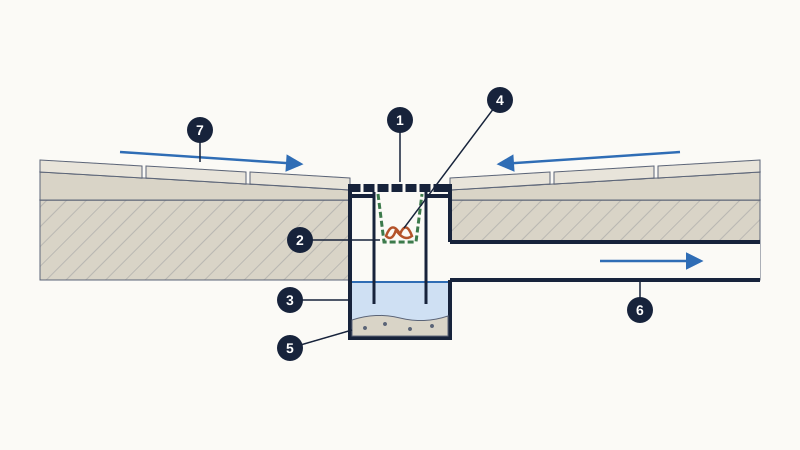
- Grating: keep it in place at all times
- Removable hair catcher or basket
- Water seal that keeps sewer air out of the room
- Clump of hair and soap, a common cause of bathroom blockages
- Sand and sediment settled at the bottom of the trap
- Outlet to the branch pipe leading to the stack
- Floor tiles laid to slope towards the trap
Toilet
- Do not flush again to test it; each flush adds water that may overflow. If the bowl is rising while the cistern refills, close the cistern's angle valve.
- Put on gloves, lay old towels round the base and, if the water is high, wait for it to drop a little before you start.[6]
- Fit the flanged plunger into the outlet, fully under water, press down and give several firm pumps; if the bowl starts to drain slowly, keep going until it clears.[6]
- If plunging fails, push a toilet auger into the outlet until it meets resistance, then turn the handle to break up or pull back the blockage.[6]
- Flush once to test. If it still drains slowly, there may be a partial blockage further down the pipe; call a plumber.[6]
Chemical drain cleaners: a last resort, used carefully
Most shop-bought drain cleaners are strong alkalis such as sodium hydroxide (caustic soda), oxidisers, or strong acids such as sulphuric acid; enzyme products use bacteria and enzymes instead.[7] Testing 17 products, Hong Kong's Consumer Council found strong alkalis worked best on kitchen grease and oxidisers on hair, the strong-acid product was for professional use only, enzyme products were far slower, and several oxidisers were unsuitable for toilets.[8]
The risks are real. The Swedish Chemicals Agency (KEMI) says caustic drain cleaners can quickly cause serious, permanent burns to eyes and skin; it advises trying by hand, with a plunger or with a drain cable first, choosing a non-corrosive product if you use one at all, and avoiding corrosive products in homes with young children.[9] The Consumer Council adds that the heat of the reaction can deform plastic pipes and joints and cause leaks.[8] Baking soda and vinegar are unlikely to clear a real clog; US Poison Control says the gas they make is unlikely to build enough pressure.[7]
If you decide to use one:
- Read the label and follow it exactly, including whether the product suits toilets and your pipe material.[8]
- Wear rubber gloves and eye protection, open a window, and remove standing water first unless the label says otherwise.[8]
- Pour slowly and close to the plughole. Splash-back is most likely when the product is poured from a height or into a fully blocked drain.[7]
- Use one product at a time, and rinse the pipe thoroughly with water before trying anything else.[8]
- Store it in its original container, away from food and out of children's reach; some sachets look like sugar or salt.[8]
When the shared stack or building drain is blocked
A blocked stack is not a job for one flat owner with a plunger. The waste comes from many flats, the blockage is often several floors down, and clearing it may mean opening access points on the stack or the inspection chambers at ground level. It is work for a plumber or drainage contractor appointed by the committee or management.
- Caretaker: note which flats and floors are affected and since when, to narrow down the blocked section.
- Committee: ask everyone on the affected line to stop using water, then call the building's plumber or drainage contractor.
- Contractor: expect them to clear the line from an access point or inspection chamber with drain rods or a powered machine; drain specialists may also use a CCTV camera or high-pressure water jetting.[1]
- Afterwards: ask for a written note of where the blockage was and what caused it.
- Old buildings with repeated problems: Hong Kong's Building Rehab Platform suggests having a building professional assess whether replacing the common drains would be cheaper in the long run.[10]
Repeated blockages on one stack usually have a fixable cause: kitchen grease, flushed wipes, renovation debris, or extra fittings connected without regard to the pipe's capacity; the Building Rehab Platform lists unauthorised additions that overload the system among drain defects.[10] A notice by the lift about what not to put down drains costs nothing. After a renovation, have the contractor flush and check the drains; see how to inspect plumbing after a flat renovation.
Prevention: habits and a simple routine
Most blockages build up slowly from everyday habits, so prevention costs little. For routine care of the whole bathroom, see maintaining washroom fittings.
- Daily: scrape plates and wipe greasy pans with paper before washing; pour cooled oil into a closed container for the bin.[5]
- Daily: keep a strainer in the kitchen sink and the gratings on floor traps.[2]
- Daily: flush only pee, poo and toilet paper; keep a lidded bin in each bathroom for everything else.[1]
- Weekly: empty sink strainers and floor-trap hair catchers into the bin.
- Monthly: lift each floor-trap grating, remove hair and sediment, and run water to check it drains quickly.
- Every few months: remove and clean the trap under the kitchen sink.[1]
- Regularly: clean the kitchen sink's waste pipe with a degreaser, as HDB advises.[2]
- Before the monsoon: clear leaves, plastic and nests from veranda drains, and check roof outlets as described in how to inspect a flat roof before the monsoon.
- For the committee: include stack and inspection-chamber checks in the building's routine; see the monthly building maintenance checklist.
Common mistakes to avoid
- Pouring boiling water after grease to wash it away. It only moves the fat further down the pipe.[5]
- Flushing a blocked toilet again and again, which can overflow the bowl.
- Mixing two drain cleaners, or following a drain cleaner with bleach.[8]
- Plunging or opening a trap after pouring in a chemical cleaner.[7]
- Leaving the floor-trap grating off, so that hair and sand go straight into the trap.[2]
- Trusting 'flushable' wipes. Put every kind of wipe in the bin.[1]
- Clearing your own floor trap again and again when the real problem is a blocked stack.
When to call a plumber, and repair versus replacement
Call a plumber when plunging and cleaning the trap have not worked, when a toilet stays blocked after plunging and augering, when two or more fittings back up together, when the same fitting blocks again within weeks, or whenever sewage is involved. KEMI gives the same advice: if simple mechanical methods fail, hire a professional.[9]
Most blockages need clearing, not replacement. Replace a plastic trap that is cracked or has stripped threads, an old pipe that is badly corroded or broken, or a section that a camera survey shows is sagging or collapsed. An old floor trap that cannot take a removable hair catcher can be swapped for one that can during the next bathroom renovation; see how to maintain floor tiles and grout.
What drives the cost of clearing a drain
We could not find reliable published prices for drain clearing in Bangladesh, so this guide does not give figures. What you pay depends mainly on:
- Location: a sink trap is quick; a blockage deep in a branch under the floor or in a stack takes longer.
- Method: hand rodding costs less than a powered machine, jetting or a camera survey.
- Access: whether there are clean-out points or inspection chambers, or tiles must be broken to reach the pipe.
- Damage: broken traps or pipes, and cleaning up after an overflow into a lower flat.
- Shared costs: work on a stack or building drain is usually a shared building cost; agree in advance how the committee will pay for it.
For anything more than a quick visit, get written quotes that say what will be done and whether the work is guaranteed. See how to get and compare repair quotes.
Next steps
- Right now: stop using the blocked fitting and check whether other fittings are affected.
- If dirty water is coming up from below, warn your neighbours and the caretaker and stop using water.
- For a single fitting: clean the strainer or grating, plunge, then clean the trap.
- If that fails, use an auger or call a plumber; keep chemical cleaners as a last resort.
- Fit sink strainers and floor-trap hair catchers, and put a bin in every bathroom.
- Add drain checks to your monthly routine and ask the committee to schedule stack checks.
Common questions
- Why does water come up through my bathroom floor trap when the flat above uses water?
- Your floor trap is probably the lowest open fitting just above a blockage in the shared stack, or in a branch your bathroom shares, so water from upstairs comes out there. Stop using water, tell the caretaker straight away and ask the committee to call a plumber; cleaning your own trap will not fix it.
- Is it safe to pour boiling water down a blocked sink?
- It will not clear a grease blockage: Northumbrian Water says the water cools and the fat sets again further down the pipe.[5] For bathroom drains, Which? suggests hot tap water rather than boiling water, followed by plunging.[1]
- Who pays to clear a blocked drain in an apartment building?
- As a general rule, the fittings and branch pipes that serve only your flat are your responsibility, and the shared stack and building drain are the building's; that is how HDB divides it in Singapore.[3] Your building's rules or association bylaws decide the details, so check them. If a blockage in a shared pipe is traced to misuse by one flat, the committee may ask that flat to pay.
- How often should a floor trap be cleaned?
- Empty the hair catcher whenever hair builds up, and lift the grating to clean the trap at least monthly, more often where the whole floor drains to one trap. Keep the grating closed in between; HDB says this stops hair and solids from choking the trap.[2]
Sources
The facts in this guide were checked against these sources.
- How to unblock a sink – and what you should never pour down your drain — Which? (published 3 September 2026). accessed 18 October 2026.
- Fixing Choked Floor Traps in HDB Flats — Housing & Development Board (HDB), Singapore. accessed 18 October 2026.
- Fixing Clogged or Leaking Pipes in HDB Flats — Housing & Development Board (HDB), Singapore. accessed 18 October 2026.
- Maintaining your bathroom: Service for showers, traps and cisterns — Geberit. accessed 18 October 2026.
- Fats, oils, and grease (FOG) — Northumbrian Water. accessed 18 October 2026.
- How to Unblock a Toilet — Wickes. accessed 18 October 2026.
- What's in drain cleaner and what happens if you drink it? — Poison Control (National Capital Poison Center). accessed 18 October 2026.
- Never Mix Drain Unblockers to Avoid Damaging Pipes or Even Injuries — Consumer Council (Hong Kong) (published 15 May 2023). accessed 18 October 2026.
- Drain cleaner — Swedish Chemicals Agency (KEMI) (published 9 December 2022). accessed 18 October 2026.
- Defective Drainage System — Building Rehab Platform (Urban Renewal Authority, Hong Kong). accessed 18 October 2026.
This guide is general information. Have gas, structural and live electrical work done by a qualified, licensed professional. Your building’s rules and committee decisions take precedence over anything written here.
Written from the cited sources by the RUAP.NET editorial team. It has not been reviewed by a licensed engineer, plumber or electrician; for work on gas, structure or live electrics, use a qualified professional.
Spotted a mistake? Tell us — we check it, correct the guide and record the date of the correction. Report an error →