
Low Water Pressure in Apartment Buildings: Causes and How to Find Them
A shower that slows to a dribble, a slow-filling cistern or taps that run well downstairs but weakly upstairs all point to low pressure. This guide explains where pressure comes from in a tank-fed building and how to find out why yours is low.
In a building with a rooftop tank, the pressure at your tap comes from the height of water above it: roughly 10 metres gives about 1 bar.[2] So the top floors always get the weakest flow, and a low tank makes it worse.
Start with who is affected. One tap: check its aerator, shower head or angle valve. Your whole flat but not your neighbours: check the stop valve, any filter, airlocks and leaks. The top floors or the whole building: it is a tank, pump or supply problem for the building committee.
Most fixes at the tap take minutes and no special tools. Do not climb onto the roof tank, enter the underground reservoir or wire a pump yourself, and never connect a pump to the incoming supply line.
Most of this can be done yourself with ordinary tools.
Weak water flow is a common and much-argued complaint in apartment buildings, because the cause can sit anywhere from the tip of a tap to the pump room. Start by understanding how water reaches your flat, then work out how far the problem spreads.
How water reaches your flat in a tank-fed building
Many Dhaka apartment buildings work the same way. Water from the WASA line or a deep tube well collects in an underground reservoir; a pump lifts it through a rising main to a roof tank; from there it flows down by gravity through vertical pipes (risers), with a branch into each flat.
So the pressure at any tap depends mainly on how far it sits below the water surface in the roof tank. WaterSafe, the UK plumbing register, treats 10 metres of 'head' (height of water) as about 1 bar or 14 psi,[2] so each metre of height gives roughly a tenth of a bar. A running tap gets a little less, because friction in pipes, bends and valves uses some of it up.
Pressure is the push behind the water; flow is how much comes out in a minute. A clogged outlet can have plenty of pressure behind it and still give a poor flow, which is why the cheapest checks start at the tap.
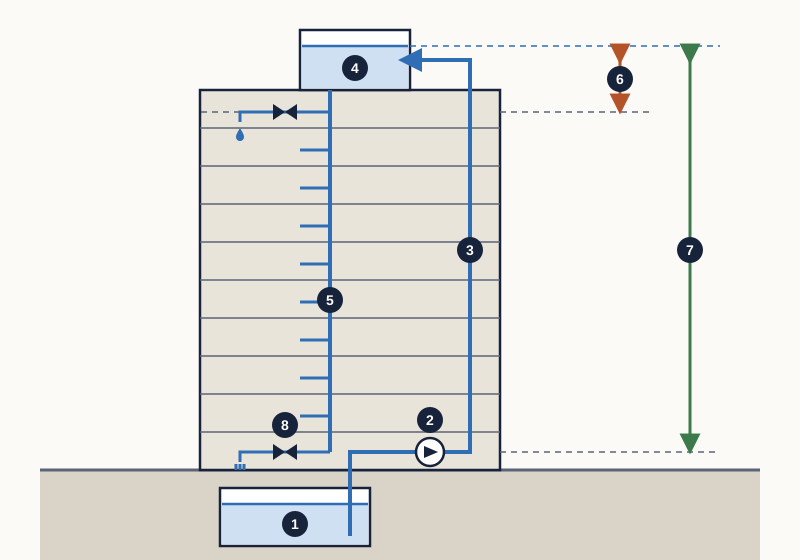
- Underground reservoir, filled from the WASA line or a tube well
- Pump that lifts the water to the roof
- Rising main from the pump to the roof tank
- Roof tank; pressure is measured from its water surface
- Down-feed riser with a branch to each floor
- Small height between the tank's water level and a top-floor outlet: low pressure
- Large height above a ground-floor outlet: high pressure
- The flat's stop valve on its branch from the riser
Signs of low pressure and what they suggest
Note which of these you see, and when. The pattern is more useful than any single symptom.
- The shower drops to a trickle when someone flushes a toilet or opens a tap, a typical sign according to the Consumer Council for Water (CCW), the UK's statutory water consumer body.[7]
- A bucket takes much longer to fill than it used to, or a cistern is slow to refill; CCW puts the average cistern refill at about 1 minute 40 seconds.[7]
- Pressure is fine at some hours and poor at others, often in the morning and evening when everyone uses water. High demand at certain times of day is one of the causes CCW lists.[7]
- Taps spit, gurgle or sputter, or pipes bang when a tap is opened, which can point to air trapped in the pipework.[3]
- Only the hot taps are weak while the cold taps run normally.
- Weak flow together with brown or rusty water in older pipework; the US water utility EBMUD notes that old, corroded galvanised pipes can cause both.[8]
Common causes, from the tap back to the pump
Clogged aerators and shower heads
Most taps end in a small screw-on insert called an aerator (or jet regulator) that shapes the stream, and shower heads have many fine nozzles; both trap grit, rust flakes and scale. The tap maker Hansgrohe notes that limescale builds up at a rate that depends on water hardness and can spoil the spray; it recommends soaking the unscrewed aerator in a citric-acid descaler for no more than 10 minutes, then rinsing.[5] A sudden drop at several taps just after pipe work or a tank cleaning usually means loosened sediment has lodged in these screens.
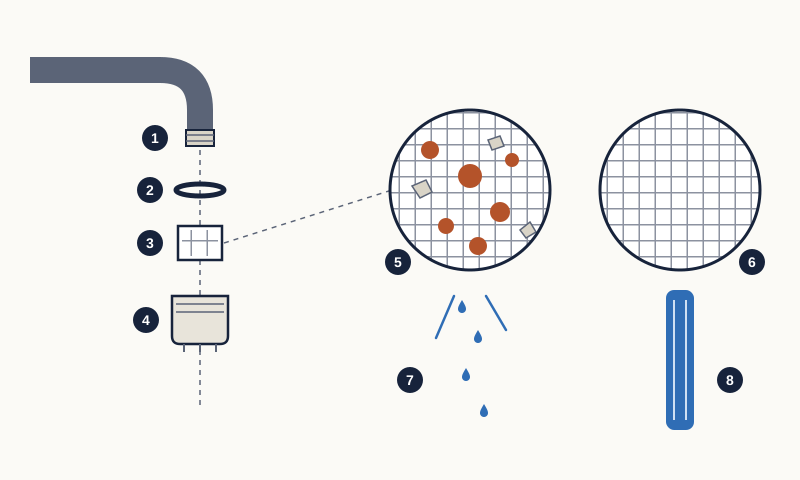
- Threaded end of the tap spout
- Rubber washer that seals the aerator to the spout
- Insert with fine mesh screens
- Outer housing that screws onto the spout
- Screen clogged with grit, rust and scale
- Clean screen
- Weak, uneven spray from a clogged aerator
- Full, even stream after cleaning
Valves that are not fully open
Every flat has a main stop valve where its branch leaves the riser, and most basins and toilets have small angle valves. A valve left half-closed after a repair quietly limits the flow. Thames Water, for example, tells customers with low pressure to check that the internal stop valve is fully open by turning it anticlockwise.[6] Lever-type ball valves are normally open when the handle lies along the pipe. How these valves work is covered in our guide to taps, showers and valves.
Airlocks
Air trapped at a high point in the pipework can choke the flow. WaterSafe lists quick draining and refilling, pressure changes after maintenance, small leaks and badly graded pipes among the causes, with weak flow, sputtering and banging as symptoms.[3] In tank-fed buildings, airlocks often follow a roof tank running dry or being emptied for cleaning.
Scale, rust and narrow pipes
Inside old galvanised iron (GI) pipes, rust builds up into lumps that narrow the bore; EBMUD notes that these deposits block flow and can discolour the water.[8] Scale does the same more slowly. A pipe too small for the outlets it serves gives a similar symptom: fine with one tap open, poor with two. Replacing corroded pipe is covered in when to repair or replace a damaged water pipe.
Your height below the roof tank
On the top floors there is very little height between the tank's water surface and the outlets, so pressure stays low however well the plumbing is kept, while the lowest floors of a tall building can get more than they need. Grundfos, a pump maker, suggests at least 1.5 to 2 bar on the top floor of each supply zone and no more than 4 to 4.5 bar on the lowest; one layout it describes adds a rooftop booster that serves only the top three or four floors and leaves the rest on gravity.[1]
Tank level, the pump and supply hours
Head is measured from the water surface, so a nearly empty roof tank gives less pressure than a full one. In many Dhaka buildings the roof tank depends on the underground reservoir, which depends on the hours when the WASA supply arrives. If the reservoir runs low, the pump is faulty, the float switch fails or load-shedding stops the pump, every flat feels it, the top floors first. A tank outlet partly blocked by sediment does the same; see how to clean and maintain water storage tanks safely.
Leaks
Water escaping from a pipe never reaches your tap, and CCW lists a leaking supply pipe among the causes of low pressure.[7] Damp patches, a wet ceiling below or a pump that runs more than usual are clues; see how to inspect water supply pipes for leakage.
Floor-by-floor reasoning: narrowing down the cause
The most useful question is: who else has the problem? Thames Water's checklist starts there: if neighbours are affected too, the problem is likely in the supply; if not, it is probably inside the property.[6]
| Who is affected | Most likely causes | Who usually deals with it |
|---|---|---|
| One tap or shower only | Clogged aerator or shower head, half-closed angle valve, kinked hose[5] | You; a plumber if a valve is seized |
| Hot water only, cold is fine | Water heater inlet valve, scale inside the heater, airlock in the hot pipework[4] | You for the checks; a plumber or electrician for the heater |
| Whole flat, neighbours are fine | Part-closed stop valve, blocked filter, leak, airlock, old GI pipes[8] | You first, then a plumber |
| Every flat on the top two or three floors | Too little height below the roof tank; low tank level[1] | Building committee; an engineer for any booster |
| Whole building, at certain times | Peak demand on a shared riser, tank running low, pump schedule[7] | Committee and caretaker |
| Whole building, all the time, or dirty water | Pump fault, empty reservoir, incoming supply problem, blocked tank outlet | Committee; pump technician; WASA |
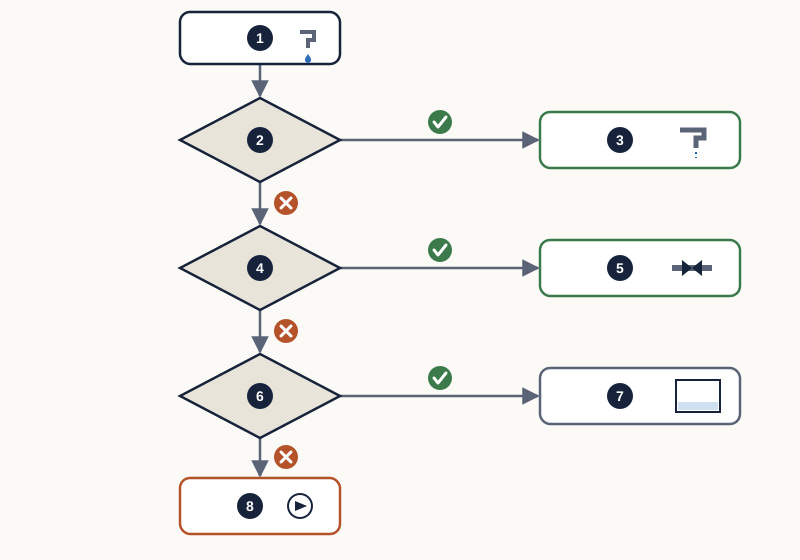
- Low pressure noticed: note which outlets and when
- Is it only one tap or shower?
- Yes: clean the aerator or shower head and check its angle valve and hose
- Is it your whole flat, while your neighbours are fine?
- Yes: check the flat's stop valve, any filter, airlocks and leaks
- Is it only the top few floors, or worse when the tank is low?
- Yes: tank height or level; report it to the building committee
- No (whole building): pump, reservoir or incoming supply; committee, pump technician or WASA
Tools and materials
- A torch, plus a notebook or phone to record times, outlets and readings.
- A bucket of known volume (for example 10 litres) and a phone stopwatch, to measure flow.
- An adjustable spanner, a flat screwdriver and a soft cloth to protect chrome when loosening aerators.
- A small bowl, a soft brush (an old toothbrush works) and a descaler suited to your fittings; read the maker's care instructions first.
Step-by-step checks inside your flat
Work through these in order. Each step either finds the fault or rules out one part of the system.
- Record the pattern for a few days: which outlets are weak, hot or cold, and when. CCW suggests noting low-pressure times over a period such as two weeks.[7]
- Ask the neighbours above, below and beside you, and ask the caretaker whether the tank was low or the pump off at those times. Do not go up to the tank yourself.
- Time how long each fully open outlet takes to fill the bucket. Repeat later to see whether a fix worked.
- Make sure the flat's main stop valve is fully open by turning it slowly anticlockwise until it stops, then do the same with the angle valves under basins and behind toilets, and look for kinked hoses. Never force a valve that will not move.[6]
- Unscrew the aerator from each weak tap. Rinse out grit; if there is scale, soak the parts in a suitable descaler within the maker's time limit, then rinse and refit.[5]
- Clean shower heads too, and run the shower briefly without its head: if the bare hose flows strongly, the head is the problem.
- If your flat has an in-line filter or strainer after the stop valve, close the stop valve and clean the screen as its maker describes.
- If only the hot side is weak, check that the water heater's (geyser's) cold inlet valve is fully open, then suspect scale in the heater or a hot-side airlock. Leave the inside of the heater to a plumber or electrician.
- If taps sputter after the tank has been empty, run each affected tap until the flow is steady. WaterSafe notes that airlocks collect at high points and suggests opening taps gradually, repeating if needed.[3]
- Look and listen for leaks: hissing in walls, damp patches, a cistern that keeps refilling. If you have a meter, take readings with every tap closed.
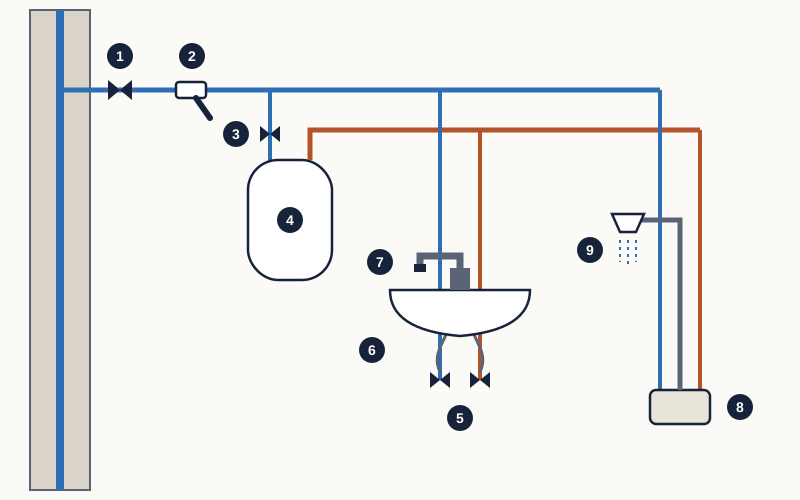
- The flat's main stop valve on the branch from the riser
- In-line filter or strainer, if fitted
- Cold inlet valve of the water heater (geyser)
- Water heater; hot water leaves from the top
- Angle valves under the basin, cold and hot
- Flexible hoses from the angle valves to the mixer
- Aerator at the tip of the basin mixer
- Shower mixer
- Shower head
For a hot-side airlock, the Irish water utility Uisce Éireann describes joining the hot and cold taps with a hose and opening the hot, then the cold, so cold-water pressure pushes the air out; on a mixer, partly block the hot outlet with a cloth, taking care not to be scalded.[4] This only works if the cold side has more pressure than the hot, which is rare when both come from one roof tank.
Booster pumps: what to know before you fit one
When the top floors suffer, a booster pump can look like the obvious answer. Do the free checks first: no pump fixes a clogged aerator, a half-closed valve or a leak. Then keep these points in mind.
- Never connect a pump straight onto the incoming WASA line. A University of Toronto study of household pumps in two Delhi neighbourhoods found that they lowered neighbours' pressure and could create negative pressure that draws dirt and sewage into the pipes.[9] Researchers writing in PLOS Medicine point out that avoiding negative pressure in a piped network is what keeps contaminated soil water out.[10] We found no current published WASA rule on household pumps, so ask the committee and WASA first.
- A pump on your branch of a shared gravity riser draws water that would otherwise reach the flats around you, and can leave them worse off. Agree any booster with the committee first.
- A building-level solution, such as a booster set serving only the top floors from the roof tank, is a design job for a qualified engineer, and pressures should be checked on every floor afterwards so the lower floors are not over-pressured.[1]
- A pump that runs dry can overheat and fail. It also needs a correctly sized circuit and protection fitted by an electrician, in a spot where a leak cannot reach the electrics.
Prevention: a routine that keeps pressure steady
- Every 3 to 6 months: clean aerators and shower heads, more often if deposits build up quickly.[5]
- Every 6 months: close and reopen the flat's stop valve and each angle valve once, gently, so they do not seize half-open.
- After any tank cleaning or supply interruption: run each tap until it is clear and steady, then check the aerators for sediment.
- Monthly (caretaker or committee): check that the roof tank refills fully and the float switch stops the pump.
- Before each monsoon and dry season: confirm the reservoir and roof tank have been cleaned and their outlets are not partly blocked.
- When renovating: ask for pipes sized for the number of outlets and for accessible valves.
Building-wide items such as tank level, the pump and the float switch belong in the committee's routine; see a monthly building maintenance checklist.
Common mistakes and troubleshooting
- Buying a 'high-pressure' shower head before checking valves and aerators. Some heads need more pressure than a top-floor gravity supply gives; check the maker's stated minimum.
- Cleaning chrome aerators with harsh acids or bleach. Hansgrohe advises against cleaners containing chlorine bleach, formic, acetic or hydrochloric acid on its taps; vinegar is a dilute acetic acid.[5]
- Fitting a booster pump on the WASA line or a shared riser without agreement.[9]
- Blaming one flat's plumbing when every top-floor flat has the same problem; that pattern points to tank height or level, not individual pipes.[1]
- Ignoring a slow fall in flow at every tap in an old flat; it can mean the pipes themselves are narrowing inside.[8]
Fix it yourself, call a plumber or take it to the committee?
Let the spread of the problem decide who should act.
- You: cleaning aerators and shower heads, opening valves fully, replacing a kinked hose, clearing a simple airlock.
- A plumber: a valve that will not open or leaks when moved, a suspected hidden leak, corroded GI pipework, a weak supply into the water heater, or an airlock that persists after repeated attempts, which is when WaterSafe advises calling one.[3]
- An electrician: anything involving the pump's wiring, the water heater's wiring or a circuit for a new booster pump.
- The building committee: low pressure on the top floors, across the building or at set times; tank, pump, float switch, reservoir and WASA supply problems.
When the committee needs to act, give it a written record: which flats, floors and times, plus your flow measurements. That makes it easier to choose between cleaning, a pump repair or a booster set, and to justify the spending from the service charge (see service charge and management).
What affects the cost
We could not find reliable published prices for this work in Bangladesh, so this guide gives none. What drives the cost:
- Fixes at the outlet cost little: cleaning an aerator is free, and a new aerator or hose costs far less than a new mixer.
- Valves: replacing an exposed angle valve is a small job; a stop valve buried in a wall means breaking and re-laying tiles.
- Pipework: replacing exposed pipe is far cheaper than re-piping concealed lines, where tiling and plaster dominate the bill.
- Pumps: a repair usually costs less than a new pump, but repeated failures or wrong sizing can favour replacement.
- A building boosting system costs far more than any flat-level fix and adds design, electrical and maintenance costs to the service charge.
- Call-out charges, access to the roof or service shafts, and warranty terms.
Ask for written quotes that name the parts, pipe sizes and warranty, and compare at least two; our guide on getting and comparing repair quotes explains how.
Next steps
- Today: ask your neighbours and the caretaker whether the problem is shared, and note the times.
- This week: open every valve fully, clean every aerator and shower head, and time a bucket fill at each outlet.
- If only your flat is still affected: look for leaks and airlocks, then call a plumber with your notes.
- If several flats or floors are affected: give the committee a written record with floors, times and flow measurements.
- For a building-wide problem: ask the committee to check tank, pump and reservoir first, and to take an engineer's advice before buying boosters.
- Add aerator cleaning and valve exercising to your household routine.
Common questions
- Why is the pressure on the top floor so much lower than downstairs?
- In a gravity-fed building, pressure comes from the height of water above the tap: roughly 10 metres gives about 1 bar,[2] so a flat just below the roof tank gets a fraction of what the ground floor gets. That is a design limit, not a fault, usually solved at building level, for example with a booster serving only the top floors.[1]
- My water was fine yesterday and is weak everywhere today. What happened?
- A sudden drop in every flat usually means the roof tank is low: the pump may have tripped, the power may have been off, or the reservoir may be short of supply. Ask the caretaker. If your neighbours are fine and only your flat has dropped, check your stop valve and look for a leak.[6]
- Should I install a booster pump in my flat?
- Only after the free checks, and only with the committee's agreement. Never connect a pump to the incoming supply line: research on household pumps in Delhi found that they lower neighbours' pressure and can draw dirty water into the pipes.[9] On a shared riser, a flat pump takes your neighbours' water. Have an electrician install the circuit.
- Why is only the hot water weak?
- Check the water heater's inlet valve first. If it is open, scale inside the heater or its pipes, or an airlock in the hot pipework, are the likely causes. Uisce Éireann describes a hose method for clearing hot-side airlocks where the cold supply has more pressure than the hot.[4] Anything inside the heater is a job for a plumber or electrician.
- How do I know if old pipes are the problem?
- Suspect the pipes if flow has fallen slowly at every tap over months or years, the water is sometimes brown, and the flat still has its original GI pipework. EBMUD notes that corroded galvanised pipes can cause both low pressure and discoloured water.[8] A plumber can open a joint to look inside.
Sources
The facts in this guide were checked against these sources.
- Water supply systems in zones — Grundfos. accessed 18 October 2026.
- What is the minimum water pressure that a water supplier must supply? — WaterSafe Register (UK). accessed 18 October 2026.
- How do you remove an airlock from water pipes? — WaterSafe Register (UK). accessed 18 October 2026.
- How to Check for and Clear Airlocks? — Uisce Éireann (Irish Water). accessed 18 October 2026.
- How to clean high-quality kitchen taps properly — Hansgrohe. accessed 18 October 2026.
- No water or low pressure — Thames Water. accessed 18 October 2026.
- Low water pressure — Consumer Council for Water (CCW). accessed 18 October 2026.
- Galvanized iron pipes — East Bay Municipal Utility District (EBMUD). accessed 18 October 2026.
- Consumer pumps not the worst of Delhi's water woes — University of Toronto Engineering News (published 19 July 2021). accessed 18 October 2026.
- Continuity in Drinking Water Supply — PLOS Medicine (Brocklehurst and Slaymaker), via PubMed Central (published 2015). accessed 18 October 2026.
This guide is general information. Have gas, structural and live electrical work done by a qualified, licensed professional. Your building’s rules and committee decisions take precedence over anything written here.
Written from the cited sources by the RUAP.NET editorial team. It has not been reviewed by a licensed engineer, plumber or electrician; for work on gas, structure or live electrics, use a qualified professional.
Spotted a mistake? Tell us — we check it, correct the guide and record the date of the correction. Report an error →