
Monthly Building Maintenance Checklist: A Walk-Round for Committees and Caretakers
Shared systems in an apartment building, such as pumps, lifts, the generator, fire equipment and drains, fail quietly until the day they are needed. A short, written round once a month catches most problems while they are still cheap and safe to fix.
Once a month, a caretaker or committee member should walk the same route from the pump room to the roof and record what they see on the same form: pumps, tanks, lifts, generator, fire equipment, escape routes, drains, roof and common lights.
The round is for looking, listening and writing down. Lift, generator, fire-system, pump-panel and electrical work belongs to licensed contractors; the committee spots faults, keeps records and makes sure the contractors' servicing actually happens.[1][4]
Anything that endangers people, such as a lift stopping off-level, a burning smell in the meter room, a blocked stair or a missing extinguisher, is reported the same day.
Most of this can be done yourself with ordinary tools.
In a fourteen-storey RUAP building, six flats share every floor, so 84 households depend on one set of pumps, lifts, stairs and drains. This checklist is written for that kind of building but suits any apartment block with shared services. Longer-term planning, such as the asset register, annual work and contracts, is covered in how to plan a preventive maintenance schedule.
Why a monthly round matters: the warning signs it catches
Most breakdowns in shared services give warning weeks ahead, but nobody looks at the pump room or the roof until something stops. Early signs include:
- A pump that runs longer than usual, cycles rapidly or grinds; one pump maker's manual treats grinding, arcing and excessive vibration as needing immediate service.[7]
- Water on the pump-room floor, dripping valves, or rust under pipework.
- A lift that stops above or below the landing, or doors that hesitate or slam.
- A generator with low fuel, fresh oil or coolant stains, or a warning on its panel.
- Missing or discharged extinguishers, dark exit signs, and stairs used as storage.
- Leaves, plastic and silt at roof outlets and compound drains, especially around the monsoon.
Caught early, each of these is cheap to fix. Left alone, it becomes a burnt-out pump, a stalled lift or a generator that fails during load-shedding.
Who does what: caretaker, committee and contractor
The round is observation only: no opening panels, adjusting lift or generator controls, or entering confined spaces. UK guidance for blocks of flats draws the same line: trained in-house staff can do simple checks, but most testing and servicing of fire safety systems needs competent contractors.[4] For lifts, the UK safety regulator allows trained in-house inspections between formal examinations, while the thorough examination is for an independent, competent person.[1]
| Item | Monthly round (caretaker or committee) | Licensed contractor |
|---|---|---|
| Pumps and control panel | Sound, leaks, rust, panel faults and running hours[7] | Electrical fault-finding, seals, bearings, motors[7] |
| Reservoir and rooftop tank | Covers locked, vents and overflows screened | Cleaning, disinfection, any entry into a tank |
| Lifts | Levelling, doors, alarm, light, fan; service record | Maintenance, rescues, thorough examination[1] |
| Generator | Fuel, leaks, panel warnings, exercise runs logged[6] | Oil, filters, coolant, battery, changeover switch[6] |
| Fire equipment | Extinguishers present, charged and sealed[4][5] | Annual servicing, refilling, pressure tests[4] |
| Escape routes and lights | Stairs clear, fire doors close, lamps work | Wiring, distribution boards, emergency-light batteries |
| Drains and roof | Outlets and gullies clear, no ponding | Waterproofing, broken pipes, blocked stacks |
For how committees share these duties and answer to residents, see our older page on running a building committee.
Tools and records you need
- The checklist on paper or a phone, one line per item with space for notes.
- A torch, and a phone camera to photograph each fault with its date and place.
- Phone numbers for the lift, generator, fire-equipment and pump contractors, the electrician and the plumber.
- Keys to the pump room, generator room, roof door and tank covers.
- The contractors' service sheets or logbooks, and a notice board for residents.
Step by step: the monthly walk-round
Use the same route every month so nothing is skipped and one month can be compared with the next:
- Pump room and the top of the underground reservoir.
- Generator room or enclosure.
- Meter and main switch rooms, from the doorway only.
- Lift lobby, then a ride in each lift.
- Stairs, floor by floor: fire equipment, doors and lights.
- Roof: tank and outlets, well away from the edge.
- Compound drains and gully pits.
- Write up the findings and post a summary the same day.
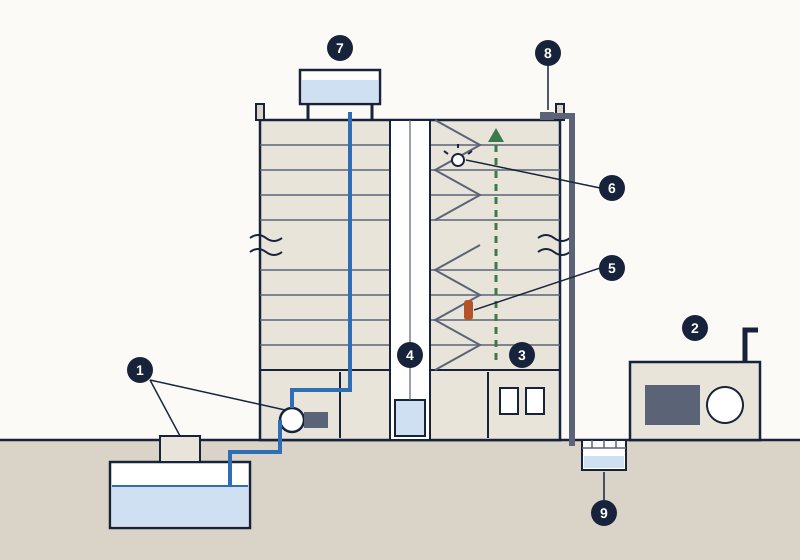
- Pump room and reservoir cover (checked from outside only)
- Generator: fuel, leaks, panel warnings
- Meter and main switch room: look from the doorway only
- Lift lobby and lift car
- Extinguisher, fire door and escape route on every landing
- Common lights on stairs and corridors
- Rooftop tank: cover, vent and overflow
- Roof outlet and downpipe
- Compound drain and gully pit
Pumps and water tanks
Stand by a running pump. A booster-set manual from the pump maker Xylem treats rubbing or grinding sounds, arcing and vibration as needing immediate service, and says a pump should not be run with excessive vibration.[7] Look for drips at seals, pipes and valves, rust and loose fixings, and note any fault the panel shows.[7] Never let the pumps run with the reservoir empty: starting a pump dry can seriously damage it.[7]
At the reservoir and rooftop tank, check from outside that covers are closed and locked and that vents and overflows are screened. Cleaning is covered in our water tank maintenance guide; for weak supply on upper floors, see low water pressure in apartment buildings.
Lifts: observe and report
Ride each lift to several floors. Check that it stops level with each landing, that the doors move smoothly and reopen when obstructed, and that the light, fan and alarm work; agree the alarm test with the contractor first. UK guidance gives checks like these, including that landing doors cannot be opened from the landing side, as inspections a trained person can do.[1] Never open a landing door yourself.
Then read the service record. In the UK, lifts that carry people need a thorough examination at least every six months by a competent person who is independent of the maintenance firm.[1] Ask your contractor what the lift's maker and local rules require, and insist that every visit is written down.
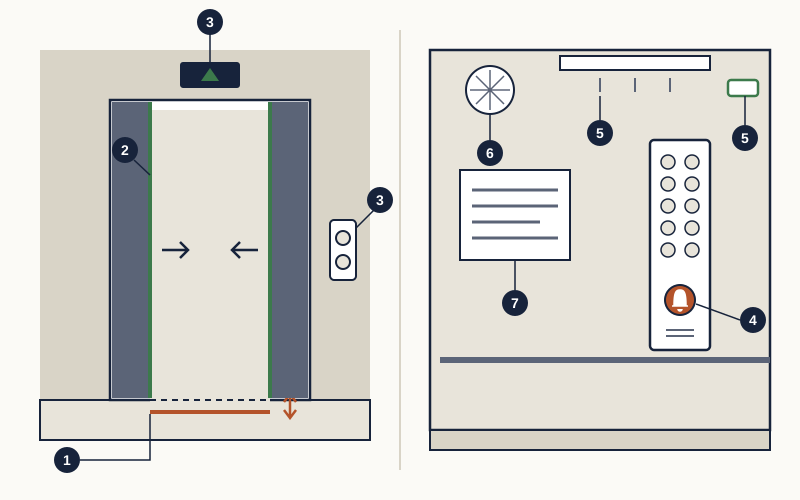
- The car floor should stop level with the landing; a step like this is a trip hazard, so report it
- Door edges: the doors should reopen if something is in the way
- Floor indicator and landing call buttons working
- Alarm or intercom button (test by prior arrangement with the contractor)
- Car light and emergency light
- Ventilation fan
- Notice: contractor's phone number and date of the last service
Generator
Check the fuel, look for fresh oil, fuel or coolant under the set, and note panel warnings and running hours. Generac's manual for its stationary diesel sets describes an automatic weekly exercise of about 12 minutes without transferring the load, and makes the owner responsible for routine checks of fluids, hoses and the radiator and for periodic inspection by an authorised dealer.[6] Record whether the exercise is happening; servicing, batteries and the changeover switch are for the contractor.
Extinguishers, alarms and escape routes
On every landing, check that each extinguisher is in place and unblocked, its gauge needle is in the green, its pin and seal are intact, the hose is sound and the service label is in date. Carbon dioxide (CO2) extinguishers have no gauge, so check the seal and label. US workplace rules require a monthly visual inspection and an annual maintenance check,[5] and UK guidance for flats has trained specialists maintain extinguishers every 12 months while others report missing or damaged ones.[4]
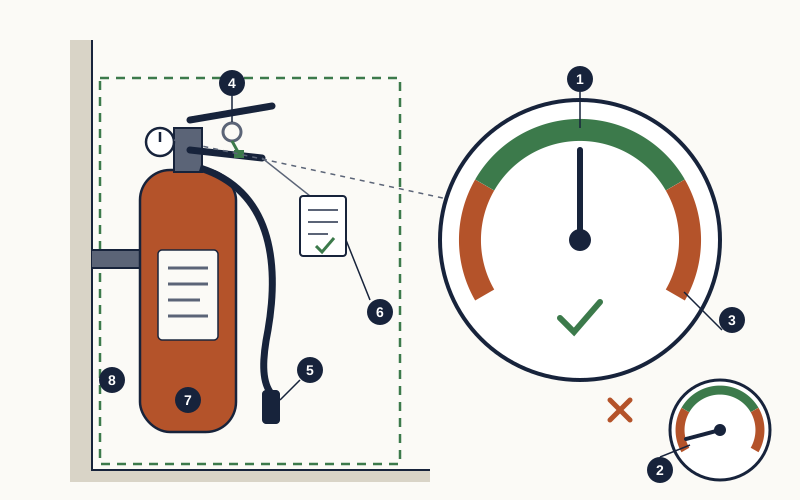
- Pressure gauge: a needle in the green band means it is charged
- Needle in the low zone: discharged or leaking, so report it
- Needle in the high zone: overcharged, so report it
- Safety pin and tamper seal in place
- Hose and nozzle: not cracked, kinked or blocked
- Service label: last service within the past year
- Body: no dents, rust or leaks
- Mounted on its bracket, visible and not blocked
Where emergency lights have a test switch, the same UK guidance recommends a monthly functional test and an annual full-duration test, without leaving escape routes unlit while batteries recharge.[4] It also suggests a weekly fire alarm test at a call point, servicing every six months, and six-monthly checks that fire main (dry riser) outlets are undamaged and still strapped or padlocked.[4] Stairs and corridors should be kept free of stored and combustible items.[4] Fire doors should close fully by themselves; UK rules for buildings over 11 metres require quarterly checks of closers, gaps, seals, hinges and damage.[3]
UK rules also require monthly checks of firefighting lifts and essential firefighting equipment in residential buildings at least 18 metres or seven storeys high, with the results shown to residents.[2] That is English law, not Bangladeshi, but it is a useful benchmark; ask your contractor and the Bangladesh Fire Service and Civil Defence what applies to your building.
Drains, roof and standing water
On the roof, clear loose leaves and plastic from outlets if you can do so safely, and note ponding and blocked downpipes for the pre-monsoon roof inspection. Check compound gullies for silt; a blocked main drain or stack is a plumber's job, as our guide to blocked drains explains. The US Centers for Disease Control and Prevention (CDC) advises emptying, scrubbing or covering anything that holds water once a week and tightly covering stored water.[8] In 2020, during an anti-dengue drive, Bangladesh's local government minister told Dhaka building owners to clear stagnant water from roofs.[9]
Common lights and electrical rooms
Note dead or flickering lamps in stairs, corridors and the compound. Look into the meter and switch rooms from the doorway: they should be dry, locked and clear, with no burning smell, buzzing or scorch marks. Report anything odd to the electrician; electrical warning signs explains what each sign can mean.
The monthly checklist
- Pumps: normal sound, no heavy vibration or leaks; panel faults and running hours noted.[7]
- Tanks: covers closed and locked; vent and overflow screens in place.
- Lifts: each car stops level; doors close and reopen; alarm, light and fan work.
- Lifts: last service visit and next examination date in the log.[1]
- Generator: fuel level, no fresh leaks, no panel warnings, weekly exercise logged.[6]
- Extinguishers: present, unblocked, gauge in the green, seal intact, label in date.[4][5]
- Emergency lights and exit signs lit; monthly test done where a test switch is fitted.[4]
- Fire alarm panel (if fitted): no fault lights; weekly tests logged.[4]
- Stairs and corridors clear; fire doors close fully on their own.[3][4]
- Roof outlets and compound drains clear; no standing water anywhere.[8]
- Common lights working; meter and switch rooms dry, locked and clear.
- Findings recorded, photos filed, faults reported, summary posted.[2]
For a detailed check of supply pipes, valves, traps and fixtures, use our plumbing inspection checklist alongside this one.
Prevention through the year: adjusting the routine
The list stays the same, but the emphasis shifts with Dhaka's seasons:
- Before the monsoon (roughly April and May): give roof outlets and drains extra attention and book the full roof inspection.
- During the monsoon (June to October): after heavy rain, check the roof and pump room for water, and look for standing water every week.[8]
- In months of heavy load-shedding: confirm that generator runs and fuel deliveries are logged, and listen for pumps restarting repeatedly.
- Once a year: file each contractor's annual service report with the monthly sheets.
Planning and budgeting for annual and quarterly jobs belongs in the committee's preventive maintenance schedule.
Recording findings and following up
Give every fault a line in a running log: date, place, what was seen, photo, who was told and when it was fixed. Decide at once whether it endangers people. If it does, close off the area or take the lift out of use and call the contractor that day; if not, report it to the committee.
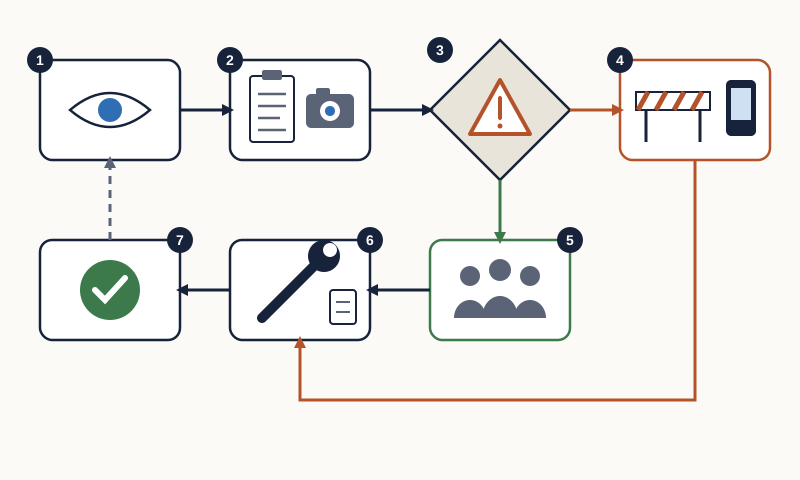
- Observe on the monthly round
- Record in the log: date, location and photo
- Decide: is there an immediate danger to people?
- Yes: keep people away or take the lift out of use, and call the contractor or 999 the same day
- No: report it to the committee with the log entry
- A licensed contractor repairs it and leaves a written service sheet
- Recheck on the next round and close the log entry
Post a summary for residents every month. UK rules require this for fire-equipment checks in high-rise blocks,[2] and it shows residents that reporting a problem leads to action.
Common mistakes to avoid
- Ticking boxes at a desk without looking, which gives false confidence.
- Changing the route or the form each month, so months cannot be compared.
- Letting the caretaker reset pump or generator controls, or 'fix' a lift door.
- Accepting a contractor's visit without a written service sheet.
- Leaving a missing or discharged extinguisher until the next service; UK guidance says report it for action as soon as it is found.[4]
- Using the stairs or the roof as storage.
When to call a professional straight away
- Lift: someone trapped, doors opening with no car behind them, stopping off-level, jerks or odd noises. Take it out of use and call the lift contractor.
- Generator: fuel or oil leaks, failing its exercise run, or exhaust getting into the building.[6]
- Pumps: grinding, arcing, heavy vibration, a pouring seal or non-stop running; electrical faults need a qualified electrician.[7]
- Electrics: a burning smell, scorch marks, buzzing or water near boards; see when to call a qualified electrician.
- Fire equipment: an alarm that will not reset, damaged fire main outlets, or a fire door that will not close.[4]
Budgeting and what drives the cost
The round costs little beyond a caretaker's time; the real costs lie in the contractor work it triggers. We found no reliable published prices for lift, generator, fire-equipment or pump service contracts in Bangladesh, so no figures are given. Costs depend on:
- The number and age of lifts, pumps and generators, and whether spare parts are available.
- Whether contracts include parts as well as labour, and how fast the contractor must respond.
- Generator fuel, which rises as load-shedding gets longer.
- Delay: a leaking seal replaced early costs far less than a burnt-out pump motor.
Compare written quotes with our guide to getting repair quotes; service charge and building management covers how buildings fund shared costs.
Next steps
- Agree who does the round, on which day of the month, and who receives the results.
- Adapt the checklist to your building's equipment and fix the route.
- Collect the contractors' phone numbers and their latest service records.
- Do the first round, photograph everything and treat it as your baseline.
- Report dangers the same day and post a monthly summary for residents.[2]
Common questions
- Who should do the monthly round?
- Usually the caretaker or building manager, with a committee member joining every few months. They need the keys, a torch, the form and the contractors' numbers. UK guidance for flats says trained in-house staff can do simple checks while contractors do the testing and servicing.[4]
- Can our caretaker test or reset the lift?
- No. The caretaker can ride it, note how it stops and whether the alarm, light and fan work, and read the service record. Resets, rescues and repairs are for the lift contractor, and the formal examination is for an independent, competent person.[1]
- How often should the generator be run?
- Follow your set's own manual. Generac's stationary diesel manual describes an automatic weekly run of about 12 minutes.[6] The monthly round confirms that these runs and the fuel and fluid checks are happening and being logged.
- How can I tell whether a fire extinguisher is usable?
- The gauge needle is in the green, the pin and seal are in place, the hose is sound, the body has no dents or rust, and the service label is in date. For a CO2 extinguisher, which has no gauge, rely on the seal and label instead. Send anything doubtful to the contractor, which should service extinguishers every year.[4][5]
- Is there a legal monthly checklist for buildings in Bangladesh?
- We could not find an official Bangladeshi monthly checklist for apartment buildings to cite. This guide uses UK and US guidance as good practice. Ask your contractors what their equipment and local rules require, and ask the Bangladesh Fire Service and Civil Defence about fire safety duties.
Sources
The facts in this guide were checked against these sources.
- Thorough examination and testing of lifts: Simple guidance for lift owners (INDG339 rev1) — UK Health and Safety Executive (HSE) (published January 2008 (rev1)). accessed 18 October 2026.
- Fact sheet: Lifts and essential fire-fighting equipment (regulation 7) — Home Office (GOV.UK) (published Last updated 24 July 2023). accessed 18 October 2026.
- Fact sheet: Fire doors (regulation 10) — Home Office (GOV.UK) (published Last updated 24 July 2023). accessed 18 October 2026.
- Fire safety in purpose-built blocks of flats — Local Government Association, published on GOV.UK by the Home Office (published 2011 (reissued with an interim note, 2024)). accessed 18 October 2026.
- 1910.157 – Portable fire extinguishers — US Occupational Safety and Health Administration (OSHA). accessed 18 October 2026.
- Owner's Manual: Stationary Diesel Generators, Residential and Commercial, 15-50 kW (Protector Series) — Generac. accessed 18 October 2026.
- TechnoForce and TechnoForce XLS Package System: Mechanical Installation, Operation, and Maintenance Manual (10-001-247 Rev 5) — Xylem (Bell & Gossett) (published Rev 5). accessed 18 October 2026.
- Mosquito Control at Home — US Centers for Disease Control and Prevention (CDC) (published 16 April 2024). accessed 18 October 2026.
- Anti-dengue drive: Govt to act against people with still water at home — The Financial Express (Bangladesh) (published 30 April 2020). accessed 18 October 2026.
This guide is general information. Have gas, structural and live electrical work done by a qualified, licensed professional. Your building’s rules and committee decisions take precedence over anything written here.
Written from the cited sources by the RUAP.NET editorial team. It has not been reviewed by a licensed engineer, plumber or electrician; for work on gas, structure or live electrics, use a qualified professional.
Spotted a mistake? Tell us — we check it, correct the guide and record the date of the correction. Report an error →
Related guides
Guides: Running the committee · Guides: Service charge