
How to Spot Plumbing Problems Early: Warning Signs and How Urgent Each One Is
Most big plumbing repairs start as something small: a faint stain, a hiss at night, a sink that drains a little slower or a bill that creeps up. This guide shows what each sign usually means, which ones need action today and which can wait for a planned repair.
Early warning signs come in five kinds: things you see (stains, bubbling paint, rust, discoloured water), hear (hissing, dripping, banging pipes), smell (musty or rotten-egg), notice in how water behaves (slow drains, gurgling, falling pressure) and read in numbers (the meter or the bill).
A 20-minute walk-round once a month, plus a two-hour meter test if your flat has its own meter, catches most hidden leaks.[1] If water is escaping now or reaching anything electrical, close the flat's stop valve and switch off the affected circuit before anything else.
A problem in one flat is usually the owner's or tenant's to sort out; the same sign in several flats or floors belongs to the building committee. Dated notes, photos and meter readings help a plumber find the cause faster.
Most of this can be done yourself with ordinary tools.
Few plumbing failures arrive without notice. A joint usually weeps before it bursts, a ceiling stains for months before plaster falls, and a drain slows long before it stops. This guide helps you recognise the signs, judge how urgent each is, and find the right detailed guide or person.
Why small signs are worth chasing
Hidden leaks waste a surprising amount of water. The US Environmental Protection Agency's WaterSense programme estimates that an average American household's leaks can waste more than 9,300 gallons (about 35,000 litres) a year, and that around 9 per cent of homes have leaks wasting 50 gallons (about 190 litres) or more a day.[1] The figures are American, but the lesson travels: small leaks keep running until someone looks.
The bigger cost is damage to the building. EPA advises drying water-damaged areas within 24 to 48 hours, because mould usually does not grow if wet materials dry within that window.[5] Water seeping slowly inside a wall never gets that chance, so plaster, paint, woodwork and the ceiling of the flat below suffer for months. In a flat, the damage often shows first in a neighbour's home.
Early warning signs: what to look, listen and smell for
What you can see: stains, bubbling paint, rust and discoloured water
WaterSafe, the UK register of approved plumbers, lists the visible signs of a leak inside a wall: yellow, brown or dark patches; paint or wallpaper that bubbles, blisters or peels; and dark spots of mould.[3] Watch the walls next to bathrooms, the cupboard base under the kitchen sink, and the ceiling of the flat directly below your bathrooms. Photograph any mark with the date to see later whether it grows.
Droplets spread evenly over a cold-water pipe or cistern may not be a leak at all; this is condensation from humid air, which EPA treats as a sign of high humidity.[5] In flats with old galvanised iron (GI) pipes, brown water and a flow that falls slowly over months can point to rust inside the pipes; EBMUD, a Californian water utility, notes that corroded galvanised pipes can cause both discoloured water and low pressure.[8]
What you can hear: hissing, dripping and banging
Night, when nobody is using water, is the best time to listen. University of Nebraska–Lincoln Extension notes that a leaking toilet often makes a telltale sound, or its fill valve opens to refill the cistern long after anyone used it.[2] WaterSafe also suggests standing quietly by a suspect wall and listening for faint dripping or running water.[3]
A bang or knock in the pipes when a tap is turned off is a different problem. WaterSafe lists faulty ball valves, badly clipped pipes that move and strike walls, air trapped at the stop valve and loose washers as causes, and warns that the sudden pressure changes behind the noise stress pipes, joints and fixings and can lead to leaks.[6]
What you can smell: musty or rotten eggs
A musty smell with no visible source can mean hidden damp or mould.[5] A rotten-egg smell is usually hydrogen sulphide, which forms when organic matter breaks down in drains and is often called sewer gas. The US Agency for Toxic Substances and Disease Registry (ATSDR) says people can smell it at very low levels, but at high levels the sense of smell can fail within minutes, so a smell that fades is not proof that the air is safe.[9] Dried-out traps and other causes are covered in our guide to drain odours.
How the water behaves: slow drains, gurgling and pressure changes
A sink or floor trap (the grated drain in a bathroom floor) that empties more slowly than it used to usually has a blockage starting to form. The sanitaryware maker Geberit notes that hair, soap and dirt residues can block shower drains.[11] In kitchens the main culprit is fat: Northumbrian Water, a UK water company, explains that oil and grease cool and harden in the pipe, and that pouring boiling water after them only moves the problem further along.[10] Gurgling as water drains generally means air cannot move freely in the pipework; if several fittings gurgle at once, the problem may be in a larger shared pipe. How to find and clear the blockage is in our guide to blocked drains.
On the supply side, a fall in pressure, sudden or gradual, is also a sign. The Consumer Council for Water (CCW), the UK's statutory water consumer body, lists a leaking supply pipe and a closed valve among the causes of low pressure and suggests recording when it happens over a couple of weeks.[7] The full method for tracing the cause is in our guide to low water pressure.
What the numbers say: the meter and the bill
If your flat has its own water meter, it is the most neutral witness you have. EPA suggests reading it before and after a two-hour period when no water is used; if the reading changes, there is probably a leak.[1] Many meters also have a small 'leak dial' that turns at very low flows.[2] A higher bill is not proof of a leak, though: the UK water company United Utilities points out that more people at home, building work or an earlier estimated bill that was too low can all raise a bill.[4] Where flats have no meter of their own, as in many Dhaka buildings, a pump that runs longer than it used to is a rough building-wide clue.
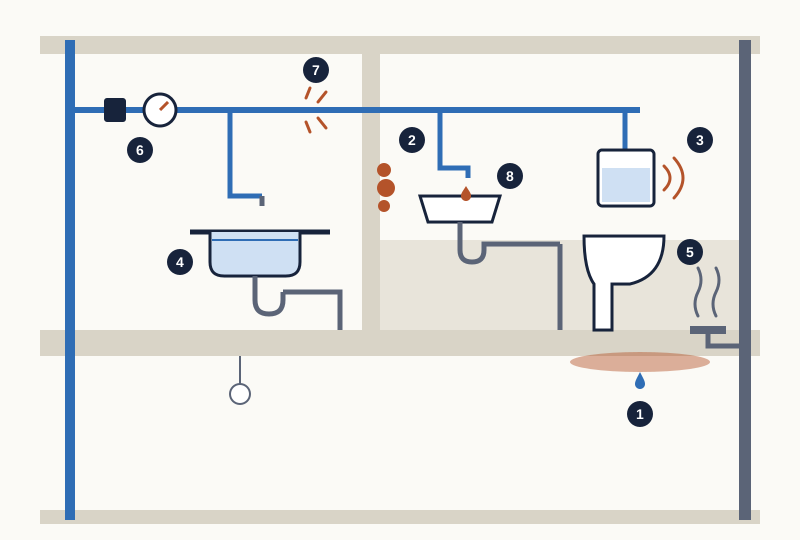
- Stain or drip on the ceiling of the flat below, usually under a bathroom
- Bubbling paint along a pipe concealed in the wall
- Cistern that hisses or refills by itself
- Sink that holds water or drains slowly
- Smell rising from the floor trap
- The flat's stop valve and meter (if fitted) on its branch from the riser
- Pipe that bangs when a tap is turned off
- Discoloured or brown water from a tap
Triage: how urgent is each sign?
| Sign | What it usually means | How urgent | Next step |
|---|---|---|---|
| Water actively escaping, or running towards a switch, socket or light | Burst pipe, loose hose or failed joint | Now | Close the stop valve and switch off the affected circuit, then call a plumber |
| A new or growing stain on the ceiling of the flat below | Leak from a bathroom or pipe above | This week | Trace the source with the bathroom leaks guide |
| Meter moves with every tap and toilet off | Leak in a supply pipe, a toilet or a hidden joint[1] | This week | Check the toilets first, then call a plumber |
| Toilet hisses or refills by itself | Worn flush valve seal or faulty fill valve[2] | Soon | See toilet flushing problems |
| Bubbling paint or a musty smell on a wall | Leak or damp inside the wall[3] | Soon | See inspecting water supply pipes |
| Pipes bang when a tap is turned off | Loose pipe, faulty valve or trapped air[6] | Within weeks | A plumber if it persists or gets worse |
| One sink or floor trap drains slowly | Hair, soap or grease building up[11] | Within weeks | See blocked drains |
| Several fittings or several flats gurgle or drain slowly together | Blockage in the building's shared drain pipe | This week | Tell the building committee or caretaker |
| Rotten-egg smell | Dry trap, broken seal or drain defect[9] | Today (now if strong) | See drain odours |
| Brown water and a flow that has fallen over months | Rust inside old GI pipes[8] | Plan for it | See repair or replace a pipe |
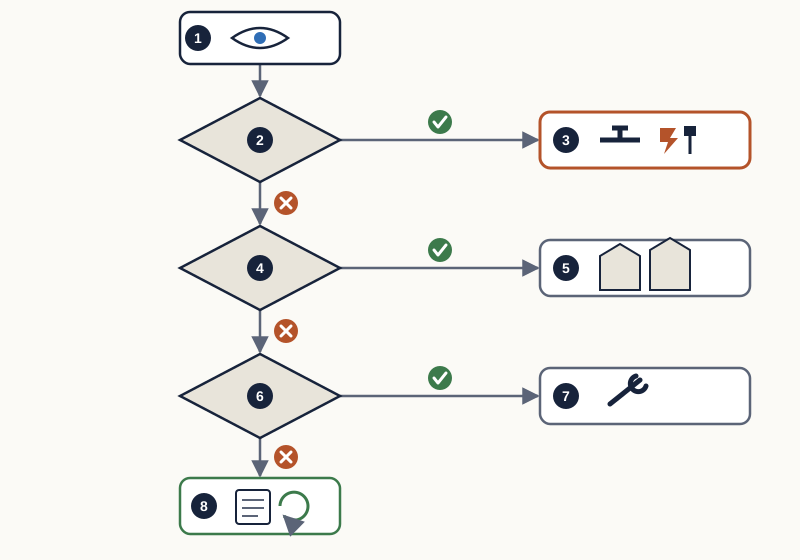
- You notice a sign
- Is water escaping now, or near anything electrical?
- Close the stop valve and the affected breaker now, then call a plumber
- Is the same sign in more than one flat or floor?
- Tell the building committee or caretaker in writing
- Is it getting worse, or coming back within a week?
- Call a plumber and show your notes
- Log it with the date and check again at the next monthly check
Tools you need for a regular check
- A torch, and a phone for dated photos.
- A notebook or a note on your phone for readings, dates and what you saw at each fitting.
- Dry toilet tissue or paper towel, which shows even slight moisture when held under a joint.
- Food colouring for the cistern test; flush afterwards so it does not stain.[1]
- Knowing where your stop valve and distribution board are.
Step by step: a 20-minute monthly early-warning check
Do this once a month at a time when nobody at home is using water. The same order each time makes months easy to compare.
- If you have a meter, read or photograph it first, use no water for two hours, then read it again. Any change means water is escaping somewhere.[1]
- While you wait, put a few drops of food colouring in each cistern. If colour appears in the pan within ten minutes without flushing, that toilet leaks.[1] In a four-bathroom flat such as those at RUAP, test every one, especially the bathroom used least.[2]
- Open the cupboard under each sink and basin and hold dry tissue under the angle valves, hoses and trap. Look for swollen boards or old tide marks on the cupboard floor.
- Look behind the washing machine and check that its hoses are properly connected; United Utilities includes this spot in its list of places to check.[4]
- Shine the torch at a low angle along walls next to bathrooms, the wall behind the kitchen and the ceilings; bubbling paint shows up much more clearly this way. Photograph anything new.[3]
- Run each tap for a few seconds: check the water is clear, the flow is as strong as usual, and the pipes stay quiet when you turn it off.[6]
- Pour a bucket of water into each sink, basin and floor trap and watch how fast it clears and whether it gurgles. This also tops up the water seal in traps that are rarely used.
- At the end of the two hours, take the second meter reading and write down everything with the date. Compare it with last month.
- Match what you found against the table above and follow the linked guide. For a full printable list covering the whole flat or building, use the plumbing inspection checklist.
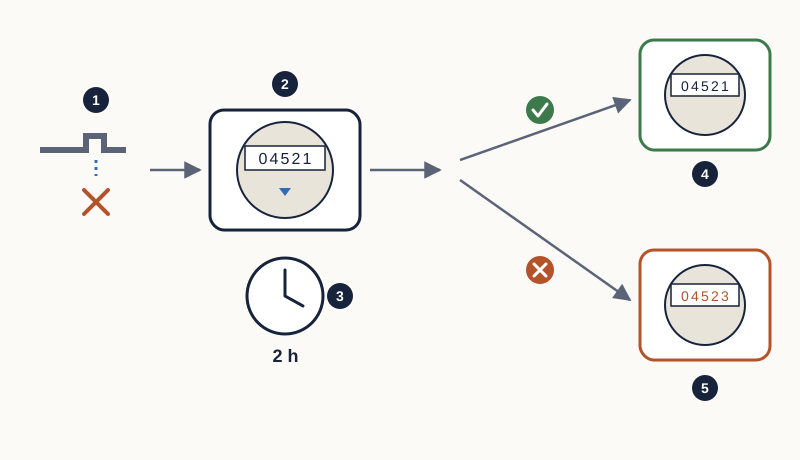
- All taps, toilets and appliances off; no cistern refilling
- Read or photograph the first reading
- Use no water for two hours
- Same reading: no leak found by this test
- Reading has risen: water is escaping; check the toilets first, then call a plumber
If the meter moves but every cistern passes the colour test, the leak is probably in a pipe inside a wall or under a floor. WaterSafe advises calling a leak-detection plumber when you cannot find the source yourself.[3] Before anyone breaks tiles, our guide to inspecting water supply pipes explains where to look.
If you find water escaping: the first few minutes
In an emergency the stop valve is your first line of defence; WaterSafe says that shutting it off quickly limits water damage and costly repairs.[12] The trouble is that many people do not know where theirs is, or find it has seized after years without being turned. Find it now and test it twice a year.
- If water has reached a socket, light or the distribution board, switch off the affected circuit breaker first, without standing in water.
- Close the flat's main stop valve; if the leak is at one fitting, closing its angle valve may be enough.
- Mop up and move wet belongings to dry, aiming to have everything dry within 24 to 48 hours.[5]
- Tell the flat below and the caretaker, so they can protect their own electrics and belongings.
- Photograph the source, the damage and the meter reading before the plumber arrives.
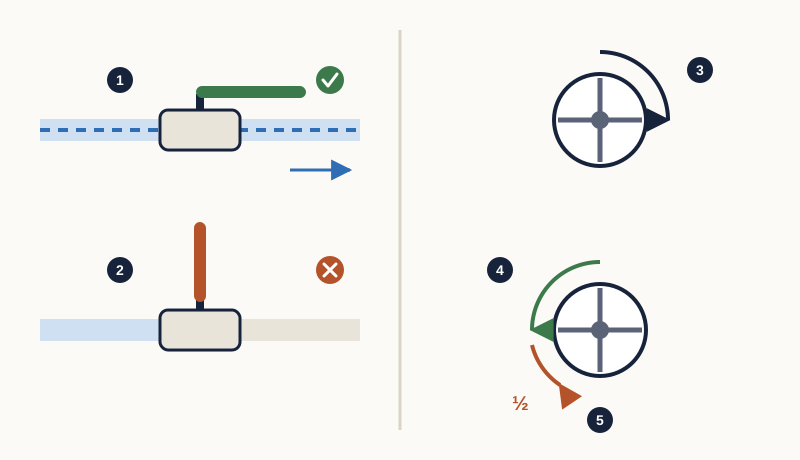
- Lever handle along the pipe: valve open, water flowing
- Lever handle across the pipe: valve closed
- Turning a screw-down valve's wheel clockwise closes it
- Turning it anticlockwise opens it
- After opening fully, turn it back half a turn so it does not seize
Prevention: habits that stop small problems starting
- Monthly: the 20-minute check above, with the meter reading and results written down.
- Every six months: close and reopen the stop valve once; leave a lever valve fully open, and turn a screw-down valve back half a turn after opening it fully.[12]
- Daily: wipe plates before washing, use a sink strainer and never pour cooking oil down the drain.[10]
- Weekly: lift hair out of shower and floor-trap grates.[11]
- In a bathroom that is rarely used: run the taps, flush and pour water into the floor trap once a week.
- Seasonally: before and after the monsoon, check ceilings and outside walls for stains, so a plumbing leak can be told apart from rain coming in.
- After any repair: check the new joints with dry tissue every day for a week.
Telling a plumbing stain from monsoon seepage is covered in our guide to damp walls and seepage. For how repairs are usually split between owners and tenants, see flat maintenance.
Common mistakes and troubleshooting
- Painting over a stain. Without fixing the cause, the leak carries on out of sight.
- Treating every drop as a leak. Beads spread evenly over a cold pipe are usually condensation, which calls for ventilation and pipe insulation.[5]
- Calling a plumber over one high bill. First check for extra people, guests or an estimated bill, then do the meter test.[4]
- Assuming a smell that has gone means the problem has gone. At high levels of hydrogen sulphide the nose can stop detecting it quite quickly.[9]
- Pouring boiling water or strong chemicals into a slow drain. Grease simply sets again further down,[10] and mixed chemicals can be dangerous.
- Ignoring banging pipes. WaterSafe warns that the pressure changes behind the noise can weaken joints over time.[6]
- Keeping no record. Without dates and photos, talks with a plumber, a neighbour or the committee turn into guesswork.
Do it yourself, call a plumber or tell the committee?
- You: the monthly check, clearing drain grates, topping up rarely used traps, tightening a loose hose connection, and turning valves twice a year.
- A plumber: a meter that moves with no visible source, a growing stain on a wall or ceiling, a stop valve that will not turn,[12] banging that does not stop,[6] or a blockage that keeps coming back.
- An electrician: water that has reached any switch, socket, light or the board; any work after you have switched the breaker off.
- The building committee or caretaker: the same sign in several flats or floors, or problems with the building's risers, main drain, roof tank or pump.
Show the plumber your notes: since when, which fitting, the meter readings and dated photos of any stain. That shortens the search and lowers the chance of tiles being broken for nothing. For the decision on whether a damaged pipe should be repaired or replaced, see this guide.
What drives the cost, and why early is cheaper
We could not find reliable published prices for this work in Bangladesh, so this guide gives none. EPA estimates that fixing easily corrected leaks can save around 10 per cent on a water bill,[1] but the larger saving is the damage avoided. What drives the cost:
- Access: an exposed joint or hose is a small job; a pipe inside a wall or floor means breaking and re-laying tiles and plaster, often most of the bill.
- Time: every week a leak runs adds plaster, paint, furniture and the ceiling below to the repair list.
- Parts versus whole fittings: replacing a seal or fill valve costs far less than replacing a whole toilet or mixer.
- Finding the leak: tracing a hidden leak takes time and equipment; your notes cut this down.
- Call-outs: night and holiday emergencies usually cost more; a problem caught early can wait for a convenient time.
Before any larger job, get written quotes that name the parts, pipe sizes, the breaking and making-good work and the warranty, and compare at least two; see our guide to getting and comparing repair quotes.
Next steps
- Today: find your flat's stop valve and distribution board and show everyone in the household.
- This week: do your first 20-minute check, with the two-hour meter test if you have a meter, and write down the results.
- Match what you find against the triage table and deal with the most urgent item first.
- If several flats or floors share a sign, tell the committee in writing, with dates and photos.
- Set a monthly reminder on your phone, and add turning the stop valve every six months to the list.
Common questions
- My flat has no water meter of its own. How can I tell if there is a hidden leak?
- There are other clues. Do the food-colouring test in every cistern,[1] listen quietly at night, and look for new stains on walls, cupboard floors and the ceiling of the flat below.[3] Ask the caretaker whether the building pump has been running longer than usual; that can be a rough sign of a leak somewhere in the building.
- There is a stain on my ceiling. Is it plumbing from the flat above, or rain?
- Watch when it grows. If it spreads after the flat above has showers or flushes, a plumbing or bathroom fault is more likely; if it grows only after rain, water may be coming through an outside wall or the roof. Take dated photos, tell your upstairs neighbour politely, and see our guide to damp walls and seepage.
- The pipes bang when I turn a tap off. Is that dangerous?
- Not immediately, but it is worth fixing. WaterSafe says the sudden pressure changes behind the noise stress pipes and joints and can cause leaks over time; loose pipe clips, faulty valves and trapped air are common causes. Call a plumber if the noise continues or gets worse.[6]
- My bathroom sometimes smells of rotten eggs. How worried should I be?
- It is usually hydrogen sulphide from the drains, which people can smell at very low levels.[9] A common cause is a floor trap that has dried out because the bathroom is rarely used; pour in water and see if the smell goes. If it is strong or causes headaches, ventilate the room and call a plumber.
- How often should I do these checks?
- A 20-minute walk-round once a month is enough for most flats, plus closing and reopening the stop valve every six months.[12] Add an extra check after renovation work, a pipe repair or a break in the water supply.
- I am a tenant. What should I do when I notice a sign?
- For an active leak, close the stop valve first, then take dated photos and tell your landlord in writing. Report small signs too, because problems reported early are usually cheaper to fix. Who repairs what depends on your tenancy agreement; see flat maintenance.
Sources
The facts in this guide were checked against these sources.
- Fix a Leak Week — US Environmental Protection Agency (WaterSense) (published Last updated 13 March 2026). accessed 18 October 2026.
- Water Wise: Water Conservation In The Home (G2190) — University of Nebraska–Lincoln Extension (Skipton and Dvorak) (published June 2013). accessed 18 October 2026.
- How to Find a Water Leak Inside a Wall — WaterSafe Register (UK). accessed 18 October 2026.
- Find leaks inside your home or business — United Utilities. accessed 18 October 2026.
- A Brief Guide to Mold, Moisture and Your Home — US Environmental Protection Agency (published Last updated 18 February 2026). accessed 18 October 2026.
- What Causes Water Pipes Banging? — WaterSafe Register (UK). accessed 18 October 2026.
- Low water pressure — Consumer Council for Water (CCW). accessed 18 October 2026.
- Galvanized iron pipes — East Bay Municipal Utility District (EBMUD). accessed 18 October 2026.
- Hydrogen Sulfide | ToxFAQs — Agency for Toxic Substances and Disease Registry (ATSDR), US CDC (published Page last reviewed 28 October 2024). accessed 18 October 2026.
- Fats, oils, and grease (FOG) — Northumbrian Water. accessed 18 October 2026.
- Maintaining your bathroom: Service for showers, traps and cisterns — Geberit. accessed 18 October 2026.
- Check your stop tap as clocks fall back — WaterSafe Register (UK). accessed 18 October 2026.
This guide is general information. Have gas, structural and live electrical work done by a qualified, licensed professional. Your building’s rules and committee decisions take precedence over anything written here.
Written from the cited sources by the RUAP.NET editorial team. It has not been reviewed by a licensed engineer, plumber or electrician; for work on gas, structure or live electrics, use a qualified professional.
Spotted a mistake? Tell us — we check it, correct the guide and record the date of the correction. Report an error →