
Which Pipe for the Repair? GI, uPVC, CPVC, PPR, PEX, Copper and HDPE Compared
The wrong pipe material can soften on a hot line, corrode where two metals meet or break a building's earthing. This guide helps flat owners and committees choose the right material for each job in a repair.
There is no single best pipe. Several materials suit cold water, but a hot line needs a material and pressure class rated for hot water, such as CPVC, PPR or PEX, never ordinary uPVC, which the maker Westlake limits to 60°C.[6]
For a small repair, the safest choice is usually the material already there, or a proper transition fitting into a new one. Never join different metals directly, and let no one cut out metal pipe until an electrician has checked the earthing.[10]
Buy pipe and fittings from one system, printed with their standard and pressure class and certified for drinking water. In Bangladesh, BSTI's mandatory certification list includes uPVC drinking-water pipe, polyethylene water pipe and galvanised steel pipe.[12]
Some steps carry risk — follow the warnings, and call a tradesperson if in doubt.
When a supply pipe is repaired or replaced, someone decides what the new pipe is made of, and often the plumber simply uses whatever is in the van. This guide explains the common materials and the questions to ask. How much pipe to change is covered in when to repair or replace a damaged water pipe.
Why the wrong material causes problems
Many failures after a repair come from a mismatch between the pipe and its job:
- A plastic pipe used above its temperature rating. Plastics lose strength as they warm, so a pipe that is fine on a cold line can soften and leak on a geyser outlet.[6]
- A pressure class too low for the position: pipes near pumps, on booster lines or on lower floors carry more pressure than those just below a roof tank.
- Two metals joined directly. Where steel meets copper or brass without an insulating fitting, galvanic corrosion can eat into the joint.[11]
- Fittings with too much lead. The US Environmental Protection Agency (EPA) notes that, where there is no lead service pipe, the commonest lead sources are brass taps and lead solder.[13]
- A break in the electrical earthing when a length of metal pipe is swapped for plastic.[10]
The main pipe materials, one by one
Brands and grades differ, so treat the figures below as examples from named publishers and check the data for the exact product you buy.
Galvanised iron (GI) or galvanised steel
GI pipe is zinc-coated steel joined with screwed threads. It is strong and resists knocks, so it is still found on exposed and shared pipework in many older buildings. Its weakness is inside: once the zinc is spent, rust narrows the bore and thins the wall, and the threads usually fail first. InspectAPedia, a building-inspection reference, gives galvanised steel water pipe a typical life of about 40 to 60 years.[11] Matching a short length of sound GI keeps a small repair simple; if the surrounding GI is old and rusting, plan a change of material.
uPVC (unplasticised PVC)
uPVC is a rigid plastic pipe joined with solvent cement, a liquid that softens the pipe and socket so that they weld together. It does not rust, is light and inexpensive, and is widely used for cold water. Its limit is heat. Westlake Pipe & Fittings, a PVC pipe maker, gives 60°C (140°F) as the maximum for PVC pipe and says its pressure rating must be reduced above about 23°C; at 60°C only a fifth of the rated pressure remains.[6] Treat uPVC as cold-water pipe, and make sure it is pressure pipe, not drainage pipe or electrical conduit.
CPVC (chlorinated PVC)
CPVC is PVC that has been further chlorinated to raise its temperature performance. It is also joined with solvent cement, but with a cement made for CPVC. The Plastics Pipe Institute (PPI), the North American plastic pipe industry association, gives CPVC tubing standard ratings of 400 psi (about 27.6 bar) at 23°C and 100 psi (about 6.9 bar) at 82°C (180°F), and lists hot and cold water among its main uses. It also describes CPVC pipe and fittings as broadly compatible between makers, which is not true of every plastic system.[3]
PPR (polypropylene random copolymer)
PPR, also written PP-R, is joined by heat fusion: the pipe end and the inside of the fitting are heated on a tool and pushed together so that they melt into one piece, with no glue or flame. PPI says PP-R and the stronger PP-RCT are used for hot and cold water, including in high-rise buildings, and that pipe with an SDR 9 wall or thicker is rated at 100 psi (6.9 bar) at 82°C.[2] Temperature matters a great deal: Valrom, a European maker, rates one thick-walled PPR pipe at 20 bar for cold water but 8 bar for continuous 70°C hot water. It also gives an expansion of 0.15 mm per metre per degree, so a 3-metre hot run warming by 50°C grows by over 2 cm.[7] Exposed hot runs need room to move; some PPR contains glass fibre to reduce expansion.[2]
PEX (cross-linked polyethylene)
PEX is a flexible plastic tube whose molecules are chemically linked, which keeps it strong when hot. Because it bends, it runs long distances with few fittings, and it is joined with mechanical fittings rather than flame or glue. PPI gives common PEX tubing standard ratings of 160 psi (about 11 bar) at 23°C and 100 psi (6.9 bar) at 82°C, says it can generally replace copper size for size, and has published labelling guidance on sunlight exposure, so keep it out of direct sun as its maker instructs.[4] Crimp, press and expansion fittings each need their own tools and parts.
Copper
The Copper Development Association, the copper industry body, describes copper tube as light, strong and corrosion-resistant, used in homes and high-rise apartments alike. It is usually soldered into capillary fittings with a flame, brazed where stronger joints are needed, or joined without heat by press-connect and push-connect fittings.[8] Solder and flux for drinking water should be lead-free, which US law defines as no more than 0.2% lead.[9] Copper must never be joined straight onto GI or steel, and it usually costs more than plastic.
HDPE (high-density polyethylene)
HDPE is a tough, flexible pipe used mainly for buried mains and incoming supply pipes rather than inside flats. It is joined by heat fusion. PPI says fused HDPE joints are as strong as the pipe, that HDPE will not corrode, and that it bends to a radius of about 25 times its diameter.[5] For hot water inside the flat, choose one of the hot-rated materials above.
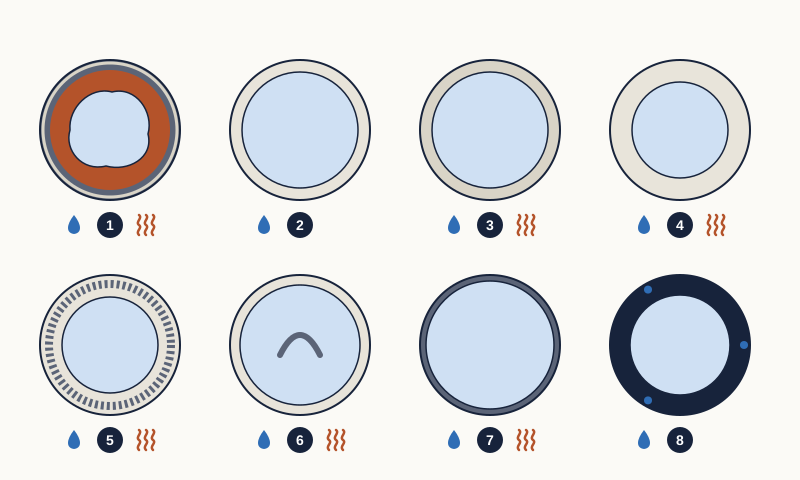
- GI: zinc-coated steel; rust builds up inside and narrows the bore
- uPVC: rigid plastic for cold water only
- CPVC: rigid plastic for hot and cold water within its rating
- PPR: thick wall, heat-fused joints
- PPR with a fibre-reinforced layer to limit expansion on hot runs
- PEX: flexible tube that bends round corners with few fittings
- Copper: thin, strong metal wall
- HDPE: tough, flexible pipe used mainly for buried and incoming supply
Hot water, pressure and the markings on the pipe
A pressure rating always belongs to a temperature. For plastics the safe pressure falls as the water gets hotter, so on a hot line read the hot-water rating.[3] Terms you will see:
- PN (nominal pressure) is a pressure class in bar, normally for cold water. A pipe marked PN 20 is not a 20-bar pipe on a hot line.[7]
- SDR (standard dimension ratio) is the outside diameter divided by the wall thickness. A lower SDR means a thicker wall and a higher pressure rating.[2]
- European PPR is often sold by application class, such as a 60°C or 70°C hot-water duty over the design life, each with its own pressure.[7]
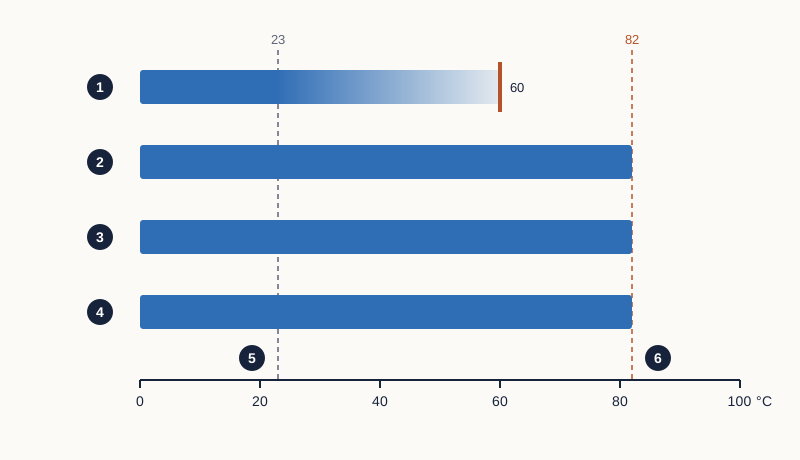
- PVC (uPVC): maximum 60°C; the fading bar shows the rated pressure falling steeply above 23°C
- CPVC tubing: rated 100 psi (about 6.9 bar) at 82°C
- PEX tubing: rated 100 psi at 82°C
- PP-R and PP-RCT with SDR 9 walls or thicker: rated 100 psi at 82°C
- 23°C: the reference temperature for most cold-water ratings
- 82°C (180°F): the temperature at which North American hot-water ratings are given
Joining methods: why to stay within one system
Most installation faults show at joints, and each material has its own method:
- Threaded joints (GI, and threaded adaptors on other pipes) are sealed with tape or paste; cutting the thread removes metal from the wall.[11]
- Solvent-cement joints (uPVC, CPVC) need the cement made for that plastic.[3] The pipe must go fully into the socket, and the joint needs time to cure before the water goes on.
- Heat-fusion joints (PPR, HDPE) need the right tool and heating time; PPI says fused HDPE joints are as strong as the pipe itself.[5]
- Press and push fittings (PEX, and copper press systems) need the fitting and tool made for that system.[8]
- Soldered and brazed joints (copper) need a flame and lead-free filler.[9]
Valrom does not accept threaded joints in screed or walls for its PPR pipe, a sensible rule anywhere: keep screwed adaptors where they can be reached.[7] Unless both makers confirm compatibility, use one brand of pipe, fittings and valves throughout a fused, pressed or push-fit run.
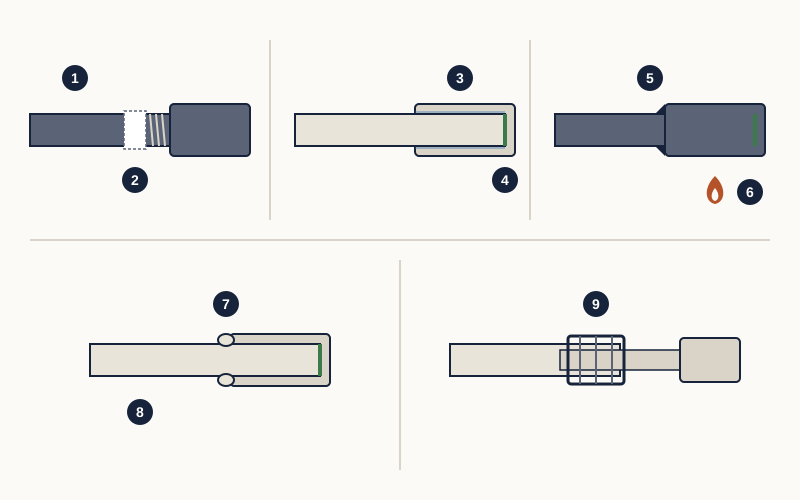
- Threaded GI joint: cutting the thread thins the pipe wall
- Sealing tape or paste wound on the thread before it enters the fitting
- Solvent-cement joint (uPVC, CPVC): a cement layer between pipe and socket
- Pipe pushed fully home to the socket stop
- Soldered copper joint: solder fills the gap and shows at the mouth
- Soldering and brazing need a flame; press fittings do not
- Heat-fused PPR joint: an even bead of melted plastic all round the mouth
- Pipe and socket fuse into one piece, with no glue or thread
- Press or crimp fitting (PEX, some copper): a sleeve pressed over the pipe onto an insert with the tool made for that system
Mixed metals, plastic replacements and earthing
Where two metals meet
When steel or GI is joined straight to copper or brass, the two metals and the water act like a small battery and the steel corrodes at the joint. InspectAPedia notes that most plumbing codes require a dielectric (insulating) fitting between steel and copper, and some accept a short brass nipple instead.[11] One US city asks for six inches (about 15 cm) of brass pipe or a brass valve between dissimilar metals.[10]
When metal pipe is replaced with plastic
In some buildings, metal water pipe is part of the electrical earthing or bonded to it, and a plastic section or insulating union can break that path. The City of Bellevue in Washington State, for example, requires the earth to be kept intact when metal water pipe is replaced with plastic, requires bonding around insulating fittings, and says a licensed electrical contractor should do the bonding.[10] Rules in Bangladesh may differ; only an electrician can tell you how your building is earthed.
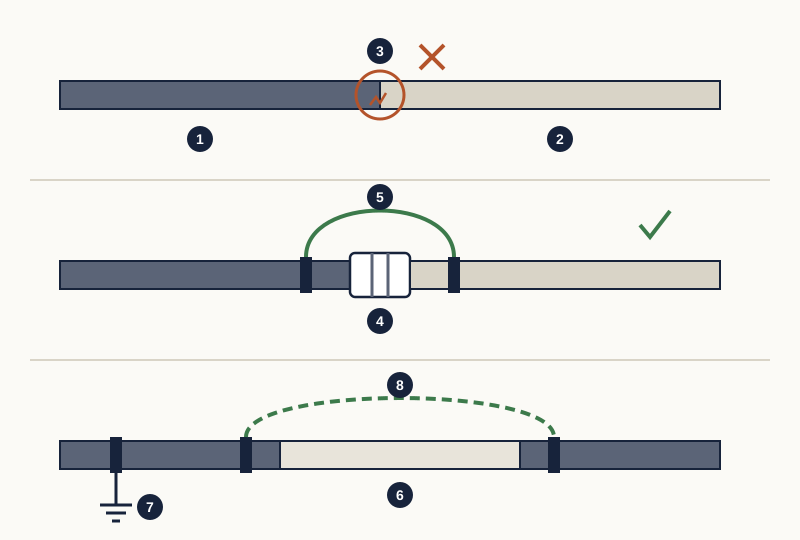
- GI or steel pipe
- Copper or brass pipe
- Joined directly: galvanic corrosion attacks the steel at the joint; avoid
- Dielectric (insulating) union separating the two metals
- Bonding wire around the insulating union keeps the metal pipe electrically continuous where required
- Plastic section cut into a metal pipe breaks the electrical path
- Earth connection on the metal pipe
- Bonding conductor fitted by an electrician where the earthing depends on the pipe
Drinking-water approval and standards marks
Drinking-water pipe should be certified for that use. PPI says plastic pipe for hot and cold water must carry third-party certification showing it is safe for that use,[1] and that PP-R is suitable for drinking water when certified to NSF/ANSI/CAN 61, a North American standard for drinking-water components.[2] HDPE water pipe is likewise specified under NSF 61.[5]
In Bangladesh, the Bangladesh Standards and Testing Institution (BSTI) lists the products that must carry its certification mark. Its 2025 list of 315 products includes uPVC pipes and fittings for potable water supply (BDS 1878:2015), polyethylene pipes and fittings for water supply (BDS ISO 4427) and black and zinc-coated (galvanised) steel pipe (BDS ASTM A53/A53M:2024).[12] We did not find PPR, CPVC or PEX on that list, so for those, ask the seller which standard the product is made to and for any certificate of drinking-water suitability.
- Good pipe is printed with the maker, product line and material, such as PP-R, PVC-U, CPVC or PEX.
- The outside diameter and the wall thickness or SDR.
- The pressure class and, for hot-water pipe, the temperature or application class.
- The standard, certification marks and a batch code.
Pipe materials compared at a glance
| Material | Hot water? | Usual joint | Strengths | Watch out for |
|---|---|---|---|---|
| GI (galvanised steel) | Used for hot and cold | Screwed threads | Strong, resists knocks | Rusts inside; threads fail first[11] |
| uPVC | No: maximum 60°C, with steep derating[6] | Solvent cement | Light, inexpensive, no rust | Heat; mix-ups with drainage pipe |
| CPVC | Yes, within its rating[3] | CPVC solvent cement | No flame to join | Wrong cement; weaker when hot |
| PPR | Yes, in a hot-water class[2] | Heat fusion | Fused joints, no glue or thread | Expansion when hot; trained fuser |
| PEX | Yes, within its rating[4] | Crimp, press or expansion fittings | Flexible, few joints | Own tools; sunlight |
| Copper | Yes[8] | Solder, braze, press or push | Strong, long track record | Cost; never straight onto GI |
| HDPE | Mainly cold, buried supply | Heat fusion | Flexible, does not corrode[5] | Rarely used inside flats |
Tools and materials: what to have and agree before work starts
You need no plumbing tools to choose a material, but these help:
- A note of the existing pipe: material, printed size, hot or cold.
- A small magnet: GI and steel are magnetic, brass is not, which helps identify painted pipe.[11]
- Photos of the pipe printing and of the fittings at each end of the repair.
- From the plumber: the joining tools for the chosen system and a test pump with a gauge.
- An electrician booked in advance if metal pipe is coming out.
Step by step: choosing the material for a repair
- Identify the pipe on each side of the repair, and whether it is your flat's pipe or a shared riser, which is for the committee to decide.
- Decide whether the line is hot or cold. For a hot line, shortlist only materials and classes rated for hot water.[3]
- Ask the caretaker or committee what pressure the pipe will see from pumps and boosters. Low water pressure in apartment buildings explains how tank-fed buildings deliver water.
- For a short spot repair in sound pipe, match the existing material. For a whole run or a re-pipe, choose one modern system and use it throughout.
- Plan every point where new meets old: a transition adaptor from the new system, and a dielectric fitting or brass piece between different metals.[11]
- If metal pipe will be removed or isolated, have an electrician confirm the earthing first.[10]
- Check approval: drinking-water certification and, for products on BSTI's mandatory list, the BSTI mark.[12]
- Put the material, brand, size and pressure class in the quote so that quotes compare like with like; see how to get and compare repair quotes.
- Agree a pressure test before the wall is closed. Checking plumbing after a renovation explains what to look for.
Common mistakes to avoid
- Using leftover uPVC on a geyser line "just for a short length".
- Choosing a pressure class for cold water and using the same pipe on the hot side.[7]
- Screwing a brass or copper fitting straight onto old GI.[11]
- Using ordinary PVC cement on CPVC, or any glue on PPR, which is meant to be fused.
- Running plastic pipe in full sun on a roof or outside wall without the maker's approval or protection.
- Removing metal pipe without asking whether it is part of the earthing.[10]
Prevention: helping new pipework last
- Clip pipes at the spacing the maker gives, and leave hot plastic runs room to expand.[7]
- Keep plastic pipe away from cooker flues, geyser bodies and other heat sources unless it is rated for them.
- Shield exposed plastic from sunlight with the sleeve or covering its maker recommends, or route it in shade.
- Keep a record of the material, brand and routes so that the next repair uses compatible parts; routine checks are in how to inspect water supply pipes.
When to call a plumber or an electrician
You can share in choosing the material; installing it is not a job for most residents. For a change of material, hot lines and pipes in walls or floors, use a plumber trained and equipped for that system, such as one with a proper PPR fusion kit or the correct PEX tool. Call an electrician before metal pipe is removed or an insulating fitting is added.[10] Shared risers, pump lines and anything before your flat's valve are for the building committee.
What drives the cost of different pipe materials
We could not find reliable published prices for pipe or plumbing labour in Bangladesh, so this guide gives no figures. The cost of a repair usually depends more on the work than on the pipe:
- Access: breaking and reinstating tiles, plaster and waterproofing often costs more than the pipe.
- Fittings and transitions: valves, adaptors and dielectric fittings add up, especially when changing material.
- Tools and skills: fusion, press and crimp systems need their own tools and trained hands.
- Material: metal pipe and fittings usually cost more than plastic, and hot-water grades more than cold-water grades.
Ask for at least two written quotes that name the same material, brand and pressure class, so that you compare like with like.
Checklist before you approve the material
- Hot lines use a hot-rated material and class; cold-only pipe is on cold lines only.
- The pressure class suits the highest pressure in your part of the building.
- Pipe, fittings and valves come from one system, or the makers confirm they are compatible.
- Every change of material uses a proper adaptor; no steel joined straight to copper.
- Drinking-water certification and, where required, the BSTI mark are on the product.[12]
- An electrician has checked the earthing if metal pipe is being removed.
- A pressure test is agreed before any wall or floor is closed.
Next steps
- Identify the pipe you have now from its printing, a magnet and photos.
- Shortlist materials using the table above, and choose one system for any run you replace.
- Book an electrician if metal pipe is coming out.
- Get written quotes that name the material and pressure class.
- Keep the pipe details, photos and pressure-test record with your flat's documents.
Common questions
- Can I use uPVC pipe for hot water?
- No. PVC loses strength quickly as it warms. Westlake Pipe & Fittings gives 60°C (140°F) as the maximum for PVC pipe and, at that temperature, leaves only a fifth of the rated pressure.[6] Use CPVC, PPR or PEX in a grade rated for hot water.
- Is PPR better than CPVC?
- Neither is best for every job; both come in grades rated for hot and cold water.[2][3] PPR is heat-fused, CPVC is solvent-cemented. The choice often depends on which system your plumber is trained and equipped for, which certified products you can buy, and whether spares will be easy to find later.
- Can new PPR or CPVC be joined to old GI pipe?
- Yes, through a threaded transition adaptor from the plastic system, screwed onto sound GI thread. Keep that joint where it can be reached; at least one PPR maker does not accept threaded joints buried in walls or screed.[7] If the GI near the joint is rusting, consider replacing the whole run instead.
- Why does changing a water pipe need an electrician?
- Because metal water pipe can be part of a building's earthing, and replacing it with plastic can break that path. US building guidance, for example, requires the earth to be maintained and leaves bonding to a licensed electrical contractor.[10]
- How do I know a pipe is safe for drinking water?
- Look for drinking-water certification, such as NSF/ANSI/CAN 61, printed on the pipe or in its documents,[2] and, for products on BSTI's mandatory list such as uPVC water pipe, the BSTI mark.[12] If the printing does not say, ask the seller for the certificate before you buy.
Sources
The facts in this guide were checked against these sources.
- Hot & Cold Water Plumbing Distribution — Plastics Pipe Institute (PPI). accessed 18 October 2026.
- PP-R & PP-RCT Pipe — Plastics Pipe Institute (PPI). accessed 18 October 2026.
- CPVC Pipe and Tubing — Plastics Pipe Institute (PPI). accessed 18 October 2026.
- PEX Pipe and Tubing — Plastics Pipe Institute (PPI). accessed 18 October 2026.
- Potable Water Benefits - HDPE — Plastics Pipe Institute (PPI). accessed 18 October 2026.
- Maximum Allowable Operating Temperature of PVC Piping Systems — Westlake Pipe & Fittings. accessed 18 October 2026.
- VALDuotherm GREEN PPR PIPE D. 32×5.4 mm SDR6 L3 m — Valrom Industrie. accessed 18 October 2026.
- Copper Tube Handbook [web version] — Copper Development Association. accessed 18 October 2026.
- Use of Lead Free Pipes, Fittings, Fixtures, Solder, and Flux for Drinking Water — US Environmental Protection Agency (EPA) (published Last updated 19 May 2026). accessed 18 October 2026.
- Electrical Grounding and Water Service Re-piping — City of Bellevue Development Services (Washington, USA) (published 4 March 2020). accessed 18 October 2026.
- Galvanized Iron Water Supply Piping, & Galvanized Drain Piping — InspectAPedia. accessed 18 October 2026.
- List of 315 Products Brought Under Mandatory Certification Marks Wing — Bangladesh Standards and Testing Institution (BSTI) (published 3 June 2025 (date shown on the BSTI mandatory products page)). accessed 18 October 2026.
- Basic Information about Lead in Drinking Water — US Environmental Protection Agency (EPA) (published Last updated 18 June 2026). accessed 18 October 2026.
This guide is general information. Have gas, structural and live electrical work done by a qualified, licensed professional. Your building’s rules and committee decisions take precedence over anything written here.
Written from the cited sources by the RUAP.NET editorial team. It has not been reviewed by a licensed engineer, plumber or electrician; for work on gas, structure or live electrics, use a qualified professional.
Spotted a mistake? Tell us — we check it, correct the guide and record the date of the correction. Report an error →