
Split AC Maintenance: What Flat Owners Can Do, and What to Leave to a Technician
A split air conditioner that cools weakly, drips water indoors or runs up the electricity bill usually needs simple care, not a new machine. This guide explains the routine jobs an owner can do safely and the ones that need a trained technician.
Clean the indoor unit's filters at least monthly in the cooling season, keep the condensate drain flowing and keep the outdoor unit's surroundings clear. ENERGY STAR recommends a monthly filter check and a professional service before each hot season.[4]
Always switch off at the breaker before cleaning. Never lean out of a window or climb onto a bracket to reach the outdoor unit.
Refrigerant ('gas') and electrical work is for a trained technician. A unit that keeps needing gas has a leak that should be repaired, not topped up.[8][1]
Some steps carry risk — follow the warnings, and call a tradesperson if in doubt.
A split air conditioner is two machines joined by pipes, one on your room wall and one outside. Most of its care is simple owner work; anything involving the refrigerant (the 'gas') or the wiring is for a trained technician.
How a split AC works, and which parts need care
The indoor unit draws room air through a filter and over a cold coil, then blows it back out cooler and drier. Refrigerant carries the heat from that coil through insulated pipes to the outdoor unit, whose fan and coil release it outside.[5] Water condensed from the air collects in a tray under the indoor coil and leaves through a drain pipe. The parts an owner looks after are the filters, the drain and the space around the outdoor unit. The coils, refrigerant circuit and electrical connections belong to the technician.
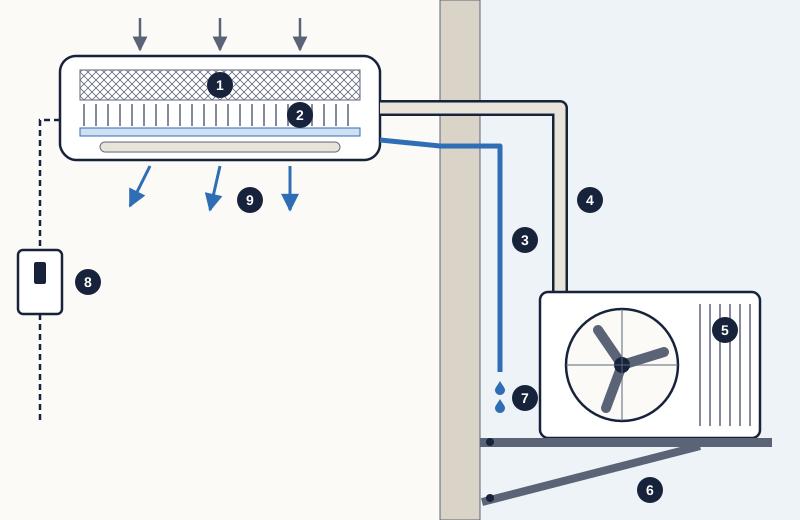
- Air filters behind the front panel: the part you clean
- Indoor coil (evaporator), which cools and dries the air; cleaned by a technician
- Condensate drain pipe carrying water from the drip tray
- Insulated refrigerant pipes between the two units: technician only
- Outdoor unit: the condenser coil and fan release heat outside
- Wall bracket and its fixings
- Drain outlet, where water should drip freely while cooling
- Breaker or isolator for the AC: switch off here before cleaning
- Cooled air leaves through the louvres; room air enters at the top
Warning signs your AC needs attention
- The room cools far more slowly than it used to.
- Water drips from the indoor unit or runs down the wall.
- No water drips from the drain outlet on a humid day while cooling.
- Ice on the pipes or coil, or an oily patch near a pipe joint.
- New rattling, grinding or banging.
- A musty smell at start-up, or dark spots on the louvres or fan.
- A tripping breaker, a hot plug or socket, or a burning smell. Switch off at the breaker and read electrical warning signs every flat owner should know.
- Rising electricity bills. ENERGY STAR notes that a dirty filter raises energy costs and can lead to early equipment failure.[4]
Some things are normal. The manufacturer GENERAL (formerly Fujitsu General) lists water sounds in the drain pipe, refrigerant flow for 2 to 3 minutes after start-up, and slight squeaks as the casing expands or contracts.[10] A faint mist from the indoor unit in cooling or dry mode is moisture condensing in the cold air stream.[13] And if you switch the unit off and straight back on, or power returns after load-shedding, the compressor waits about 3 minutes before it starts.[12]
Common causes of poor cooling and leaks
Dirty filters and coils
Dust on the filters restricts airflow, which is why GENERAL treats regular filter cleaning as every owner's minimum maintenance.[7] Dirt that gets past the filter coats the coils. ENERGY STAR says dirty coils reduce cooling and shorten the system's life, and that airflow problems can cut efficiency by up to 15 percent.[4]
The room itself
Before blaming the machine, GENERAL suggests checking for blocked grilles, an unsuitable temperature setting, an open door or window, direct sunlight, heat-producing equipment or a crowded room, and a quiet mode that limits output.[9]
A blocked or badly laid drain
When the drain clogs, the tray overflows and water comes out of the indoor unit. ENERGY STAR warns that a plugged drain can cause water damage and affect indoor humidity.[4] A hose that sags, kinks or rises on its way out, or a unit that is not level, can cause the same overflow.
A refrigerant leak
A correctly installed unit should not need its refrigerant topped up during its life; it only runs short if there is a leak, which a qualified technician must find and repair.[8] The US Environmental Protection Agency (EPA) says the same: a leaking unit should be repaired, not just 'topped off'.[1]
Tools and materials for routine care
- The owner's manual, or the model number from the indoor unit's label to find it online.
- A stable step stool or stepladder, and a helper to steady it.
- A vacuum cleaner with a soft brush attachment, or a soft brush.
- A sink, mild detergent if your manual allows it, and towels.
- A torch for checking the drain hose, pipes and bracket.
Step by step: cleaning the filters
ENERGY STAR advises inspecting filters monthly, and cleaning split-unit filters when visibly dirty or when the filter light comes on.[4][5] Your manual may ask for more often. Ask the installer to show you the steps once, as GENERAL recommends.[7]
- Switch the AC off with the remote, then switch off its breaker or isolator so it cannot start while your hands are inside.
- Set the step stool on a dry, level floor and have someone hold it.
- Lift the front panel until it stays open, following the manual for your model.
- Slide the filters out gently and note which way round they fit. Take a photo if it helps.
- Vacuum off loose dust, or rinse the filters with water. Use detergent and warm water only as your manual allows; very hot water can warp plastic filters.
- Let the filters dry completely in the air before refitting them. Do not run the unit without them.
- Wipe the front panel and louvres with a dry or slightly damp cloth. Do not spray water or cleaner into the unit.
- Refit the filters, close the panel, restore power and check that the airflow feels stronger. Note the date.
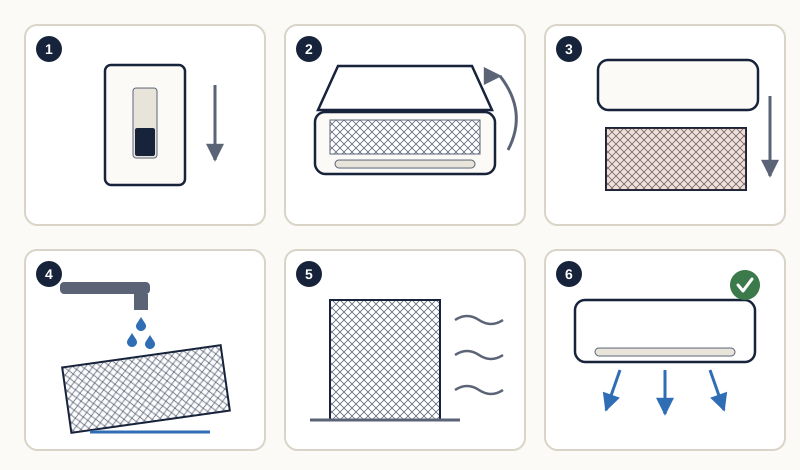
- Switch off with the remote, then at the breaker or isolator
- Lift the front panel until it stays open
- Slide the dusty filters out, noting how they fit
- Vacuum or rinse off the dust, as your manual allows
- Let the filters dry completely in the air
- Refit, close the panel, restore power and check the airflow
Keeping the condensate drain flowing
In Dhaka's humid months a split AC removes a lot of water from the air, so the drain works hard. EPA's moisture guidance advises keeping air-conditioning drip pans clean and drain lines unobstructed and flowing.[6] ENERGY STAR lists checking the drain as part of a professional service.[4] Between visits you can check it yourself:
- On a humid day, after a while, water should drip steadily from the outlet.
- Follow the visible hose with a torch: it should fall all the way, with no sags or kinks.
- Keep the outlet open, out of mud, pots and puddles, and free of insects or slime.
- Check where the water lands: not on a walkway, a neighbour's veranda or an outside wall; see how to prevent damp walls and seepage.
- If water comes out of the indoor unit, switch off, dry the area and call a technician. EPA advises drying wet materials within 24–48 hours to prevent mould.[6]
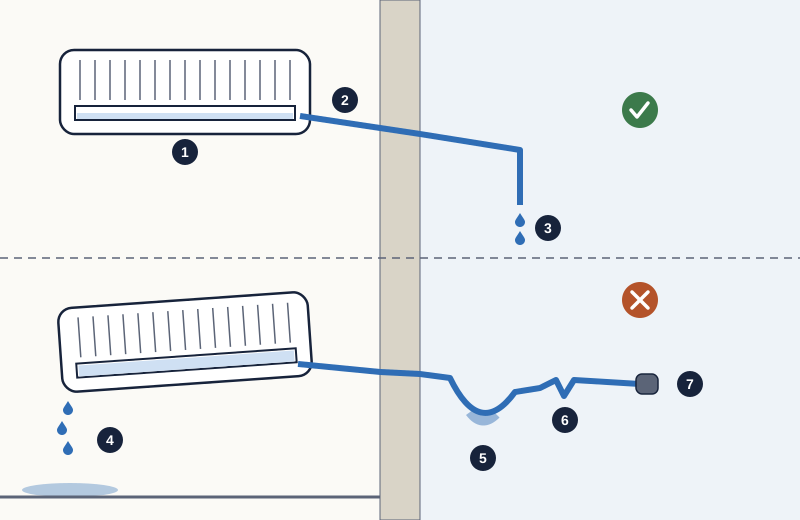
- Drip tray under the indoor coil collects the water
- The hose falls continuously all the way to the outlet
- Open outlet: water drips freely, away from walkways and the flat below
- Unit tilted away from the drain: water spills from the tray into the room
- Sagging hose: water sits in the dip and slows the flow
- Kinked or crushed hose
- Outlet blocked by dirt, insects or slime
The outdoor unit: clearance and safety at height
The outdoor unit releases your room's heat into the open air, so it needs free airflow. ENERGY STAR advises keeping airflow around it unobstructed and leaving access for service.[5] GENERAL says the front needs open space and should not be covered.[15] In many Dhaka buildings these units hang on brackets outside windows, several floors up, so check them by eye from a safe position:
- Keep plants, stored boxes, laundry, covers and sheets away from the front and sides.
- Look at the bracket and its wall fixings for rust, cracks or any sign that the unit has moved. A loose bracket is a danger to people below; report it to the installer and the building committee at once.
- Check the pipe insulation where it passes through the wall. Torn insulation, or an oily mark at a joint, is something to show your technician.
- After a storm, look for debris on or around the unit and for damage to the bracket.
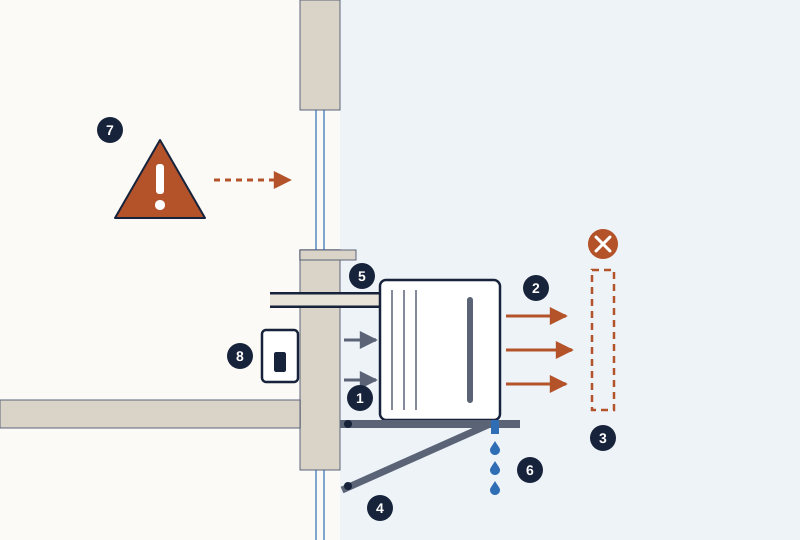
- Air is drawn in at the back and sides
- Warm air is blown out at the front: keep this space open
- Never cover the front or put plants, sheets or stored items in front
- Bracket and wall fixings: look for rust, cracks or movement from a safe position
- Insulated pipes through the wall: report torn insulation or oily marks
- Condensate drips: they should not fall on the flat below or a walkway
- Do not lean out of the window, sit on the sill or climb onto the bracket
- The AC's breaker or isolator inside the flat
What a professional service should include
ENERGY STAR recommends a professional check of the cooling system each spring, before the busy season.[4] In Bangladesh that means booking before the hot weather starts, when technicians are less busy. The table shows who does what.
| Task | Who | How often |
|---|---|---|
| Clean the filters | Owner | Monthly, or when dirty[4] |
| Check drain drips; outdoor unit clear | Owner | Monthly in summer |
| Clean both coils | Technician | Yearly[4] |
| Clean the tray, clear the drain line | Technician | Yearly, or if water leaks indoors |
| Tighten connections, measure voltage and current | Technician | Yearly[4] |
| Check refrigerant, repair leaks | Refrigeration technician | Yearly, or when cooling drops[4] |
| Check bracket and fixings at height | Technician with fall protection | Yearly and after storms |
Refrigerant work is for technicians only
Refrigerant is under pressure, and working on it needs gauges, recovery equipment and training. In the United States, EPA requires certification to attach gauges, add or remove refrigerant or cut refrigerant lines, and deliberately releasing refrigerant is illegal.[1][3] We found no equivalent published register for Bangladesh, so use the maker's authorised service centre or a firm that can show its technicians' training.
Each system is designed for one refrigerant. EPA notes that older units commonly used HCFC-22 (R-22), that its main replacement R-410A needs different components, and that there are no 'drop-in' replacements for R-22.[2][1] It also warns that propane and products sold as 'R-22a' are flammable, not approved for home air conditioners, and a fire or explosion hazard.[2] When a technician says your AC needs 'gas', ask:
- Where is the leak, how did you find it, and how will you repair it?
- Does the refrigerant you will use match the one on the unit's nameplate?
- Will any refrigerant removed be recovered rather than released into the air?
- Will you give a written job sheet listing the work, parts, quantity charged and warranty?
A simple maintenance routine that saves electricity
- Monthly in the cooling season: inspect and clean the filters.[4]
- Monthly: confirm that the drain drips outside and nothing blocks the outdoor unit.
- Every use: keep doors and windows closed and draw curtains against direct sun.[9]
- Every use: hold a steady, comfortable temperature and use auto fan or the lowest fan speed that keeps you comfortable.[5]
- Aim to keep indoor humidity below 60 percent, which EPA recommends to limit mould.[6]
- Before the hot season: book the yearly professional service.[4]
Building committees can add outdoor-unit brackets and drain discharge points to the routine walk-round in a monthly building maintenance checklist.
Common mistakes to avoid
- Running the AC without filters, or with filters still wet.
- Spraying water or foam cleaner into the indoor unit, where it can reach the electrics.
- Paying for a 'gas top-up' every season instead of having the leak found and repaired.[1]
- Covering the outdoor unit or boxing it in to hide it.[15]
- Switching the unit off and on repeatedly when it does not start at once, instead of waiting about 3 minutes.[12]
- Resetting a breaker that keeps tripping. Check for a power cut, the breaker and the timer once;[14] if it trips again, report it.
- Running an AC from a multi-plug or extension lead; the fire, gas and electrical safety guide explains why.
Troubleshooting: fix it yourself or call a technician?
| Symptom | First check (owner) | Call a technician when |
|---|---|---|
| Weak cooling | Filters, setting, open windows, sun, heat sources[9] | Still weak with clean filters and a closed room |
| Water dripping indoors | Switch off; look for a sagging or blocked hose | Almost always: the tray and line need clearing[4] |
| Ice on pipes, or cooling fades over weeks | Clean the filters | It persists: suspect a refrigerant leak[8] |
| Unit will not start | Power, breaker, timer; wait 3 minutes[14][12] | The breaker trips again or lamps blink in a pattern |
| New rattling or grinding | Rule out normal sounds[10] | The noise is new and continues |
| Burning smell, hot plug, sparking | Switch off at the breaker; do not touch | Immediately, and an electrician |
Replacing makes more sense than repairing when an old unit keeps leaking, parts are unavailable, or the compressor fails on an ageing machine. EPA notes that R-22 units can be serviced only with recycled or previously produced R-22, and converting them usually needs component changes.[2] For the supply circuit and socket, see when to call a qualified electrician.
What affects the cost of a service or repair
We could not find reliable, dated prices for AC servicing in Bangladesh, so this guide does not quote figures. The main cost drivers are:
- Type of service: a filter and drain check costs less than washing both coils.
- Access: a unit on a veranda is far quicker to reach than one outside an upper-floor window.
- Refrigerant: repairing a leak costs more than a top-up, but a top-up alone must be repeated.
- Parts: a capacitor or drain hose costs far less than a fan motor, circuit board or compressor.
- Cover: check what the warranty or a maintenance contract already includes.
Ask for written quotes that list the work, parts, refrigerant and warranty, and compare at least two. See how to get and compare repair quotes.
Next steps
- Find your model number and download or locate the owner's manual.
- This week: switch off at the breaker and clean the filters.
- On the next humid day, check that the drain drips freely and lands somewhere harmless.
- From a safe position, look at the outdoor unit, its clearance and its bracket.
- Book a professional service before the hot season, and ask for a written job sheet.
- Put the monthly checks in your calendar and keep a simple service log.
Common questions
- How often should I clean the filters of a split AC?
- ENERGY STAR advises inspecting filters monthly and cleaning them when dirty.[4] During the hot months in a dusty city, a monthly clean is a sensible minimum, and more often if the filter looks grey after a few weeks or your manual asks for it.
- Does an AC need its gas refilled every year?
- No. A correctly installed unit should not need refrigerant added during its life; low refrigerant means a leak, which a qualified technician should find and repair.[8] EPA advises repairing leaks rather than repeatedly topping up.[1]
- Why is water dripping from my indoor unit?
- Usually because the drain line or tray is blocked, the hose sags or kinks, or the unit is not level. Switch it off, dry the area and call a technician to clear the drain; a plugged drain can cause water damage.[4]
- Can I clean the outdoor unit myself?
- Only if it stands on a veranda or roof floor within easy reach, and then only to remove leaves and clutter with the power off. Coil washing, fin repair and any work outside a window are for a technician with fall protection.
- Who should I hire to service my AC?
- Choose a firm whose technicians are trained for your unit's refrigerant, such as the maker's authorised service centre. EPA suggests asking whether technicians are certified and asking to see the card.[1] Ask for a written job sheet and keep it with your records.
Sources
The facts in this guide were checked against these sources.
- Homeowners and Consumers: Frequently Asked Questions — US Environmental Protection Agency (published Last updated 1 April 2026). accessed 18 October 2026.
- Purchasing and Repairing Home Air-Conditioners or Heat Pumps — US Environmental Protection Agency (published Last updated 5 August 2026). accessed 18 October 2026.
- Section 608 Technician Certification Requirements — US Environmental Protection Agency (published Last updated 15 July 2026). accessed 18 October 2026.
- Maintenance Checklist — ENERGY STAR (US EPA and US Department of Energy). accessed 18 October 2026.
- Ductless Heating & Cooling — ENERGY STAR (US EPA and US Department of Energy). accessed 18 October 2026.
- A Brief Guide to Mold, Moisture and Your Home — US Environmental Protection Agency (published Last updated 18 February 2026). accessed 18 October 2026.
- What maintenance work do I need to do for my air conditioner? — GENERAL (formerly Fujitsu General). accessed 18 October 2026.
- Does an air conditioner ever need to be recharged with gas? — GENERAL (formerly Fujitsu General). accessed 18 October 2026.
- I have poor cooling (or heating) performance of an indoor unit. — GENERAL (formerly Fujitsu General). accessed 18 October 2026.
- The indoor unit is making a strange noise. — GENERAL (formerly Fujitsu General). accessed 18 October 2026.
- Safe use of ladders and stepladders — UK Health and Safety Executive (HSE) (published Updated 5 June 2024). accessed 18 October 2026.
- The indoor unit doesn't start to operate immediately after it is switched on. — GENERAL (formerly Fujitsu General). accessed 18 October 2026.
- Mist or steam is coming out of the indoor unit. — GENERAL (formerly Fujitsu General). accessed 18 October 2026.
- The indoor unit doesn't operate at all. — GENERAL (formerly Fujitsu General). accessed 18 October 2026.
- Can I cover the front of the outdoor unit to make it less conspicuous? — GENERAL (formerly Fujitsu General). accessed 18 October 2026.
This guide is general information. Have gas, structural and live electrical work done by a qualified, licensed professional. Your building’s rules and committee decisions take precedence over anything written here.
Written from the cited sources by the RUAP.NET editorial team. It has not been reviewed by a licensed engineer, plumber or electrician; for work on gas, structure or live electrics, use a qualified professional.
Spotted a mistake? Tell us — we check it, correct the guide and record the date of the correction. Report an error →
Related guides
Guides: Fire, gas and electrical